Why you should experience Manoa Falls in Hawaii.
Manoa Falls in Honolulu captures the rainforest's beauty from a perspective that feels both grand and deeply personal.
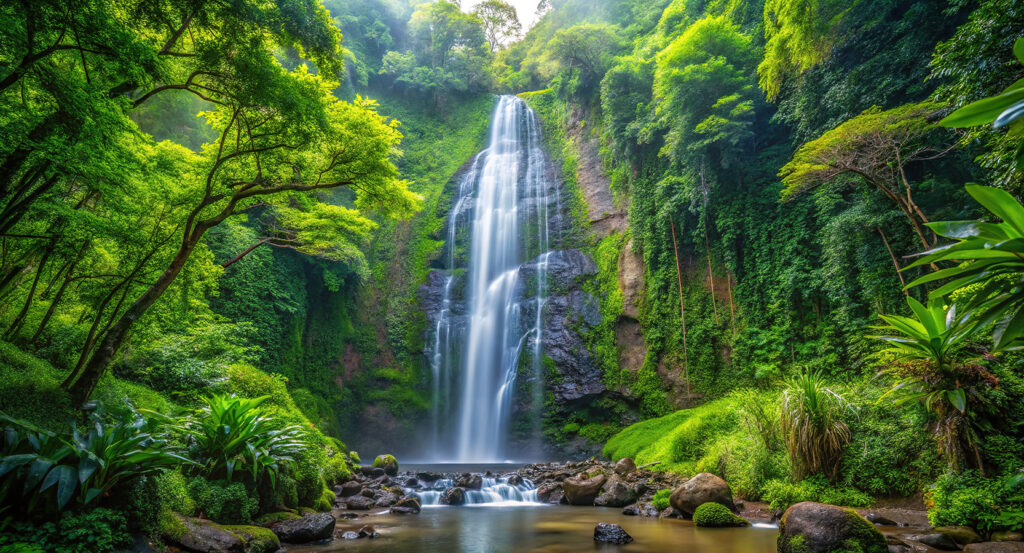
Perched along the trail leading to one of Oʻahu's most beloved natural landmarks, this vantage point offers a sweeping view over Manoa Valley, a sea of emerald foliage framed by the mist-wrapped Koʻolau Mountains. The air here is rich with the scent of rain and earth, a physical immersion that begins the moment you step from the shaded forest into the open light. You can hear the distant whisper of the waterfall before you see it, the sound carried on humid breezes through towering bamboo and twisted banyan trees. The lookout isn't a polished platform but a natural clearing, simple, unassuming, and alive. When the clouds part, the view feels infinite: the silvery thread of Manoa Falls tumbling down volcanic cliffs, surrounded by dense rainforest that glows a dozen shades of green. It's one of those rare places where you feel nature's rhythm slow your heartbeat, reminding you that wonder doesn't need performance, only stillness.
What you should know about Manoa Falls.
Manoa Falls sits within one of Hawaii's most storied valleys, a cradle of myth, ecology, and living history.
Long before it became a favorite hiking route, Manoa was a sacred landscape in Hawaiian tradition, home to deities and the renowned moʻo guardians of fresh water. Ancient Hawaiians cultivated taro here in intricate loʻi kalo systems, fed by the very streams that now nourish the waterfall below. The lookout marks a natural convergence where those waters descend from the Koʻolau ridgeline, the same ridgeline that traps the trade winds and creates the near-constant mist that keeps this valley lush. In the 1800s, the area became a retreat for Honolulu's missionaries and intellectuals, drawn by its cool air and fertile land. Over time, trails were cut through the jungle, some used by sugar plantation workers and others by naturalists documenting the island's botany. The modern path to the lookout follows those early routes, winding through a forest where native and introduced species coexist: kukui trees, guava, bamboo, and ti plants. If you pause here long enough, you'll notice subtle signs of life, the flutter of an ʻapapane bird, the faint rustle of ferns, reminders that this viewpoint is part of a thriving, breathing ecosystem.
How to fold Manoa Falls into your trip.
Reaching Manoa Falls is a journey that rewards patience and mindfulness as much as curiosity.
The hike begins at the Manoa Falls Trailhead, about a 15-minute drive from Waikiki, and the ascent to the lookout is steady but manageable. Start early, when the morning mist hangs low over the valley and the trail glistens with dew. As you climb, let the forest guide your pace, breathe with the rhythm of the rain, listen to the symphony of dripping leaves and chirping mynahs. The lookout emerges about halfway along the trail, where the canopy briefly opens and the valley unfolds before you. Bring a moment of stillness here, not for a photograph, but to let your eyes trace the contours of the rainforest, the waterfall in the distance, and the shimmering thread of sunlight that catches it all. Continue onward if you wish to reach the falls themselves, but don't underestimate the serenity of the lookout; many hikers find it to be the most spiritual point of the entire route. On your way back, stop at the nearby Manoa Falls Trail Café for fresh pineapple juice or a local pastry, a perfect bookend to your rainforest escape. Manoa Falls is more than a viewpoint; it's a living threshold between the modern city and Hawaii's ancient, unbroken heart.
Where your story begins.
Foresyte Travel reveals places that feel extraordinary long before you arrive.
Experience premium editorial crafted for luxury travelers.