
Why Midtown Garden matters.
Midtown Garden is a layered urban landscape where Roppongi's design culture meets Japanese garden principles, mature trees inherited from a former government compound and a green corridor shaped across the historic terrain of an Edo daimyo estate.
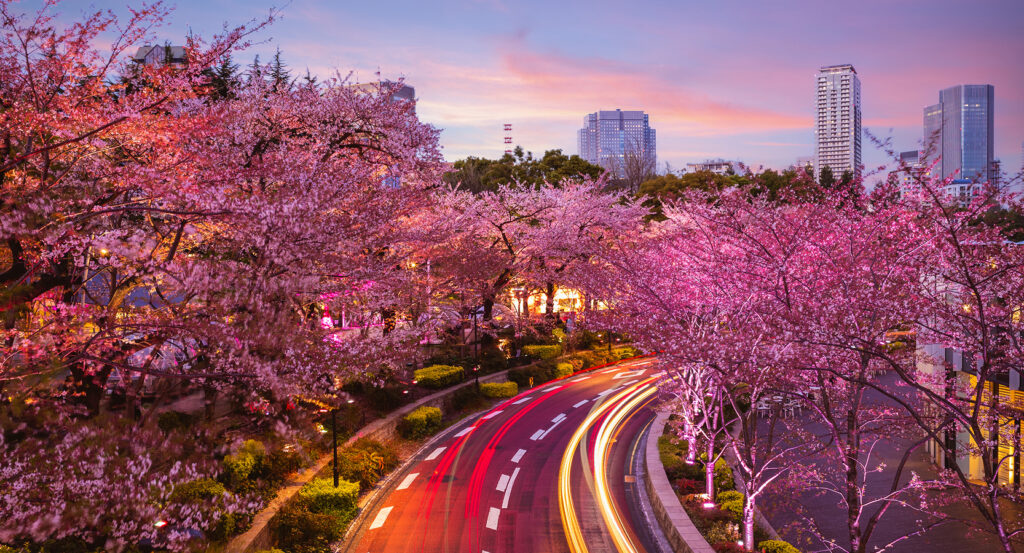
Set within Tokyo Midtown near Gaien Higashi-dori and just steps from Hinokicho Park, the garden extends across the development's western side as part of a broader green zone occupying 40 percent of the complex. Cherry, camphor, ginkgo and other mature trees establish substantial overhead cover, with lawns, planted edges and water features carrying the landscape away from the surrounding towers. Changes in elevation organize the route into distinct episodes, beginning with a higher source area before water and planting descend toward broader open ground adjoining the municipal park. Paths cross these zones without enclosing them behind a formal garden boundary, allowing the landscape to remain connected to Roppongi's surrounding streets and pedestrian routes. The result is a Central Tokyo garden whose scale and inherited vegetation give the redevelopment a physical continuity extending beyond its twenty-first-century architecture.
What defines Midtown Garden.
Midtown Garden is best known for turning part of the former Japan Defense Agency property into the principal landscape of Tokyo Midtown, carrying older vegetation and topography into a redevelopment completed in 2007. The ground had previously belonged to the Mōri family of Hagi Domain during the Edo period, then became an Imperial Japanese Army site during the Meiji era. American officers occupied the property after the Pacific War, and its return to Japan led to use as the Defense Agency's Hinokicho headquarters. That succession kept much of the land closed to the public for more than four centuries. The Defense Agency transferred its headquarters to Ichigaya in 2000, opening the way for a new plan encompassing the former government property and adjacent Hinokicho Park. A six-company consortium acquired the site in September 2001, construction began in May 2004 and Tokyo Midtown opened in March 2007. Nikken Sekkei acted as core architect for a project involving twelve architectural firms and designers, with EDAW responsible for the landscape design. The completed development created about four hectares of public space when considered with Hinokicho Park, using the historical terrain to connect new green areas with vegetation already surrounding the site. 140 established trees from the Defense Agency grounds were selected for preservation, temporarily moved into a growing area during construction and returned after exterior work was complete. Stones recovered from a drainage feature belonging to the former Mōri estate also entered the new landscape as retaining elements. Midtown Garden emerged through physical inheritance as much as new construction, retaining trees, stone and terrain from earlier occupations of the property inside a contemporary public landscape.
EDAW organized the garden through an interpretation of Japanese garden principles that uses topography and water to establish continuity across the site. The design begins near Gaien Higashi-dori with terrain conceived as a deep mountain and spring source, then carries water downhill through a sequence of four landscape zones. The Highland Spring Zone uses fountains to suggest rapid mountain water among fir trees and alpine planting. The Mountain Stream Zone slows that movement through shibazakura, agapanthus, ferns and ornamental grasses, with cherry trees forming a seasonal canopy above the route. A Forest Edge Zone concentrates transplanted camphor and chinquapin trees near the site boundary, supported by lower plantings including enkian and nandina. The sequence opens into the Lawn Plaza Zone, where several grass species maintain a broad green field beside a mature ginkgo. Boundaries among paving, soil, planting and open ground deliberately avoid rigid geometry, adapting the looser transitions among earth, rock, ponds and vegetation found in Japanese garden composition. EDAW used those principles without reproducing a historical garden, creating a contemporary landscape in which flowing water and descending terrain connect four distinct planting environments across the former government property.
How Midtown Garden fits.
Midtown Garden works as the anchor for an Akasaka route through three nearby sites that move from an Edo shrine shaped by shogunal patronage through the residence of a statesman killed during the upheavals of 1936 and into a Buddhist institution carrying the religious legacy of one of Edo's most celebrated magistrates.
Begin at Akasaka Hikawa-jinja Shrine, whose history connects the district with eighth shogun Tokugawa Yoshimune and the network of daimyo residences that once occupied Akasaka. Yoshimune ordered the shrine transferred to its present ground during the eighteenth century, a property previously associated with the Asano family of Miyoshi Domain and the wider Asano presence surrounding the Genroku-period Akō incident. The precinct retains that Edo spatial inheritance inside a district subsequently transformed by estates, government institutions and modern development, giving the route a religious point of entry into the same feudal geography underlying Tokyo Midtown. Continue to Takahashi Korekiyo-o Memorial Park, occupying the former residence of Takahashi Korekiyo, whose career moved through finance and government before he served as prime minister and repeatedly as finance minister during the Taisho and early Showa periods. Takahashi was assassinated at the residence during the February 26 Incident of 1936, when young army officers attacked political leaders in an attempted coup. A memorial association donated the property to Tokyo in 1938, and it opened as a commemorative park in 1941; the residence itself was transferred to Koganei and is preserved at the Edo-Tokyo Open Air Architectural Museum. The Akasaka ground retains its pond, stone bridge, lanterns and established trees, preserving the garden setting of a property inseparable from one of prewar Japan's defining political crises. Conclude at Toyokawa Inari Tokyo Betsuin, a Soto Zen Buddhist temple whose Tokyo history centers on Ooka Tadasuke, the Edo magistrate known as Ooka Echizen. Ooka enshrined Toyokawa Dakini Shinten at his Akasaka residence, extending devotion to the deity from Toyokawa Myogonji in Aichi into the shogunal capital. An Edo worship hall followed on Ooka family ground in 1828, and the institution moved to its present Moto-Akasaka site in 1887 as a branch directly connected with the parent temple. Its fox imagery derives from Dakini Shinten's association with a white fox, giving the precinct a visual character easily mistaken for Shinto despite its Soto Zen affiliation. The progression moves from Akasaka Hikawa-jinja Shrine's shogunal and daimyo geography through Takahashi Korekiyo-o Memorial Park's connection with the political rupture of 1936 into Toyokawa Inari Tokyo Betsuin's preservation of Ooka Tadasuke's Buddhist devotion, placing Midtown Garden within an Akasaka landscape repeatedly shaped by religious patronage, political power and inherited estates.
Where your story begins.
Foresyte Travel reveals places that feel extraordinary long before you arrive.
Enjoy editorial crafted for luxury travelers.
Foresyte may earn a commission when you book.

















































































































