
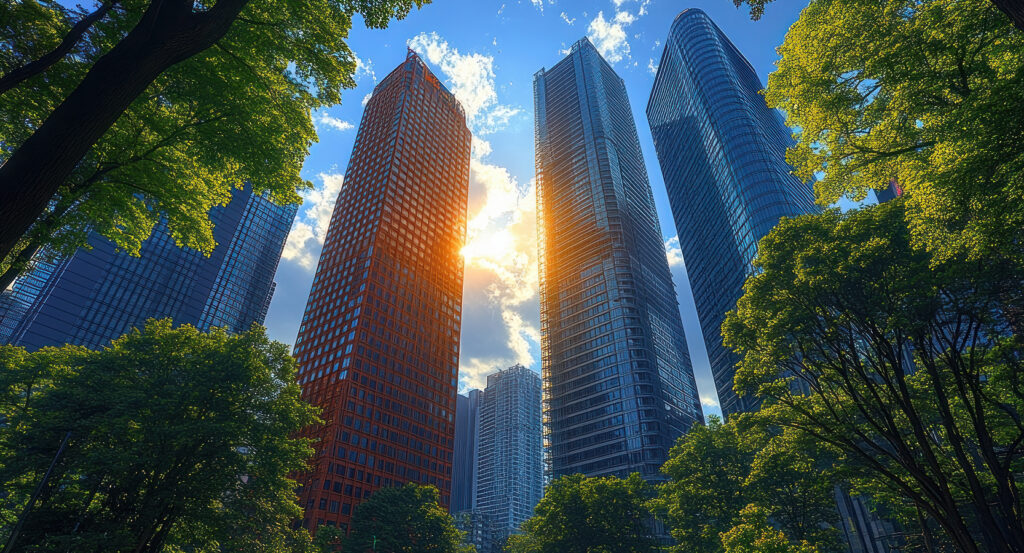
Why you should experience Azabudai Hills Mori JP Tower in Tokyo, Japan.
The first time you see Azabudai Hills Mori JP Tower, it hits you, a vertical symbol of Tokyo's cosmopolitan rhythm and ambition, soaring over Roppongi Hills like a modern-day temple to innovation and art. What draws travelers here isn't just the view, it's the intoxicating blend of urban energy and quiet sophistication that defines this part of the city. Inside, every level feels curated: avant-garde galleries, open-air observatories, MICHELIN-starred dining, and luxury boutiques that seem to hum with Japanese precision. The tower doesn't just offer scenery, it offers immersion. To stand here is to watch Tokyo breathe, a metropolis in motion, alive and luminous, framed beneath glass and steel.
Beyond its architectural splendor, the Mori JP Tower serves as a conduit between culture and commerce, offering travelers a glimpse into how Japan redefines modern life. It's where cutting-edge design harmonizes with old-world grace, a contrast you can feel whether you're admiring the skyline at dusk or stepping into the tranquil galleries below. This is not a building you simply visit; it's one you absorb, letting the energy of Tokyo's creative core pulse through you until it feels inseparable from your own.
What you should know about Azabudai Hills Mori JP Tower.
What many visitors don't realize is that the Mori JP Tower is as much an incubator of creativity as it is a skyscraper. Its upper levels host the Mori Art Museum, among Tokyo's most influential cultural spaces, where installations blend philosophy, technology, and emotion with seamless grace. Beneath the tower's sleek shell lies a heartbeat, a community of thinkers, curators, and architects shaping Japan's modern narrative. The rooftop observatory, meanwhile, serves as both literal and figurative perspective, a reminder that Tokyo's grandeur is best appreciated not just from above, but from a place of reflection.
Perhaps most striking is the tower's dedication to environmental artistry, a subtle integration of green spaces and open-air balance that softens its dominance over the skyline. This duality, progress grounded in poise, gives it an almost meditative quality. When you realize that its blueprint was inspired by both New York's ambition and Kyoto's restraint, you understand that the Mori JP Tower isn't simply Japanese; it's universal, a discussion between tradition and the future spoken fluently in glass.
How to fold Azabudai Hills Mori JP Tower into your trip.
The key to enjoying the Mori JP Tower lies in timing and intention. Arrive just before sunset, when the city's pulse shifts from work to wonder, and ascend to the observation deck as Tokyo blushes gold.
Afterward, wander slowly through Roppongi Hills, where the lights below begin to shimmer and spill like liquid mercury. Pair the visit with dinner at one of the tower's upper-level restaurants, not for the exclusivity, but for the resonant punctuation it provides. A glass of sake, a view that stretches beyond imagination, and the hum of one of the world's most captivating cities below, it's Tokyo at its most cinematic, a rare moment where you don't just see the city, you feel its heartbeat sync with yours.
Where your story begins.
Foresyte Travel reveals places that feel extraordinary long before you arrive.
Experience premium editorial crafted for luxury travelers.

















































































































