
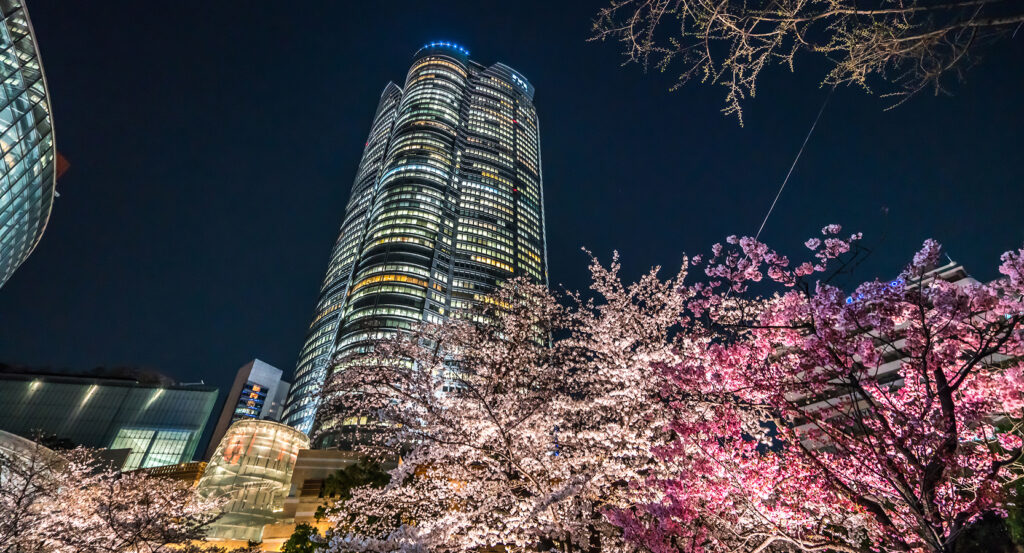
Why Mori Art Museum matters.
Mori Art Museum is a high-rise contemporary art museum where Roppongi's international cultural character meets ambitious exhibition-making, Asia-Pacific artistic practice and galleries suspended above Tokyo on the upper floors of Mori Tower.
Set within Roppongi Hills near Keyakizaka-dori and just steps from Mōri Garden, the museum occupies the 53rd floor of Mori Tower, separating its exhibition spaces from street level through a vertical ascent into the building's cultural core. Large gallery volumes accommodate painting, sculpture, photography, moving image and installation at scales extending from intimate works to room-sized commissions. Circulation repeatedly shifts among enclosed galleries and elevated outlooks, placing contemporary art inside a tower whose metropolitan position remains perceptible throughout the visit. The museum's location also binds it physically to Roppongi Hills, where cultural facilities were incorporated into a broader redevelopment intended to make art part of the district's daily movement. The result is a museum whose altitude and exhibition scale reinforce one another, giving contemporary art an unusually commanding position within Central Tokyo.
What defines Mori Art Museum.
Mori Art Museum is best known for establishing an international contemporary art institution at the summit of Roppongi Hills as a central component of founder Mori Minoru's plan to give the new district a major cultural institution. An International Advisory Committee formed in September 1999, bringing directors of leading museums into discussions surrounding contemporary art, institutional roles and international partnerships years before the museum opened. Mori Minoru founded the museum with Mori Yoshiko, and its board was established in March 2003 as the larger Roppongi Hills project approached completion. Founding director David Elliott shaped an institution oriented toward contemporary work across national boundaries, with Japan and the wider Asian region occupying a central position in its program. The museum opened on October 18, 2003 with Happiness: A Survival Guide for Art and Life, an exhibition extending across the 52nd- and 53rd-floor galleries and organized around Arcadia, Nirvana, Harmony and Desire. Ito Jakuchu, Vija Celmins and works drawn from cultures and periods beyond contemporary art appeared within that opening exhibition, establishing a curatorial approach willing to connect current practice with much older artistic production. Roppongi Crossing followed in February 2004 with 57 emerging creative practices from Japan, initiating a recurring exhibition devoted to taking periodic readings of the country's contemporary art. The institution began acquiring its own collection in summer 2005 with particular emphasis on works commissioned for exhibitions, gradually converting a museum founded without a permanent collection into a collecting institution focused primarily on Japan and the Asia-Pacific. A 2015 renovation expanded that strategy through MAM Collection, MAM Screen and MAM Research, placing collection displays, moving-image practice and archival investigation beside the museum's major exhibitions and MAM Projects. The holdings reached 520 works by August 2026 across painting, photography, drawing, sculpture, video and installation, and Kataoka Mami now directs an institution whose development has moved from a non-collecting exhibition venue toward a museum joining temporary exhibitions, commissioned work, research and an expanding Asia-Pacific collection.
Roppongi Crossing supplies one of the clearest mechanisms through which the museum has repeatedly examined changes inside Japanese contemporary art. The inaugural 2004 edition assembled 57 participants at a moment when the museum itself had been open for only several months, giving emerging Japanese practice a large institutional platform beside its international exhibitions. Subsequent editions returned to the format at intervals, changing curators and participating artists as new generations and artistic concerns entered view. Roppongi Crossing 2013: OUT OF DOUBT marked the museum's tenth anniversary, extending the series into questions surrounding Japanese society after the 2011 Great East Japan Earthquake. Later editions continued to bring established figures into proximity with younger practitioners, allowing differences among generations, media and working methods to occupy the same exhibition. The recurring structure gives the museum a mechanism unavailable to a single permanent display: Japanese contemporary art is revisited through successive curatorial selections separated by enough time for artistic conditions to change. Its importance within Mori Art Museum lies in repetition across decades, turning one exhibition title into a continuing examination of how artistic production in Japan changes around the institution itself.
How Mori Art Museum fits.
Mori Art Museum works as the anchor for a Roppongi and Nogizaka route through three nearby institutions that move from Meiji commemoration through a national exhibition center and into a design institution created by some of Japan's most consequential twentieth-century designers and architects.
Begin at Nogi-jinja Shrine, established in 1923 beside the former residence of General Nogi Maresuke and his wife Shizuko, both of whom are enshrined there. Nogi served during the First Sino-Japanese and Russo-Japanese wars before becoming principal of Gakushuin, where his later career connected military service with the education of the future Emperor Shōwa; the adjacent residence preserves the domestic setting associated with the final years he shared with Shizuko. The shrine carries the Roppongi and Akasaka area backward from contemporary cultural institutions into the commemorative culture that developed during the Taisho period around prominent figures of Meiji Japan. Continue to The National Art Center, Tokyo, whose January 2007 opening introduced an institution fundamentally different from a conventional collecting museum. Planning began when the Agency for Cultural Affairs formed a preparatory committee in 1999, and Kisho Kurokawa with Nihon Sekkei received the design commission the following year. Kurokawa created 14,000 square meters of exhibition area behind an undulating glass facade and a 21.6-meter-high entrance atrium, enabling several independently organized exhibitions to operate simultaneously; completed in 2006, it became the final art museum finished during his lifetime. The institution opened on January 21, 2007 without a permanent collection, concentrating its resources on exhibitions, information, education and cross-cultural exchange. Conclude at 21_21 Design Sight, whose origins reach to Issey Miyake's decades-long discussions with Isamu Noguchi, Ikko Tanaka, Shiro Kuramata and Tadao Ando over Japan's need for a dedicated center for design culture. Miyake brought the idea into public debate through his January 2003 Asahi Shimbun essay calling for a design museum, and support from Mitsui Fudosan and other partners carried the project into Tokyo Midtown in March 2007. Miyake, Taku Satoh and Naoto Fukasawa became directors with Noriko Kawakami as associate director, and Tadao Ando translated Miyake's A Piece of Cloth concept into a building whose folded steel roof covers galleries sunk predominantly below the surrounding garden. The progression moves from Nogi-jinja Shrine's Taisho commemoration of a Meiji military household through The National Art Center, Tokyo's Kurokawa-designed model for large-scale exhibitions into 21_21 Design Sight's convergence of Miyake, Ando, Satoh and Fukasawa, placing Mori Art Museum within a compact district where successive generations built radically different institutions around art, architecture and design.
Where your story begins.
Foresyte Travel reveals places that feel extraordinary long before you arrive.
Enjoy editorial crafted for luxury travelers.
Foresyte may earn a commission when you book.

















































































































