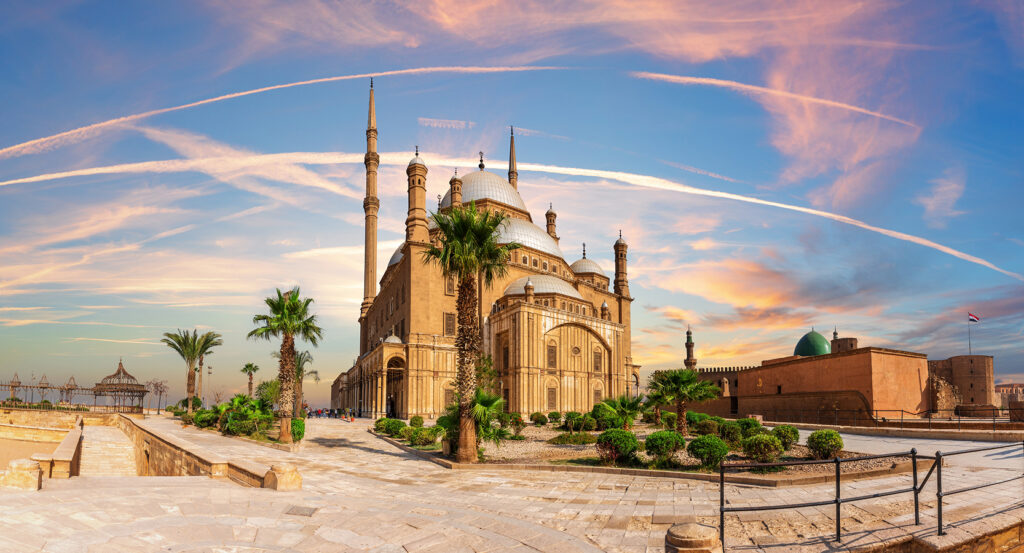
Why you should experience The Alabaster Mosque of Muhammad Ali in Cairo, Egypt.
The Alabaster Mosque of Muhammad Ali is a vast, luminous canopy that seems less built than breathed into existence.
From beneath it, you feel the architecture lift the air itself, transforming stone into light. The alabaster glows honey-gold in the sun, its translucent surface softening the lines of the vast Ottoman geometry above. Every curve, every rib, every medallion gleams with divine rhythm, verses from the Qur'an spiraling upward like sound waves toward eternity. The dome is not just a feat of design; it's a revelation of scale and faith, a physical echo of heaven suspended over Cairo's skyline. When the chandeliers below shimmer against the alabaster walls, the space feels almost alive, breathing, radiant, infinite.
What you should know about The Alabaster Mosque of Muhammad Ali.
The Alabaster Dome of the Mosque of Muhammad Ali is among the most ambitious architectural undertakings in Egypt's Ottoman period, rivaling the imperial mosques of Istanbul in both proportion and symbolism.
Completed around 1848 CE, it rises 52 meters high at the apex, supported by four massive piers and surrounded by four half-domes and four corner domes, creating a cascading rhythm of celestial symmetry. Its composition mirrors the structural harmony of Istanbul's Blue Mosque, yet Muhammad Ali demanded that his dome surpass even that, in clarity of light, purity of material, and spiritual resonance. The dome's alabaster cladding was sourced from quarries in Beni Suef, a region south of Cairo known for its high-luster calcite, and its use here was unprecedented at this scale. The stone was polished so thin that daylight seeps through it, bathing the interior in a perpetual amber glow that changes with the hour. Engineers of the time were astonished by the balance achieved: a dome of grand mass resting gracefully upon a network of arches and pendentives, distributing its weight with mathematical perfection. Inside, gold-gilded calligraphy outlines each segment, inscribed with verses that celebrate divine unity and the eternity of light. The dome's acoustics are equally intentional, a single whispered prayer can echo for several seconds, an effect designed to make the recitation of the Qur'an feel as if it expands beyond the body of the worshipper. During restoration efforts in the late 20th century, conservators discovered a hidden inner layer of plaster once used to amplify both sound and temperature control, proof of the dome's fusion of artistry and engineering. Symbolically, the alabaster itself holds deep meaning: in Islamic architecture, light is the ultimate metaphor for God, and alabaster, a stone that contains light, becomes the material example of divine presence. To look up beneath it is to stand at the threshold of heaven, where faith becomes visible.
How to fold The Alabaster Mosque of Muhammad Ali into your trip.
Experiencing the Alabaster Dome is to encounter Cairo's most breathtaking blend of architecture and devotion, a moment that redefines what it means to see.
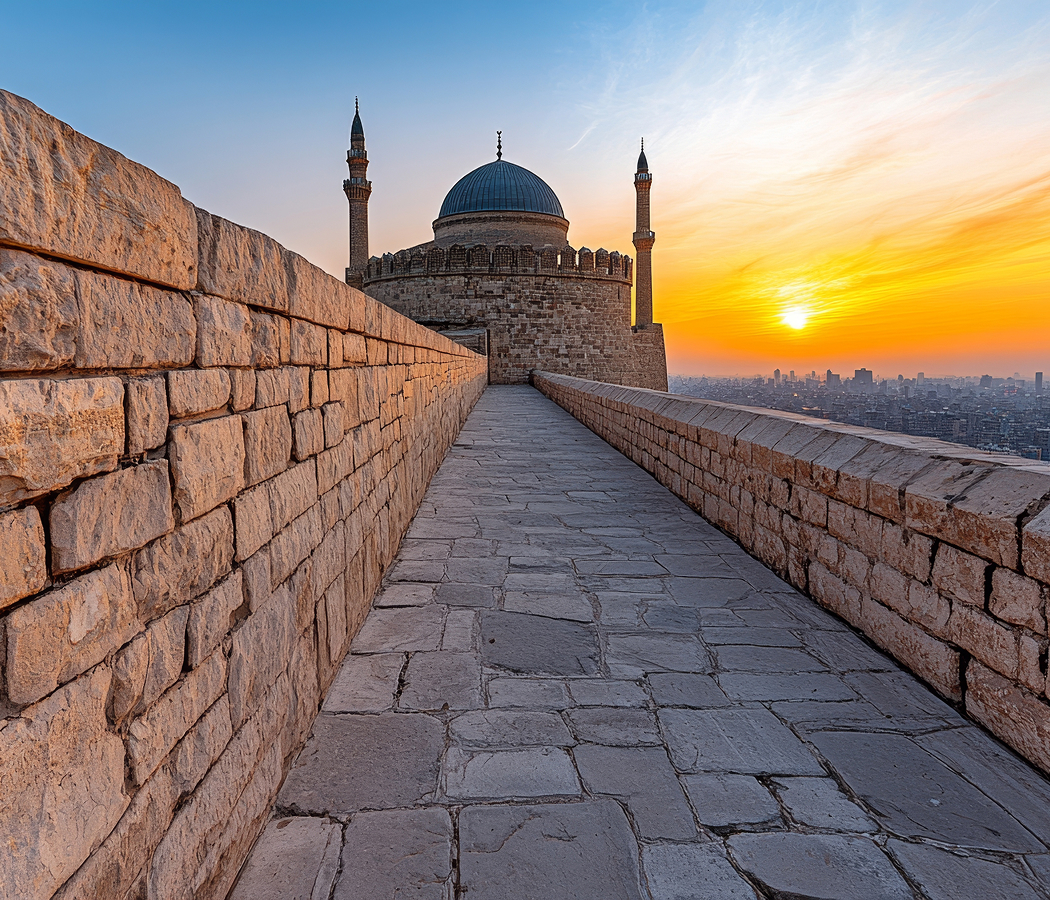
Once inside the Mosque of Muhammad Ali, move to the center of the prayer hall and look straight upward. Let your gaze trace the dome's concentric rings of calligraphy and ornament until you reach its zenith, the golden medallion that catches and reflects the light like the sun itself. Visit in the morning hours (9-11 AM) for the purest illumination, when sunlight filters through the alabaster panels and paints the walls in shifting tones of amber, ivory, and rose. Midday light, while harsher, reveals the dome's architectural brilliance, the way its ribs channel the eye heavenward. Evening visits, especially at sunset, are hushed and reverent; as daylight fades, the chandeliers ignite the alabaster from below, transforming the dome into a lantern glowing softly against the darkening sky. Bring no distractions, no music, no noise. Stand still and let the silence rise around you. Notice how every whisper, every step, reverberates, how the sound itself becomes part of the architecture. Before you leave, circle once around the outer edges of the prayer hall to view the dome from each angle; its symmetry shifts with your movement, creating an illusion of rotation as light moves across the stone. When you finally exit into the Citadel Courtyard, the dome lingers in your mind's eye like an afterimage of divinity, proof that human hands can, for a moment, build something eternal.
Where your story begins.
Foresyte Travel reveals places that feel extraordinary long before you arrive.
Experience premium editorial crafted for luxury travelers.