
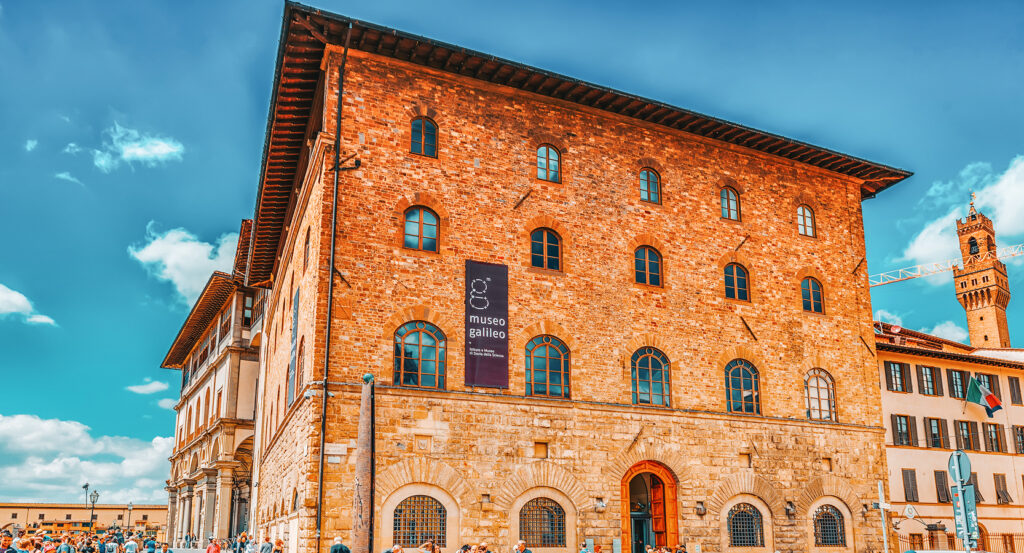
Why you should experience Galileo's Telescope at Museo Galileo in Florence, Italy.
Few objects on Earth have changed how humanity sees the universe as profoundly as Galileo's telescopes, small tubes of glass and brass that opened the heavens to human eyes for the first time.
Displayed within the Museo Galileo in Florence, these delicate instruments stand like sacred relics of reason itself. Crafted around 1609, they are surprisingly modest in scale, yet grand in consequence. Through these lenses, Galileo observed the moons of Jupiter, the phases of Venus, and the rough, mountainous surface of the Moon, discoveries that shattered centuries of cosmic certainty and ignited the scientific revolution. To stand before them is to feel the very moment when imagination became evidence. The craftsmanship is exquisite: wooden casings bound with leather, lenses ground by hand, the faint etchings of a man obsessed with clarity. Under the museum's soft lighting, the glass still catches the glow of possibility. What was once a forbidden act of curiosity now radiates as one of humanity's greatest triumphs, a reminder that courage, not comfort, moves the stars.
What you should know about Galileo's Telescope at Museo Galileo.
The telescopes on display at the Museo Galileo are among the few surviving instruments personally built and used by Galileo Galilei, and their survival borders on miraculous.
Two of the scopes were crafted during his tenure at the University of Padua, where Galileo perfected his lens-grinding technique to achieve unprecedented magnification. One telescope magnifies about 14 times, another 21, crude by modern standards, yet revolutionary for their day. These instruments were not mere curiosities; they were tools that rewrote the structure of the cosmos. Galileo used them to publish Sidereus Nuncius (The Starry Messenger) in 1610, unveiling a universe far more complex than Aristotle's crystalline spheres. One of the telescopes even retains its original leather wrapping and paper covering, fragile but intact after more than four centuries. Near them rests a case containing a preserved relic: one of Galileo's fingers, delicately displayed and pointing skyward, a hauntingly poetic gesture from the man who dared to point beyond Earth. Together, these objects form the heart of the Museo Galileo, embodying both the audacity of discovery and the fragility of genius.
How to fold Galileo's Telescope at Museo Galileo into your trip.
When visiting the Museo Galileo, approach the gallery housing Galileo's telescopes as you would a chapel, quietly, attentively, and with a sense of reverence.
The telescopes are displayed in a glass case on the upper floor, accompanied by star maps and early lunar sketches. Take your time to observe their proportions and imagine Galileo's hands aligning the lenses under candlelight. Read the accompanying notes to appreciate how these instruments transformed astronomy from philosophy into science. Then, turn slowly toward the nearby Medici and Lorraine collections, glittering arrays of armillary spheres and compasses that show how Florence became the cradle of empirical thought. If possible, visit in the late afternoon, when natural light through the Arno-facing windows casts a golden reflection on the brass fittings. For an added layer of experience, step outside the museum afterward and gaze up at the Florentine sky, the same one that Galileo once charted, not as mystery, but as truth revealed. To witness Galileo's telescopes in Florence is to stand at the threshold of modern thought, where faith in observation forever changed the way humanity sees itself.
Where your story begins.
Foresyte Travel reveals places that feel extraordinary long before you arrive.
Experience premium editorial crafted for luxury travelers.




















































































































