Why Museo Galileo matters.
Museo Galileo is Florence's cathedral of curiosity, where science, art, and human wonder orbit in perfect alignment.
Perched beside the Arno River near the Uffizi, this museum feels like a secret whispered by the Renaissance itself, a reminder that Florence's brilliance extended far beyond painting and sculpture. Inside, sunlight glints off brass, glass, and polished wood, centuries-old instruments that once mapped the heavens, measured time, and challenged the limits of human understanding. Here, the spirit of Galileo Galilei is palpable, not just in the relics of his life but in the revolutionary way he changed how humanity saw the universe. Standing before his telescopes, you can almost feel the tremor of discovery, the moment when Jupiter's moons first came into focus and the world's center shifted forever. The museum isn't cold or clinical; it's alive with imagination. Every room invites you to trace the Renaissance mind at work, where astronomy met philosophy, and beauty was inseparable from truth. Florence has many masterpieces carved in marble and painted on walls, but at Museo Galileo, the masterpiece is thought itself.
What defines Museo Galileo.
Museo Galileo's collection began long before the modern era, rooted in the Medici family's obsession with understanding the natural world.
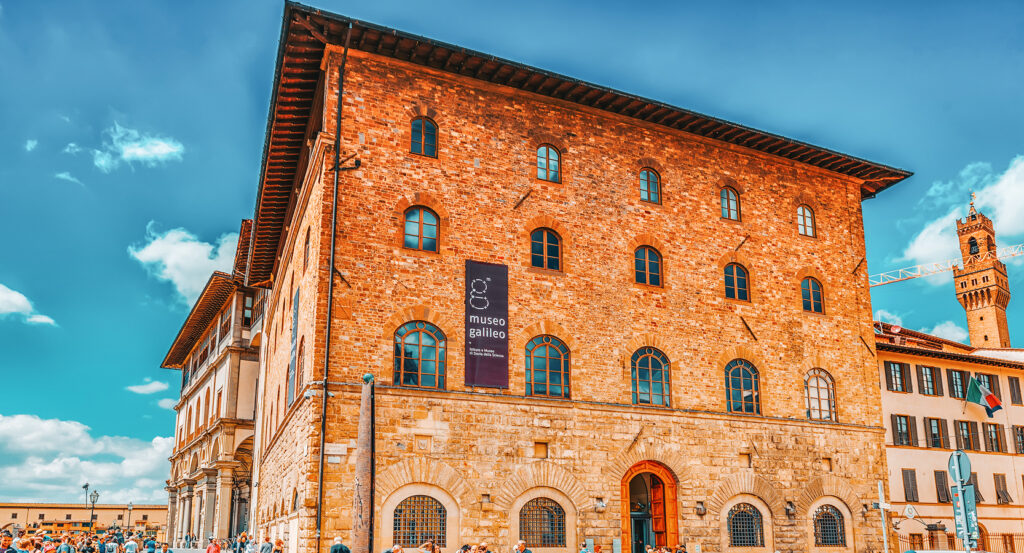
Known originally as the “Institute and Museum of the History of Science,” it was renamed in 2010 to honor Florence's most famous thinker. Its heart beats with two extraordinary collections: the Medici and Lorraine scientific instruments, spanning from the 15th to the 19th centuries. These artifacts weren't just tools, they were symbols of human progress, crafted with the same artistry that filled Florence's cathedrals. The Medici princes, great patrons of both art and science, collected astrolabes, sundials, and globes that merged function with aesthetics, golden orbs that charted the cosmos with as much grace as any Botticelli canvas. The Lorraine dynasty later expanded this vision, embracing the Age of Enlightenment's quest for precision. Among the museum's treasures are Galileo's original telescopes and his objective lens, the instruments through which he observed the heavens, as well as thermometers, compasses, and surgical devices that trace the evolution of discovery itself. A more controversial relic sits quietly in a glass case: Galileo's preserved fingers and tooth, removed after his death and enshrined as relics of intellect rather than sanctity, a reverence once reserved for saints. Yet the museum's story extends beyond preservation. Its interactive exhibits and 3D reconstructions reveal how ideas moved from imagination to experiment, from parchment to planet. Few visitors realize that the building itself, the Palazzo Castellani, dates to the 11th century, once a medieval tower house that evolved, like the instruments it holds, through centuries of human ingenuity.
How Museo Galileo fits.
To visit Museo Galileo is to walk into the mind of the Renaissance, a space where curiosity becomes sacred.
Begin your journey on the Arno promenade, just steps from the Uffizi and Ponte Vecchio, and enter through the understated doors of the Palazzo Castellani. Move slowly through the galleries, each one feels like a time capsule suspended in amber. Start with the Medici collection, where celestial globes and armillary spheres gleam under soft light, embodying Florence's early fascination with the heavens. Then seek out Galileo's telescopes, their wooden frames humble, yet history-changing. Pause before the glass reliquary holding his fingers, not out of morbidity, but awe. They point eternally upward, a gesture toward the stars and the courage it took to question them. Continue to the Lorraine collection to see instruments of chemistry, medicine, and navigation, marvels that bridged the Renaissance and Enlightenment. Don't rush; the museum rewards those who linger and read the inscriptions, many in Latin, their elegant lettering echoing a time when science was still poetry. Before leaving, explore the hands-on exhibits that reinterpret these tools through digital simulations, perfect for travelers who want to connect intellect with experience. Step outside to the Arno, where the city's reflection ripples like a celestial map, and consider that the same skies Galileo studied still shine above Florence. Museo Galileo is more than a museum, it's a conversation across centuries, between wonder and reason, between the eyes that looked up and the minds that dared to understand.
Where your story begins.
Foresyte Travel reveals places that feel extraordinary long before you arrive.
Enjoy editorial crafted for luxury travelers.
Foresyte may earn a commission when you book.