
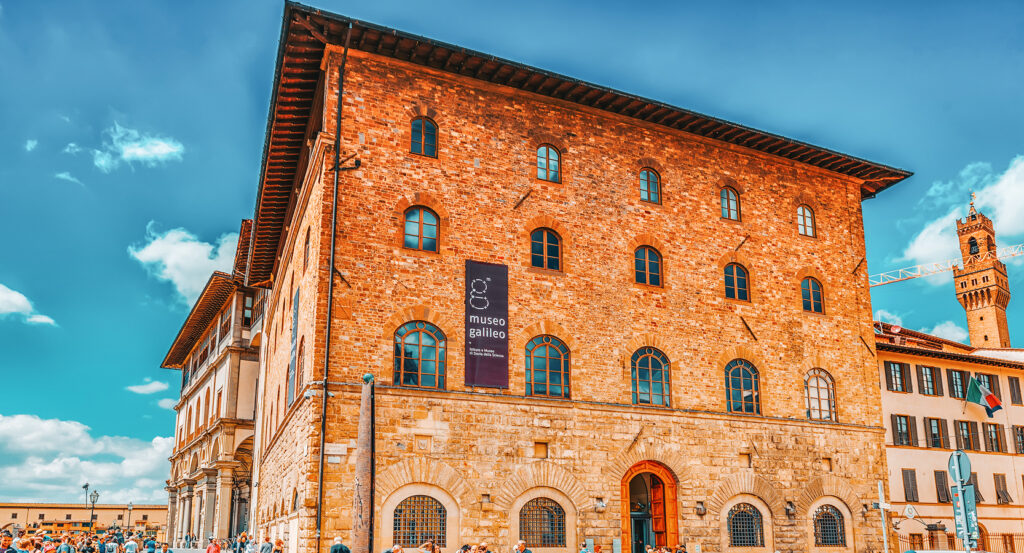
Why you should experience Monumental Sundial at Museo Galileo in Florence, Italy.
The Sundials and Timekeepers Exhibit at the Museo Galileo in Florence is a unique journey through humanity's evolving relationship with time, from sunlight and shadow to gears and precision.
Here, the abstract becomes tangible: stone, brass, and glass transformed into instruments of cosmic rhythm. Rows of ancient sundials, beautifully engraved and delicately ornamented, share space with Renaissance water clocks, pendulums, and early pocket watches. Each object tells a story of how civilizations have tried to capture the fleeting, to measure the immeasurable. Walking through the exhibit feels like watching time materialize in slow motion, the history of science unfolding second by second. In the soft, golden light of the gallery, every dial gleams like a frozen sun, every clock a beating heart of ingenuity. You begin to sense that time itself, that invisible current, was once treated as art, reverence, and revelation.
What you should know about Monumental Sundial at Museo Galileo.
The Sundials and Timekeepers Exhibit is not merely a display of instruments; it's a chronicle of how Florence helped shape the modern conception of time.
In the Renaissance, the measurement of hours was both a scientific and philosophical pursuit. Early Florentine sundials, many on display here, were designed not only for practical use but also as objects of contemplation, aligning human life with celestial order. The collection includes portable sundials from the 16th and 17th centuries, ingeniously crafted to fit inside travelers' pockets, as well as grand horizontal and vertical dials used for public regulation of the day. The exhibit transitions seamlessly into mechanical innovation: water clocks that marked hours through gentle drips, pendulum regulators that heralded Galileo's influence, and exquisitely decorated 18th-century watches that blurred the line between function and ornament. Several pieces once belonged to the Medici and Lorraine courts, who funded horological research as a symbol of order and progress. What makes this collection exceptional is how it unites beauty and precision, every dial and escapement a miniature cosmos of human thought.
How to fold Monumental Sundial at Museo Galileo into your trip.
When visiting the Museo Galileo, make the Sundials and Timekeepers Exhibit your meditative pause between the drama of discovery and the quiet of reflection.
Begin with the sundials displayed near the entrance to the gallery, approach them slowly, noting how each was designed for different latitudes and purposes. Step close enough to see the engraved zodiac signs, the Latin mottoes about mortality and enlightenment. Continue through to the section on mechanical clocks, where the rhythm of pendulums and ticking escapements replaces the silence of sunlight. If you time your visit for late morning, the natural light streaming through the Arno-side windows will strike the brass and glass faces perfectly, casting subtle reflections that animate the instruments as if they've awakened once more. Spend a few minutes before the grand 17th-century regulator, a masterpiece of engineering that represents Florence's transition from celestial to mechanical time. End your visit by stepping into the adjoining terrace and feeling the real sun on your face, the first, and oldest, clock of all. The Sundials and Timekeepers Exhibit is more than a study of hours; it's a meditation on how humankind turned eternity into experience.
Where your story begins.
Foresyte Travel reveals places that feel extraordinary long before you arrive.
Experience premium editorial crafted for luxury travelers.




















































































































