
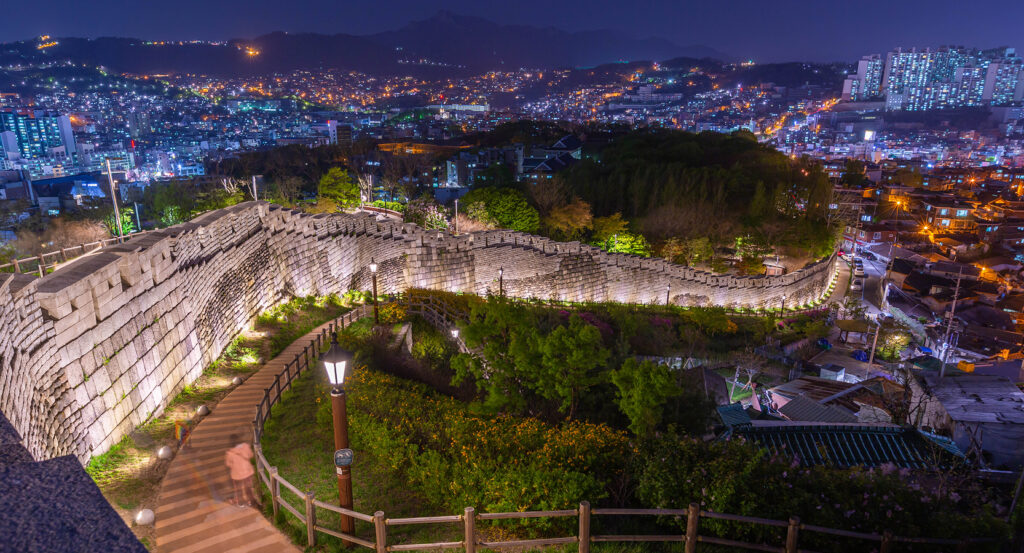
Why you should experience Naksan Park in Seoul, South Korea.
Naksan Park is Seoul's quiet masterpiece, a place where nature, art, and history merge above the city's skyline.
Perched on a gentle ridge between Daehangno and Ihwa-dong, Naksan Park offers one of the most intimate panoramas in the capital, a sweeping view of urban sprawl that somehow feels serene. The park's name means “camel mountain,” a nod to its soft, undulating shape, and its trails trace the remnants of the ancient Seoul Fortress Wall, a ribbon of stone that once guarded the Joseon Dynasty's royal capital. By day, sunlight glints off the tiles of traditional houses below; by night, the city unfolds in a sea of glowing lights, as if the stars have descended to earth. The park feels both old and new, murals painted by local artists adorn stairways, young couples share coffee beneath old pines, and the hum of Seoul's energy drifts upward from the streets below. Naksan Park isn't just a view, it's an experience of perspective, a place where the city exhales and time slows to a calm, golden rhythm.
What you should know about Naksan Park.
Beneath its tranquil surface lies a layered story of preservation, art, and rebirth.
Naksan was once one of the four guardian mountains of Seoul, forming part of the natural fortress line that encircled the ancient capital. Over centuries, its slopes became dotted with small neighborhoods and shrines, but much of the area was damaged during the Korean War and postwar reconstruction. In the early 2000s, the Seoul Metropolitan Government undertook a major restoration project to revive both the mountain's ecology and its cultural identity. The result wasn't merely a park, but a fusion of heritage and creativity. The surrounding Ihwa Mural Village, once a declining hillside community, became a canvas for over 80 local artists, transforming its alleys into open-air galleries. The ancient fortress wall was carefully restored, allowing visitors to walk alongside the same stones that once defined the boundaries of the Joseon capital. Few realize that Naksan Park's lighting system was designed to preserve the nocturnal environment while illuminating key historic landmarks, blending technology and tradition seamlessly. Today, it stands as a symbol of Seoul's evolution: a city that doesn't just build upward but restores outward, honoring memory while embracing motion.
How to fold Naksan Park into your trip.
To experience Naksan Park fully is to climb slowly, to let the path carry you from the hum of the city into the hush of its heights.
Begin your walk near Hyehwa Station or Dongdaemun, where the fortress wall trail begins its gentle ascent through clusters of local homes. Follow the winding stone steps past energetic murals and hidden cafés until the air grows cooler and the noise fades to birdsong. At the summit, pause by one of the many overlooks, the panorama stretches from Namsan Tower to the Han River, a living map of Seoul unfurled beneath you. For art lovers, detour through Ihwa Mural Village, where painted staircases and mosaic walls turn even the quietest corners into conversation pieces. As sunset nears, make your way toward the main observatory, where the city lights flicker on one by one, the wall glowing amber, the horizon deepening to violet. Stay until dusk fully descends; there's a moment when the entire skyline shimmers as if the mountain itself is breathing. End your visit with tea or makgeolli at a nearby rooftop café, watching the contrast between the ancient stones and the futuristic towers below. Naksan Park isn't simply a viewpoint, it's Seoul distilled: history and modernity, solitude and energy, all balanced on one breathtaking ridge.
Where your story begins.
Foresyte Travel reveals places that feel extraordinary long before you arrive.
Experience premium editorial crafted for luxury travelers.

















































































































