
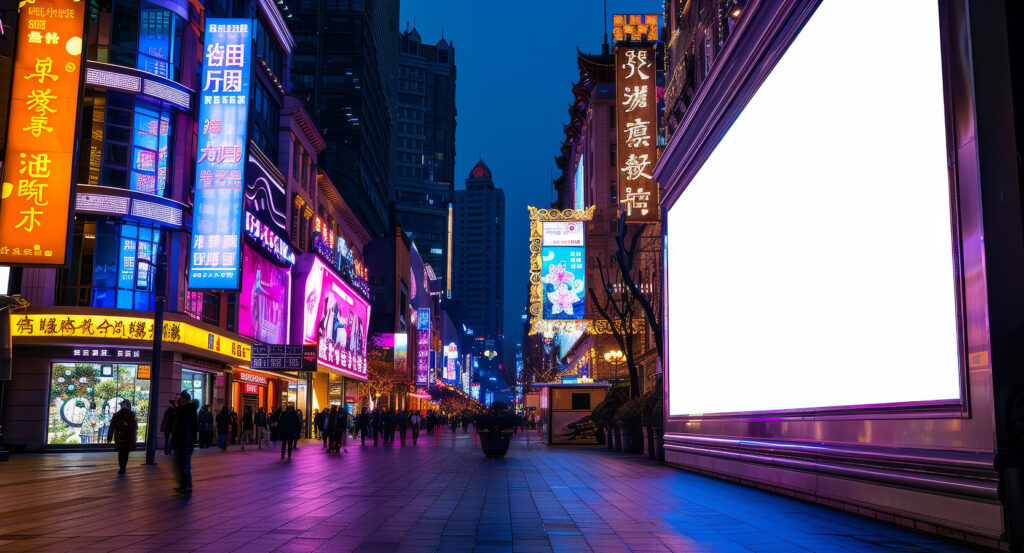
Why East Nanjing Road matters.
East Nanjing Road is where Shanghai's heartbeat begins, a radiant corridor of light and history linking the Bund's colonial grandeur to the city's modern rhythm.
By day, its marble sidewalks bustle with shoppers, locals, and travelers drawn to the hum of open-air life; by night, it transforms into a river of neon color that spills toward the Huangpu River. The air vibrates with sound, the jingle of trams, the laughter of street performers, the distant rhythm of jazz echoing from the Peace Hotel. Every façade tells a story: Art Deco storefronts beside futuristic glass towers, 1930s neon script glowing above luxury boutiques. Between the flashing signs and ornate windows, there's a pulse you can feel beneath your feet, a living memory of Shanghai's evolution from trading port to cosmopolitan powerhouse. Walking here isn't just sightseeing; it's immersion in the spirit of modern China, fast, luminous, endlessly alive.
What defines East Nanjing Road.
East Nanjing Road is the oldest section of Shanghai's most famous street, and the one most deeply intertwined with its colonial and cultural legacy.
Originally part of the International Settlement in the mid-19th century, the street was a symbol of early globalization, where British traders, Chinese merchants, and Western missionaries converged. By the 1920s, this was the epicenter of the “Paris of the East,” lined with department stores such as Wing On, Sun Sun, and Sincere, which introduced Shanghai to Western retail, from glass elevators to tailor-made fashion. Its architecture remains a timeline of Shanghai's transformation: Renaissance façades beside Bauhaus blocks, and Art Deco masterpieces that once framed the world's first Chinese-run fashion shows. After the People's Republic was founded, many of these stores became state-owned, marking the socialist redefinition of commerce. In 1999, East Nanjing Road was transformed into one of the world's longest pedestrian malls, 1,200 meters of stone-paved promenade illuminated by thousands of lights. Beneath it runs a warren of metro lines, shops, and arcades, while above, the Peace Hotel's green pyramid roof stands like a beacon of continuity. Hidden among the flagship brands, you'll still find heritage cafés and silk shops preserved from the 1930s, fragments of Shanghai's golden age woven into its modern identity.
How East Nanjing Road fits.
Exploring East Nanjing Road is best done at a pace that mirrors the city's rhythm, unhurried but fully awake to its physical energy.
Start the walk from the Bund, where the road begins beneath the towering columns of colonial banks, and head westward toward People's Square. Visit in the late afternoon, when daylight softens and the neon signs begin to flicker to life. Along the way, step into the Peace Hotel to glimpse its opulent Art Deco lobby, or linger over a drink at the Jazz Bar, where musicians have been playing since the 1930s. Continue to Wing On Department Store, whose preserved façade hides a tho modern shopping interior, and pause for a photo beside the Nanjing Road tram, the slow-moving red trolley that glides through the crowds like a relic from another century. Street vendors sell everything from candied fruit to calligraphy brushes, perfect mementos of Shanghai's dual identity, East and West, past and present. When night falls, find a café balcony or open-air terrace near Henan Middle Road, and look down the glowing stretch of East Nanjing Road: a living timeline of Shanghai's transformation, where history still shimmers beneath the lights.
Where your story begins.
Foresyte Travel reveals places that feel extraordinary long before you arrive.
Enjoy editorial crafted for luxury travelers.
Foresyte may earn a commission when you book.

















































































































