
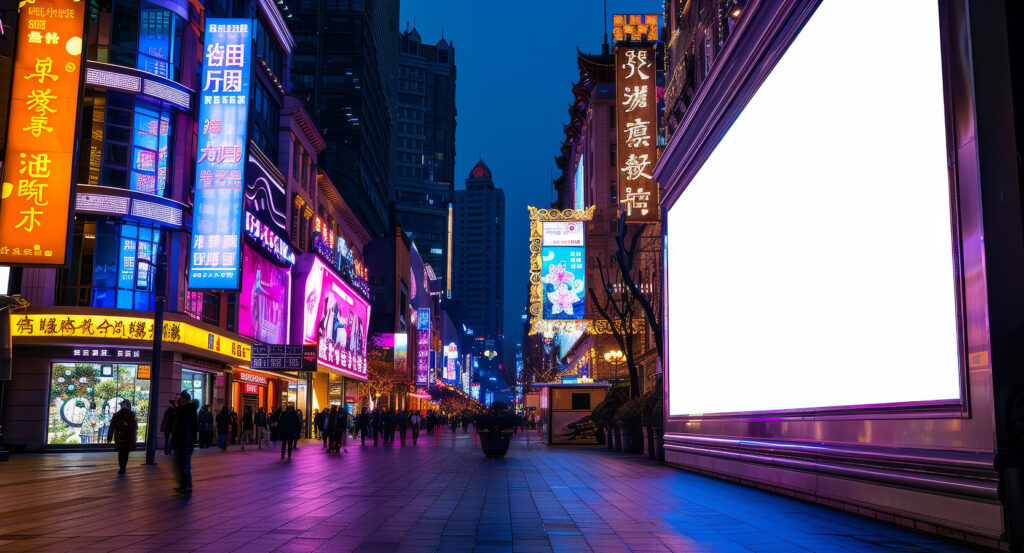
Why West Nanjing Road matters.
West Nanjing Road is Shanghai refined, a boulevard where heritage and high design meet beneath canopies of plane trees and glass towers.
If East Nanjing Road is the city's pulse, the west is its poise: quieter, greener, and steeped in understated luxury. As you walk, the rhythm slows; the crowds thin, replaced by the gentle murmur of café conversations and the hum of passing taxis gliding over polished streets. The architecture shifts from neon-lit performance to curated elegance, Art Deco facades, European-style villas, and sleek malls like Plaza 66 and Shanghai Centre, where East meets West with effortless grace. But beyond the storefronts and chandeliers lies something deeper: the story of Shanghai's transformation into a cosmopolitan capital that never lost its sense of artistry. Under the soft shade of trees, amid the scent of roasted coffee and jasmine, you feel the city's confidence, bold but never hurried, modern but deeply rooted in its cultural rhythm.
What defines West Nanjing Road.
West Nanjing Road, once known as Bubbling Well Road, began as a residential district for Western diplomats and elite Chinese families in the late 19th century.
It was named after the natural springs that once bubbled near what is now Jing'an Temple, and its tranquil character made it the city's first boulevard of prestige. As Shanghai entered the Republican era, the road evolved into a showcase of architectural innovation, home to consulates, embassies, and private clubs that defined Shanghai's golden age of international culture. Unlike the eastern section's bustle, West Nanjing Road cultivated refinement: tailor houses, private art galleries, and cafés frequented by writers and intellectuals. The area's transformation in the late 20th century mirrored Shanghai's rise as a global design hub, landmark developments like Plaza 66, Westgate Mall, and Jing'an Kerry Centre redefined urban luxury while preserving traces of its historic charm. A few hidden treasures remain: the MoCA Shanghai (Museum of Contemporary Art) tucked within People's Park, the Shanghai Exhibition Centre built in grand Soviet style, and tucked-away villas where the city's literati once gathered for poetry readings. Even today, the blend of heritage façades and modern minimalism captures the balance Shanghai has mastered, reverence for history, devotion to progress.
How West Nanjing Road fits.
To walk West Nanjing Road is to experience Shanghai's elegance at its most human scale, less a performance, more a conversation between past and present.
Begin at Jing'an Temple, whose golden rooftop glimmers against the skyline, and move eastward toward People's Square. Visit in the late morning or early evening, when sunlight filters through the trees and shop windows gleam like jewelry. Stop at Plaza 66 or Reel Mall to browse international designers, then step into the Shanghai Exhibition Centre across the street, its grand Soviet spire remains one of the city's most recognizable silhouettes. Pause for coffee or tea at a sidewalk café near Yan'an Middle Road, where the world seems to drift by at a gentler pace. For a cultural interlude, detour slightly to MoCA Shanghai inside People's Park, an oasis of glass and greenery housing rotating exhibitions of Chinese contemporary art. End your walk at dusk, just as the city lights flicker on, illuminating the shopfronts in soft gold. Stand still for a moment and listen, the sound of cars, laughter, and evening footsteps blending together. That's the real luxury of West Nanjing Road: not what you can buy, but the quiet sense that you're standing at the center of a city that's learned how to breathe between its heartbeats.
Where your story begins.
Foresyte Travel reveals places that feel extraordinary long before you arrive.
Enjoy editorial crafted for luxury travelers.
Foresyte may earn a commission when you book.

















































































































