
Why you should experience The Gardens at Kyoto National Museum in Kyoto, Japan.
The gardens and courtyards of the Kyoto National Museum are not designed to impress, they're designed to let you exhale.
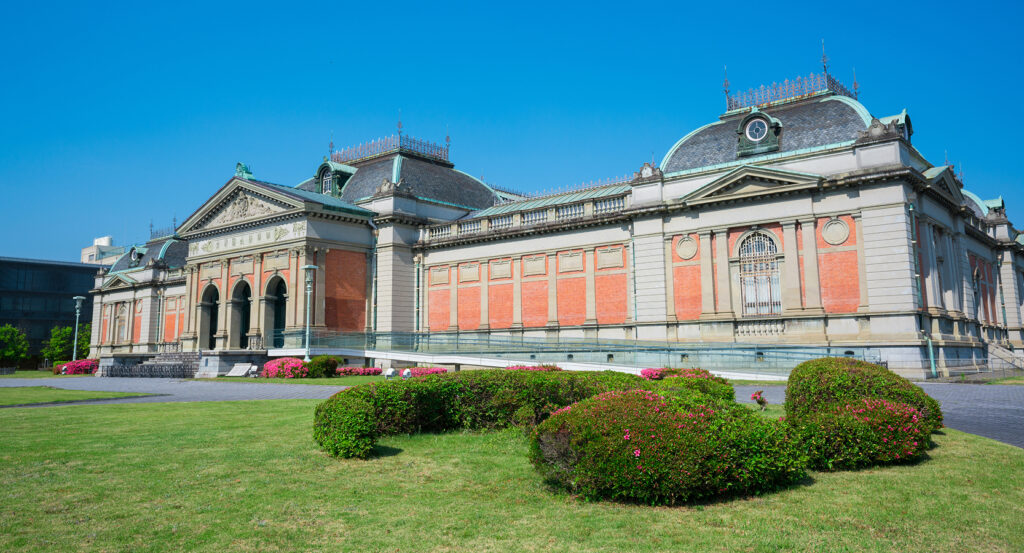
Between the grand Meiji Kotokan Main Hall and the sleek Heisei Chishinkan Wing lies a space that feels both ancient and im new. It's here, under Kyoto's ever-changing light, that the discussion between eras becomes visible. The red brick of the 19th century meets the quiet stone of the 21st, reflected together in still water that seems to breathe with the day. Plum and maple trees line the paths, their branches tracing the rhythm of the museum's architecture like brushstrokes on paper. The gravel paths crunch softly underfoot; the sound itself feels curated, part of the experience. Benches face the reflection pools where clouds drift lazily across mirrored surfaces, and beyond them, the faint silhouette of Higashiyama's ridges anchors everything in place. This is where the museum becomes Kyoto, structured yet organic, disciplined yet endlessly alive.
What you should know about The Gardens at Kyoto National Museum.
The museum's gardens were conceived as integral components of its design, not ornamentation, but philosophy.
When Tokuma Katayama designed the Meiji Kotokan in the late 1800s, he aligned its central axis to create open sightlines across the property, framing Sanjusangendo Temple directly to the east. That alignment was preserved more than a century later when Yoshio Taniguchi designed the Heisei Chishinkan Wing, his minimalist geometry extending those same sightlines through new courtyards of glass, stone, and reflection. Few visitors realize the subtle precision of the transition: the brick plaza between the two halls isn't merely a walkway but a spatial bridge, its dimensions match the proportions of a tatami mat multiplied across an architectural scale. The reflecting pools, introduced in the 2014 expansion, were engineered to mirror Kyoto's sky while concealing the museum's advanced climate systems below. Seasonal plantings were chosen to echo Japan's poetic calendar, plum blossoms in late winter, irises in early summer, maples and ginkgo in autumn, ensuring that every visit reveals a different palette. Even the gravel gradation shifts subtly from warm tones near the Kotokan to cooler grays near the Chishinkan, symbolizing the museum's evolution from history to modernity. The courtyards were also designed for sound: shallow water, rustling leaves, and the distant city murmur combine to form what Taniguchi described as “Kyoto's natural silence.” It's one of the few museum spaces in Japan where architecture and landscape are inseparable, where the pause between buildings becomes part of the art.
How to fold The Gardens at Kyoto National Museum into your trip.
To experience the museum's gardens is to witness Kyoto's philosophy of continuity made physical.
Enter from the south gate and move slowly toward the central plaza, where the Kotokan's red brick glows softly against the pale granite of the Chishinkan. Pause midway, it's the museum's heartbeat. The reflection pools at your feet frame both buildings perfectly; when the sky is clear, their symmetry feels infinite. Visit in spring when plum blossoms scatter across the water, or in autumn when the maples burn crimson against the brick, the color contrast is quietly theatrical. Walk along the gravel paths that trace the outer edges of the grounds; each turn offers a new composition, from the angular modern wing to the arched windows of the Meiji façade. Take time to sit, there are benches tucked between trimmed hedges and bamboo clusters, placed deliberately to capture shifting light. If you arrive near sunset, the courtyard transforms into gold; the old and new buildings reflect each other like twin lanterns at dusk. Before leaving, circle once around the reflecting pool, the sound of your steps and the water's hush will merge into one long breath. That's the essence of Kyoto: a place where nothing stands alone, and every space, even the air between walls, carries meaning.
Where your story begins.
Foresyte Travel reveals places that feel extraordinary long before you arrive.
Experience premium editorial crafted for luxury travelers.

















































































































