
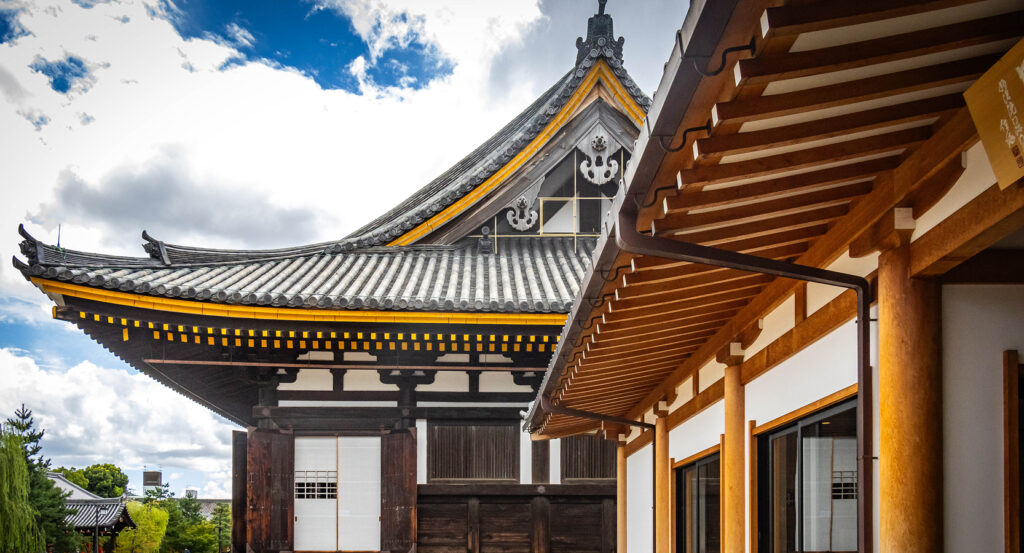
Why you should experience Sanjūsangendō Temple in Kyoto, Japan.
Sanjūsangendō Temple in Kyoto is one of Japan's most breathtaking expressions of faith and artistry, a sacred place where stillness becomes sound and repetition becomes revelation.
Known formally as Rengeō-in, the “Hall of the Lotus King,” this 12th-century temple stretches across Kyoto's eastern district in astonishing symmetry, home to 1,001 statues of Kannon, the Buddhist goddess of mercy. Stepping inside the main hall is a moment of quiet overwhelm: the air feels charged, golden light glows across cypress wood, and the thousandfold assembly of Kannon figures seems to move in the flicker of candlelight. Each statue, life-sized, gilded, and hand-carved with subtle variations, stands shoulder to shoulder, their faces serene, their gestures compassionate. At the center presides a grand seated Kannon with forty arms that symbolize infinite benevolence, radiating an almost tangible sense of calm. This hall, the longest wooden structure in Japan, stretches 120 meters from end to end, yet every step draws you deeper inward. Outside, gardens of stone and moss frame the temple in quiet contrast, grounding the scale of devotion inside with the simplicity of nature beyond. Sanjūsangendō doesn't just impress, it humbles, teaching that repetition, when done in faith, becomes transcendence.
What you should know about Sanjūsangendō Temple.
Behind its serene façade, Sanjūsangendō carries centuries of resilience, innovation, and ritual.
Commissioned by Emperor Go-Shirakawa in 1164, the temple was built to express gratitude and invoke peace after a period of political unrest. A devastating fire destroyed the original hall less than a century later, but it was rebuilt in 1266, preserving the emperor's vision with astonishing precision. Its name, “Sanjūsangendō,” meaning “thirty-three intervals between columns”, reflects a poetic marriage of architecture and philosophy. The 33 bays symbolize the number of manifestations of Kannon in Buddhist belief, making the building itself an act of worship. The thousand-armed Kannon at the center was sculpted by the master artist Tankei of the Kei school, whose team spent decades carving each surrounding statue, ensuring no two faces are identical. The result is a chorus of compassion in wood and gold. The temple is also known for a centuries-old ritual that bridges spirituality and sport: the Tōshiya archery competition. Since the 16th century, archers from across Japan have gathered in January to test their precision by shooting arrows the full length of the 120-meter hall, a feat of concentration and endurance dedicated to Kannon's guiding spirit. This blend of devotion, discipline, and artistry captures Kyoto's character, reverent, exacting, and timeless. Even the hall's weathered pillars and cypress scent seem to breathe history, reminding visitors that faith here isn't confined to prayer alone, it lives in craftsmanship, movement, and persistence.
How to fold Sanjūsangendō Temple into your trip.
To truly experience Sanjūsangendō in Kyoto, give it the time and reverence it deserves.
Arrive early in the morning before the crowds gather, when the light is soft and golden, filtering through the latticed windows and casting halos upon the statues. Step inside slowly, shoes removed, camera silent, and let your eyes adjust to the gilded glow. Walk the entire length of the hall from south to north, noticing how the Kannon figures shift subtly with each change in perspective. Their calm expressions seem to follow you, offering a quiet discussion between human and divine. Take a moment near the central statue to breathe in the stillness; it's said that each visit reveals a different Kannon watching over you, depending on what your heart seeks most. Afterward, explore the outer grounds, the vermilion gates, the understated garden, and the plaques that tell stories of centuries of restoration. If you visit in January, witnessing the Tōshiya archery festival adds another layer of meaning, a living ritual that celebrates endurance and focus. Pair your visit with a stop at the nearby Kyoto National Museum or the steps of Hōkan-ji Temple to round out your exploration of Kyoto's eastern quarter. Sanjūsangendō is easily reached by bus or on foot from Kyoto Station, yet its tranquility feels galaxies away from the modern city. Within its wooden walls, sound fades, breath slows, and the line between art and faith dissolves. To stand before a thousand Kannon is to confront infinity, and find peace reflected in every face.
Where your story begins.
Foresyte Travel reveals places that feel extraordinary long before you arrive.
Experience premium editorial crafted for luxury travelers.

















































































































