Why you should experience the Heisei Chishinkan Wing at the Kyoto National Museum in Kyoto.
The Heisei Chishinkan Wing is Kyoto's study in silence, a museum within a museum, where architecture becomes the exhibit.
From the moment you approach its low, linear form of stone and glass, the noise of the city falls away. The building seems to hover above its reflecting pool, each surface calibrated to absorb sound and soften light. Designed by architect Yoshio Taniguchi, the same mind behind the Museum of Modern Art in New York, the Heisei Chishinkan embodies the Japanese principle of ma: the beauty of empty space. Step inside, and the air feels deliberate. The galleries unfold like a whisper, white walls, pale floors, and invisible boundaries guiding you through centuries of art. There is no grandeur here, only grace. The light shifts gently across the rooms, tracing shadows that feel almost alive. Every step, every pause, every breath becomes part of the experience.
What you didn't know about Heisei Chishinkan Wing, Kyoto National Museum.
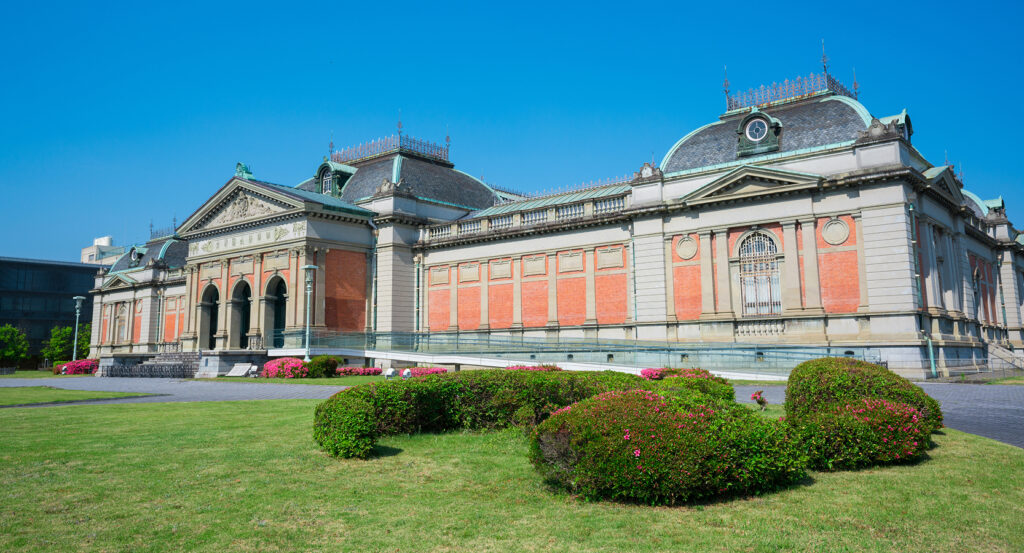
Opened in 2014, the Heisei Chishinkan Wing was conceived not as an addition but as a dialogue, a conversation across time with the Meiji Kotokan Main Hall across the courtyard.
Where the red-brick hall rises proudly, the Chishinkan withdraws, half-submerged and horizontal. Its name, meaning “Hall for Reflecting on the Past,” captures its intent: to honor Kyoto's heritage while embodying the refinement of modern Japanese design. The structure's minimalist composition, pale granite, glass, and steel, conceals an advanced climate system that maintains ideal humidity for fragile artifacts, from Heian-period scrolls to Edo lacquerware. Few visitors realize that Taniguchi designed the galleries to align with natural daylight angles specific to Kyoto's latitude, allowing sunlight to wash the walls with subtle variation throughout the day. The windows are placed low and narrow, framing fragments of the surrounding gardens. The Chishinkan's proportions follow the classical tatami ratio, its modular rhythm guiding the placement of every beam and seam. Beneath the floor lies an intricate vibration-absorbing foundation, protecting delicate works from even the faintest tremors. The wing's restraint conceals mastery; every inch is engineered to let art and air coexist. This isn't architecture meant to be noticed, it's architecture meant to be felt.
How to fold Heisei Chishinkan Wing, Kyoto National Museum into your trip.
To experience the Heisei Chishinkan Wing is to practice attention, to let stillness become the guide.
Enter from the courtyard that bridges old and new; pause halfway and notice the reflection of the Meiji Kotokan in the Chishinkan's glass facade. The symmetry feels deliberate, past meeting present, both humbled by the other. Inside, move without hurry. Each gallery invites contemplation more than observation; linger before a sculpture, a painted screen, a piece of pottery, and let the silence fill in what the labels leave unsaid. Visit in the late morning when the light begins to shift, creating faint silver gradients along the stone. Sit for a while in the final room, where the view opens to a small inner garden, an intentional exhale after the quiet density of the exhibits. If time allows, return near closing, when the glass darkens into mirror and the museum's lights turn the space into a soft lantern. When you step back into the courtyard, look again toward the Kotokan across the way. Between them lies Kyoto's continuum, a city that remembers not by holding still, but by evolving with grace. The Heisei Chishinkan doesn't declare its presence; it disappears beautifully into the light.
Where your story begins.
Start your planning journey with Foresyte Travel.
Experience immersive stories crafted for luxury travelers.