
Why Northern Lights matters.
Northern Lights is a polar atmospheric phenomenon where Iceland's subarctic geography meets solar activity, Earth's magnetic field and the scientific study of charged particles interacting with the upper atmosphere.
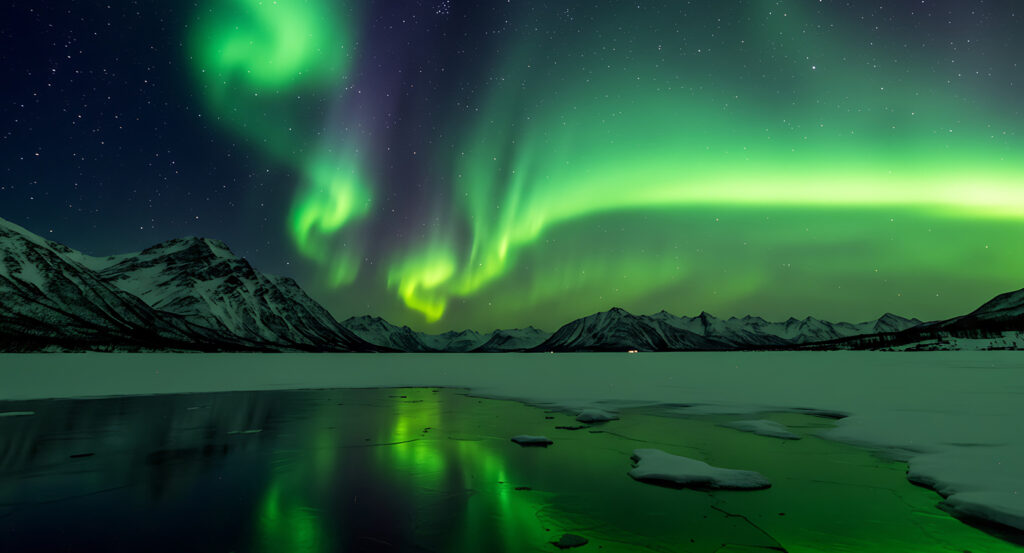
Visible across Iceland under suitable atmospheric conditions, the aurora occupies the night sky above volcanic highlands, coastal settlements and glacial landscapes, with observation areas extending from Reykjavík's outskirts to the sparsely populated regions of the country's northern and eastern districts. Iceland lies beneath the auroral oval, a zone surrounding Earth's geomagnetic pole where auroral activity occurs frequently. Displays appear as arcs, curtains and shifting bands of light above the horizon. Their visibility depends on darkness, cloud cover and the intensity of geomagnetic activity. The result is an atmospheric performance shaped by solar processes and Iceland's position beneath one of the Northern Hemisphere's principal auroral zones.
What defines the Northern Lights.
Northern Lights is best known for the luminous displays produced when charged particles from space interact with gases in Earth's upper atmosphere. The phenomenon is scientifically known as aurora borealis, a term associated with the Roman goddess of dawn and the Greek name for the north wind. Auroral activity originates in processes occurring within the Sun's atmosphere, where magnetic disturbances release energy and accelerate charged particles. The solar wind carries electrons, protons and magnetic fields outward through the solar system. When this flow encounters Earth's magnetosphere, interactions between magnetic fields and charged particles transfer energy into the planet's near-space environment. Some particles travel along magnetic field lines toward the polar regions, entering the upper atmosphere at high latitudes. Collisions with oxygen and nitrogen atoms and molecules excite these atmospheric constituents, causing them to emit light as they return to lower energy states. Oxygen produces green emissions at altitudes commonly associated with visible auroral curtains and red emissions at greater heights. Nitrogen contributes blue, violet and pink coloration under suitable conditions. The resulting displays follow the structure of Earth's magnetic field and the distribution of energetic particles entering the atmosphere. Auroral activity intensifies during geomagnetic storms associated with disturbances in the solar wind. The frequency of major solar disturbances changes across the eleven-year solar activity cycle. Iceland's position near the Arctic Circle places much of the country beneath the auroral oval, creating favorable geographical conditions for observation. Historical Icelandic accounts and northern European traditions incorporated auroral displays into descriptions of the night sky and natural phenomena. Scientific investigation expanded during the nineteenth and twentieth centuries as researchers developed electromagnetic theory and instruments for studying Earth's magnetic environment. Norwegian scientist Kristian Birkeland conducted experiments demonstrating how charged particles interact with magnetic fields, contributing to the modern understanding of auroral processes.
How the Northern Lights fits.
Northern Lights works as the atmospheric science centerpiece for an Iceland outing connecting volcanic landscapes, geothermal activity and the astronomical institutions that support the observation of the northern sky.
Begin at Grótta Lighthouse, the coastal navigation structure standing on a small tidal island at the western edge of Reykjavík. The lighthouse occupies a low-lying shoreline exposed to Faxaflói Bay, providing an observation setting separated from the densest commercial districts of the capital. Its history is associated with the development of maritime navigation along Iceland's southwestern coast. The surrounding intertidal flats and coastal paths support seabird habitats and provide views toward the mountains across the bay. The site's western orientation and open horizon make it a recognized location for observing the night sky during periods of clear weather. Continue to Kleifarvatn, the lake occupying a volcanic depression on the Reykjanes Peninsula. Its elongated basin lies within a landscape of dark lava fields, mountain ridges and geothermal terrain associated with the peninsula's active geological systems. The lake's water level has undergone substantial changes following tectonic disturbances, including the earthquakes of 2000. Its shoreline contains sections of exposed volcanic rock and sparsely vegetated slopes. The surrounding terrain provides a setting for observing the night sky beyond Reykjavík's concentrated urban lighting. Conclude at the Aurora Reykjavík Northern Lights Center, the exhibition institution devoted to the scientific and cultural interpretation of auroral phenomena. Its displays examine the relationship between solar activity, Earth's magnetosphere and the atmospheric processes responsible for visible auroras. Photographic and audiovisual presentations demonstrate the changing forms and colors associated with auroral activity. The center also explores Icelandic traditions connected with the northern sky and provides information concerning observation techniques and photography. Its educational exhibits connect direct viewing with the scientific principles governing auroral formation. The progression moves from Reykjavík's coastal observation sites through the volcanic landscapes of Reykjanes and culminates at an institution devoted to auroral science, connecting Northern Lights with Iceland's geography and astronomical research.
Where your story begins.
Foresyte Travel reveals places that feel extraordinary long before you arrive.
Enjoy editorial crafted for luxury travelers.

















































































































