
Why Notre-Dame-des-Champs matters.
Notre-Dame-des-Champs is an elegant enclave where Saint-Germain-des-Prés meets Montparnasse through garden-facing avenues, former artists' streets and residential blocks that chart the Left Bank's passage from semi-rural outskirts into one of nineteenth-century Paris's most cultivated quarters.
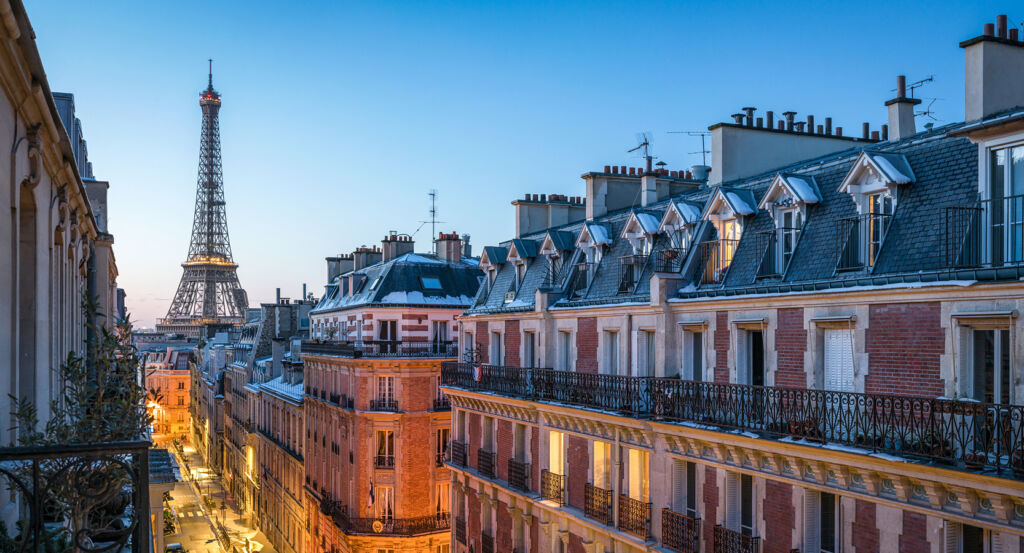
Positioned between Saint-Germain-des-Prés, Montparnasse, and Luxembourg, the neighborhood occupies a southern Left Bank pocket where Rue Notre-Dame-des-Champs, Rue d'Assas and Boulevard Raspail cross territory once dominated by fields, religious estates and gardens beyond the dense medieval city. Long streets lined with apartment houses conceal private gardens, former studios and interior workshops, preserving a quieter depth behind facades that grew increasingly urban as Paris expanded southward during the nineteenth century. Rue Notre-Dame-des-Champs establishes the primary encounter through an old country route whose gentle bends resist the geometric regularity of the later boulevards and retain the memory of its passage across open ground. Rue Vavin and the adjoining streets deepen that character through narrower residential blocks that place the Luxembourg Garden, Montparnasse and the neighborhood's former studio culture within a compact walk. Boulevard Raspail adds a broader metropolitan scale, cutting across the inherited street network and marking the transformation of an outer district into a fully integrated part of Central Paris. The result is a neighborhood where old rural alignments, nineteenth-century urban expansion and generations of cultural life remain unusually close together, preparing a history that begins centuries before Montparnasse became synonymous with the artistic Left Bank.
What defines Notre-Dame-des-Champs.
Notre-Dame-des-Champs is best known for taking its name from an ancient religious site whose successive incarnations trace the transformation of southern Paris from cultivated outskirts into a densely inhabited nineteenth-century district. Tradition associates the original ground near present-day Rue Pierre-Nicole with an early Christian oratory connected to Saint Denis and a Roman sanctuary dedicated to Mercury, followed by a church surrounded by vineyards and known as Notre-Dame-des-Vignes. Robert II granted the property to the Benedictines of Marmoutier around the eleventh century, and the monks established a priory serving an area whose growing population encouraged parish life during the twelfth century. Removal of surrounding vines accompanied the shift toward the Notre-Dame-des-Champs name, binding the institution to the fields that still characterized this edge of Paris. The property passed to the Carmelites in 1604 and became closely connected with the royal court: Marie de Médicis visited the convent, Louise de La Vallière entered religious life there after leaving Louis XIV's court, and the heart of Marshal Turenne was deposited within the complex. Revolutionary suppression expelled the Carmelites, dispersed their possessions and led to destruction of the old church. Population growth and the remaking of southern Paris eventually demanded another parish building, and Léon Ginain designed the present Notre-Dame-des-Champs, whose first stone was laid in 1867. Joseph Aubert subsequently developed an extensive painted cycle devoted to the Virgin across the nave, choir and chapel between the closing years of the nineteenth century and 1906, carrying an ancient neighborhood name into an ambitious new religious interior.
The western edge of the Luxembourg estate supplied a separate mechanism through which Notre-Dame-des-Champs acquired its modern urban structure. Marie de Médicis had assembled the Luxembourg domain through acquisitions made between 1614 and 1631, placing a major royal garden immediately northeast of land that remained substantially less urbanized. The Count of Provence received the palace in the eighteenth century and sought funds for its restoration by selling ten hectares on the Notre-Dame-des-Champs side in 1782. Rue de Luxembourg, later Rue Guynemer, was opened through the alienated ground, eliminating walks that included the Vallée des Philosophes, where Jean-Jacques Rousseau had exercised his memory on Virgil during his Paris residence in 1741. Another major contraction arrived under Second Empire reconstruction as widening Rue de Vaugirard and opening Boulevard Saint-Michel consumed additional garden territory. A proposal in 1865 to subdivide the nursery and botanical garden triggered intense opposition, including a petition gathering 12,000 signatures. The resulting works fixed the Luxembourg Garden near its present boundaries and converted adjoining former garden territory into streets and building plots, giving the northern side of Notre-Dame-des-Champs a lasting relationship between dense residential construction and one of Central Paris's principal historic gardens.
How Notre-Dame-des-Champs fits.
Notre-Dame-des-Champs works as the anchor for a daytime exploration connecting three preserved creative environments through which individual studios became enduring institutions devoted to modern sculpture and the artistic culture of Montparnasse.
Begin at Musée Zadkine, where Russian-born sculptor Ossip Zadkine and painter Valentine Prax lived and worked from 1928 in a house, garden and collection of studios on Rue d'Assas. Zadkine added another workshop after returning from the United States in 1945 and continued teaching sculpture around the property, turning the address into both a working environment and a gathering place during his lifetime; after his death in 1967, Prax pursued the creation of a museum, donated a major body of property to the City of Paris in 1978 and confirmed the gift through her 1980 will before the museum opened on April 19, 1982. Continue to Institut Giacometti, installed in the former home and studio of decorator Paul Follot at 5 Rue Victor Schoelcher, an Art Deco hôtel particulier whose surviving interiors were restored for the Fondation Giacometti. Alberto Giacometti spent his Paris career in Montparnasse, and the institute brings his work into a preserved creative environment through exhibitions, research and a reconstruction of the tiny studio in which he developed much of his mature sculpture, joining Follot's decorative architecture to the legacy of an artist whose elongated figures became central to postwar European art. Conclude at Musée Bourdelle, formed around the studios where Antoine Bourdelle worked from 1885 until his death in 1929 and where sculpture, architecture and garden spaces preserve the physical setting of his career. Bourdelle trained in Toulouse and Paris, worked as an assistant to Auguste Rodin for fifteen years and achieved international recognition through works including Héraklès archer and the Monument au général Alvéar; his widow Cléopâtre and daughter Rhodia pursued the preservation of the studios, allowing the City of Paris to open the museum in 1949 and retain a rare ensemble linking finished sculpture with the spaces of its production. The progression moves from Zadkine and Prax preserving a private house and garden through Giacometti's reconstructed working environment inside Follot's Art Deco architecture into Bourdelle's studios becoming a museum around the sculptor's own production, revealing how Montparnasse converted the intimate spaces of artistic labor into permanent cultural institutions.
Where your story begins.
Foresyte Travel reveals places that feel extraordinary long before you arrive.
Experience premium editorial crafted for luxury travelers.
Foresyte Travel may earn a commission when you book through the link on this page.














































































































