
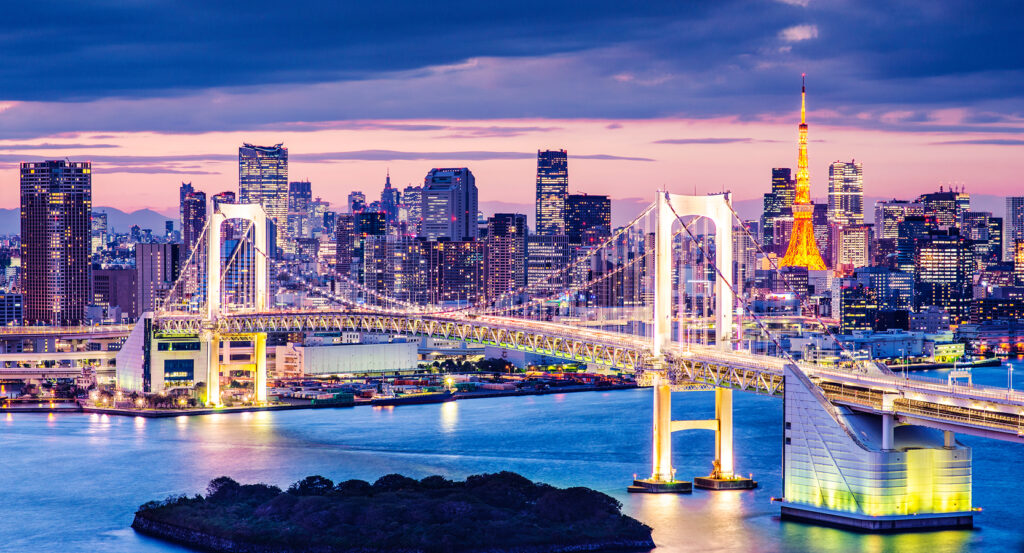
Why Odaiba matters.
Odaiba is an engineered waterfront district where Daiba's bayfront character meets the remnants of Tokugawa coastal defense, late twentieth-century urban planning and a concentration of architecture built to reconnect Tokyo with its harbor.
Set along Tokyo Bay near the mouth of the Sumida River and just across the water from Shibaura, the district occupies reclaimed territory reached from Central Tokyo across Rainbow Bridge and by an elevated transit system that keeps the harbor visible throughout the approach. Broad promenades, artificial shorelines and large development parcels give its streets a scale distinct from Tokyo's older inland districts, with long views opening between buildings toward shipping lanes and the metropolitan skyline. Major structures stand as isolated compositions against that water, particularly Kenzo Tange's Fuji Television Headquarters with its twin towers, exposed structural grid and suspended titanium sphere. Yurikamome reinforces the district's engineered character as automated trains climb above the streets, curve across the reclaimed islands and connect Daiba with Aomi, Ariake and the mainland. The result is a waterfront district whose open scale exposes the mechanisms of Tokyo's expansion, placing fortifications, transportation infrastructure and ambitious late twentieth-century architecture across territory progressively claimed from the bay.
What defines Odaiba.
Odaiba is best known for transforming artificial fortifications ordered by the Tokugawa shogunate after Commodore Matthew Perry's 1853 arrival into the nucleus of Tokyo's modern waterfront subcenter. Perry's warships exposed Edo's vulnerability from the bay, prompting construction of six completed batteries intended to defend the shogunal capital from naval attack. Third Battery and Sixth Battery survived later harbor transformation, leaving physical remnants of the military project that supplied the district's name, since daiba denotes a battery or fortification. Tokyo's twentieth-century expansion gradually surrounded that defensive geography with reclaimed land devoted to port functions and a new metropolitan development strategy. Plans for the Waterfront Subcenter sought to distribute urban functions away from the concentrated center, and the transportation company responsible for its new transit system was established in April 1988. Construction of Yurikamome began the following year as development advanced across the reclaimed districts. The proposed World City Expo became a major catalyst, and construction of its waterfront venue began in October 1994, but the political context changed when Yukio Aoshima won the 1995 Tokyo gubernatorial election after campaigning to cancel the event. Cancellation followed that May, removing a central component of the development strategy only months before the transportation system was scheduled to begin operating. Yurikamome opened between Shimbashi and Ariake on November 1, 1995, becoming the first railway connection between Central Tokyo and the Waterfront Subcenter, and drew 53,000 passengers on November 3 alone. The initial phase of waterfront infrastructure reached completion in March 1996, after which private development and entertainment projects increasingly supplied activity across the new district. Odaiba emerged through repeated changes of purpose, carrying a nineteenth-century military response to foreign naval power into a metropolitan expansion project whose defining exposition disappeared before the new city had fully opened.
Kenzo Tange's Fuji Television Headquarters supplied that emerging city with an architectural centerpiece connected directly to his much older ideas about restructuring Tokyo around its bay. Tange had developed A Plan for Tokyo 1960 as a proposal to redirect metropolitan growth across Tokyo Bay through a linear urban structure, challenging the radial expansion of the existing capital. Decades later, he joined the Fujisankei Communications Group in a competition for waterfront development and won the commission for its new headquarters in Daiba. Construction began in April 1993, and the 141,825.438-square-meter complex reached completion in June 1996 under Tange Associates and Kobori Research Complex, with Kajima Corporation executing construction. Five large studios occupy the lower section between an office tower and media tower, resolving the conflicting requirements of column-free production areas, heavy broadcasting equipment and conventional workplaces inside one composition. Six corridors connect the towers above, and a titanium-clad sphere measuring 32 meters in diameter occupies the void between them. Exposed mast columns turn structural logic into exterior architecture, and Pentagram extended their grid into the building's signage system. Fuji Television transferred its headquarters to Daiba in April 1997, placing a major national broadcaster inside territory still establishing its metropolitan role. Tange's commission joined an urban idea conceived in 1960 with the reclaimed Tokyo Bay ground where a version of that outward expansion finally became physical city.
How Odaiba fits.
Odaiba works as the anchor for a Daiba and Aomi route through three nearby sites that move from Japan's Antarctic exploration through the functioning infrastructure of Tokyo Port into a maritime gateway designed for the largest generation of international cruise ships.
Begin at Museum of Maritime Science, where the preserved Sōya carries the waterfront beyond Tokyo's own history into Japan's first Antarctic research program. The vessel was launched on February 16, 1938 under the name Borochaebetsu and accumulated several careers before departing Harumi Pier on November 8, 1956 for Japan's first Antarctic research expedition. Sōya became inseparable from the early national expeditions and the celebrated survival of Sakhalin huskies Taro and Jiro after they were left in Antarctica for a year; the ship now forms the central historic artifact of an institution devoted to Japanese maritime and ship culture. Continue to TOKYO PORT MUSEUM, which places the reclaimed waterfront inside the economic history of the harbor itself. Edo's port supplied the shogunal capital through water transportation before successive landfill projects altered the shoreline, and Tokyo Port became an international trade gateway in 1941. The museum traces that development across four centuries and interprets the Waterfront Subcenter as another stage in the same physical expansion, linking the surrounding city with a port serving production and consumption across the greater metropolitan region. Its location in Aomi makes the industrial harbor visible beyond the exhibition itself, with working port infrastructure extending outward from the reclaimed districts occupied by contemporary Odaiba. Conclude at Tokyo International Cruise Terminal, opened on September 10, 2020 as a new maritime entrance capable of receiving super-large passenger vessels whose dimensions had outgrown older facilities farther inside the harbor. Its roof combines three references, ocean waves, a ship under sail and the upward-curving rooflines of Japanese temples and shrines, giving the terminal an architectural form tied simultaneously to navigation and Japanese building traditions. The project pushes Odaiba's relationship with the bay into an international transportation role, placing contemporary passenger infrastructure on waterfront territory whose earliest artificial islands were built to keep foreign ships away from Edo. The progression moves from Museum of Maritime Science's preservation of Sōya and Japan's Antarctic ambitions through TOKYO PORT MUSEUM's account of the harbor that enabled Tokyo's expansion into Tokyo International Cruise Terminal's accommodation of contemporary ocean-going vessels, tracing the extraordinary reversal by which a waterfront created for maritime defense became a gateway connecting Tokyo with the world.
Where your story begins.
Foresyte Travel reveals places that feel extraordinary long before you arrive.
Enjoy editorial crafted for luxury travelers.
Foresyte may earn a commission when you book.

















































































































