
Why Rainbow Bridge matters.
Rainbow Bridge is a sweeping suspension bridge where Shibaura's waterfront character meets large-scale structural engineering, layered transportation and one of the most recognizable crossings in Tokyo Bay.
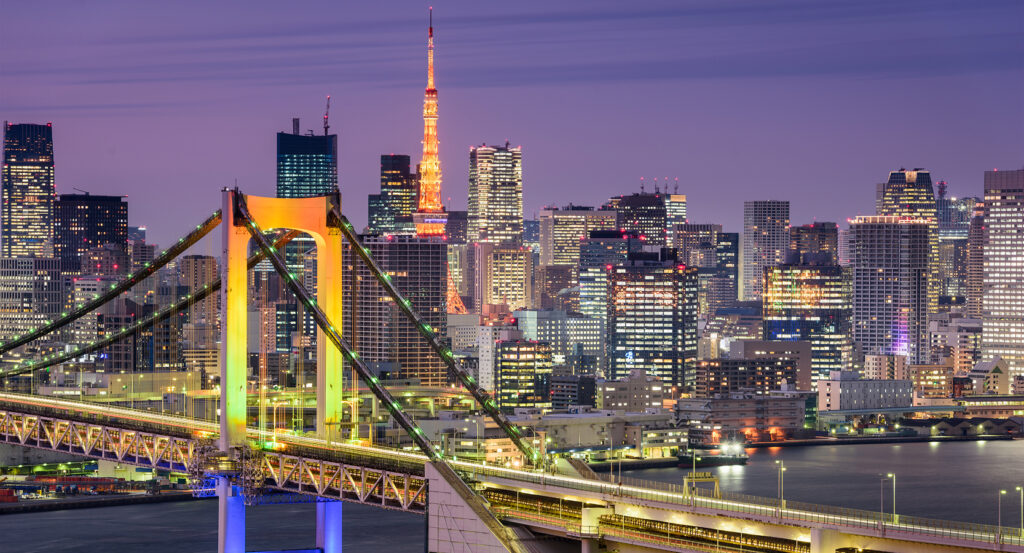
Set across Tokyo Port near Shibaura Wharf and just steps from Shibaura-futo Station, the 798-meter bridge carries its white towers across the water between mainland Tokyo and Daiba, framing a 570-meter central span between towers rising 126 meters above sea level. Two structural levels concentrate several forms of movement into the crossing, with the Metropolitan Expressway Route 11 Daiba Line above and a lower deck accommodating local road traffic, the Yurikamome and pedestrian passages. The promenade places walkers directly inside the bridge structure, where suspension cables and steelwork repeatedly frame Tokyo Tower, port infrastructure, passing vessels and the reclaimed islands extending through the bay. Shifts between the northern and southern sides alter the metropolitan panorama, exposing Central Tokyo from one orientation and the open harbor, Daiba and waterfront development from the other. The result is an immense piece of transportation infrastructure that also functions as an elevated encounter with Tokyo Port, turning the physical act of crossing the bay into a sustained reading of the city's waterfront geography.
What defines Rainbow Bridge.
Rainbow Bridge is best known for solving the transportation challenge between Central Tokyo and the emerging waterfront subcenter through a suspension bridge engineered under severe constraints from shipping and aviation. Construction began in January 1987 under the working name Tokyo Port Connector Bridge as part of Metropolitan Expressway Route 11, conceived to connect Route 1 Haneda with the Bayshore Route and improve access to the developing waterfront. Tokyo Port presented a demanding structural problem: large vessels required a wide navigation channel beneath the crossing, and proximity to Haneda Airport restricted the permissible height of the towers. Engineers selected a suspension system capable of spanning 570 meters between the main towers. Foundations had to reach soft rock 46 meters beneath sea level, leading the project to employ pneumatic caissons that ranked among the largest in the world at the time of construction. Main towers, anchorages, cables and stiffening girders subsequently assembled the 798-meter bridge across the active harbor. Its transportation program became unusually dense, combining the expressway, port road and Yurikamome system inside one structure. A public naming campaign drew 20,023 submissions, and Rainbow Bridge was announced as the selected name in November 1992. The bridge and the five-kilometer Route 11 Daiba Line opened on August 26, 1993, establishing a second connection between the Inner Circular Route and the Bayshore Route and strengthening the transportation structure behind Tokyo's expanding waterfront districts.
Illumination developed as a separate engineering and design system intended to establish a nighttime presence for the new waterfront subcenter. Designers considered the relationship between the horizontal surface of Tokyo Port, surrounding towers and the bridge's suspension geometry, choosing soft curves and white structural elements to distinguish the crossing against the rectilinear waterfront skyline. The lighting installation adopted electrodeless lamps for their long service life, reduced power requirements and high output, and the bridge became the first bridge in the world whose illumination shifted among three colors. Its system distributes 176 fixtures across the upper portions of the main towers, 84 across their lower portions, 152 along the cables, 28 beneath the girders and 80 around the anchorages. Seasonal programming changes the towers from cooler white illumination between April and October to warmer white between November and March, with cable colors changing through weekday, weekend, holiday and event sequences. Special programs continue to adapt the structure for civic occasions, including blue illumination for Japan's Sign Language Day on September 23, 2026. The lighting system gives the bridge a second architectural existence after sunset, translating structural components designed for load and stability into an immense composition of illuminated towers, cables and suspended roadway across Tokyo Port.
How Rainbow Bridge fits.
Rainbow Bridge works as the anchor for a Tokyo Bay route through three Daiba sites that trace the waterfront from the shogunate's nineteenth-century coastal defenses through international commemoration and into Kenzo Tange's architectural vision for Tokyo's expansion across the bay.
Begin at Daiba Park, where the geometric earthworks of the former No. 3 Battery preserve the military origins of the name Odaiba. Commodore Matthew Perry entered Japanese waters with four American naval vessels in 1853, prompting the Tokugawa shogunate to order Nirayama magistrate Egawa Hidetatsu to construct Western-style marine batteries protecting Edo. Eleven batteries were initially planned, yet the Convention of Kanagawa arrived in March 1854 after No. 1, No. 2, No. 3, No. 5, No. 6 and the partly land-based Gotenyama battery had been completed. No. 3 later opened as a public park in 1928, preserving remnants of its jin-ya administrative building, powder magazine and defensive earthworks on an artificial island now surrounded by the contemporary waterfront. Continue to Statue of Liberty, whose presence beside Odaiba Marine Park grew from a late twentieth-century cultural exchange between France and Japan. A Statue of Liberty from Paris was installed in Odaiba in April 1998 for a year during the French Year in Japan, creating an unexpected association between the French monument and Tokyo Bay. The reception led to a permanent bronze replica cast from a mold connected with the visiting statue and installed in December 2000. Standing 11 meters high without its pedestal and weighing about nine tonnes, the work occupies a waterfront already radically different from the defensive landscape established after Perry's arrival. Its placement facing the bay gives the route a second international chapter, replacing nineteenth-century anxiety over foreign ships with a monument explicitly created around Franco-Japanese cultural exchange. Conclude at Fuji Television Headquarters Building, where Kenzo Tange translated decades of thinking about Tokyo Bay into architecture during the waterfront subcenter's emergence. Tange had proposed A Plan for Tokyo 1960 as a dramatic response to metropolitan concentration, and decades later his firm won the competition with the Fujisankei Communications Group for a new headquarters in the reclaimed waterfront district. Construction began in April 1993, finished in June 1996 and preceded Fuji Television's move to Daiba in April 1997. Tange arranged five large studios horizontally between an office tower and media tower, joined the towers with six corridors and suspended a 32-meter-diameter titanium-clad observation sphere 100 meters above the ground. The 25-storey composition exposed mast columns and circulation across its facade, giving the young waterfront district a building whose structural organization became its public image. The progression moves from Daiba Park's response to Perry's arrival through Statue of Liberty's Franco-Japanese commemoration into Fuji Television Headquarters Building's realization of Tange's long engagement with Tokyo Bay, placing Rainbow Bridge within the extraordinary transformation of the harbor from defensive perimeter to metropolitan extension.
Where your story begins.
Foresyte Travel reveals places that feel extraordinary long before you arrive.
Enjoy editorial crafted for luxury travelers.
Foresyte may earn a commission when you book.

















































































































