
Why Tokyo Tower matters.
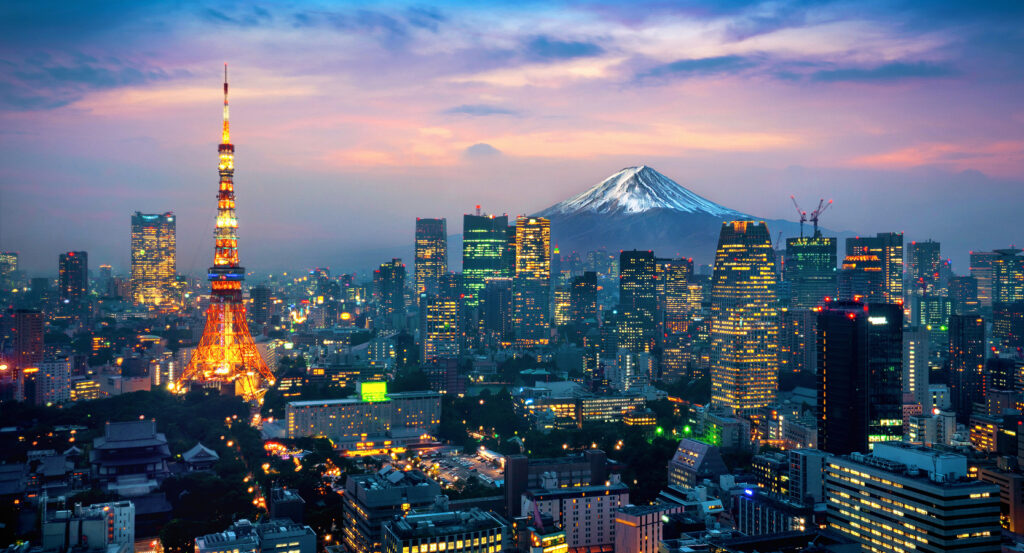
Tokyo Tower is a soaring postwar beacon where Shiba's temple-district character meets a 333-meter broadcasting structure whose orange-and-white steel silhouette became inseparable from Tokyo's twentieth-century skyline.
Set along Tokyo Tower-dori near Sakurada-dori and just steps from the wooded precincts south of Atago, the tower rises from an elevated pocket where temple grounds, mature trees, institutional buildings and compact streets separate its enormous steel frame from the dense office blocks of Toranomon and Central Minato. Four lattice legs spread across the base before narrowing sharply toward the observation decks and antenna mast, producing dramatic changes in scale as the structure emerges between neighboring buildings. The 150-meter Main Deck places Central Tokyo beneath the latticework at a height that still reveals individual streets, rooflines and the terrain descending toward Tokyo Bay. Ground-level approaches provide the opposite encounter, with the legs occupying separate corners and the tower disappearing overhead as its structural members converge toward the upper decks. The result is a rare Tokyo structure whose engineering remains visually comprehensible from the pavement even as its height transforms the surrounding district into a sweeping metropolitan panorama.
What defines Tokyo Tower.
Tokyo Tower is best known for translating Japan's explosive adoption of television into a 333-meter broadcasting tower that became one of the defining structures of the country's postwar economic expansion. Regular television broadcasting began in Japan in 1953, and individual broadcasters initially relied on separate transmission towers as new stations entered the Tokyo market. Hisakichi Maeda recognized an opportunity to consolidate those signals within a single structure whose observation facilities would also generate income, and in 1957 he established Nippon Television City Corporation to advance the project. Maeda wanted a tower surpassing Paris's Eiffel Tower, though radio-wave specialists determined that 333 meters provided the height required to serve the wider Kanto region and accommodate the expanding television system. Structural engineer Tachu Naito, already renowned for his work on earthquake-resistant tall buildings, designed the self-supporting steel tower with Nikken Sekkei. Construction began in 1957 and advanced with teams of specialized tobi ironworkers assembling the lattice high above Shiba. The structure weighs close to 4,000 tons, yet its steel frame rises 33 meters higher than the Eiffel Tower, demonstrating the efficiency of twentieth-century structural engineering against its nineteenth-century precedent. Tokyo Tower was completed on December 23, 1958 after a year and a half of construction, becoming the world's tallest freestanding tower at the time. All television channels were transmitting from it by 1959, placing the new structure directly inside the communications revolution reshaping Japanese domestic life. The tower's completion during the same period that preceded the Tokaido Shinkansen and the 1964 Tokyo Olympics gave Maeda's broadcasting venture a significance extending beyond telecommunications, fixing its silhouette to the public image of Japan's rapid postwar ascent.
Engineering requirements governed a structure built in a country exposed to earthquakes and typhoons, leading Naito's team to develop a lattice capable of resisting severe horizontal forces. Firm ground in the Shiba district contributed to selection of the site, and foundations beneath the four principal legs descend 20 meters. The completed tower was designed for wind speeds reaching 90 meters per second at its summit, turning its tapered profile and steel bracing into essential structural responses to Tokyo's climate. Broadcast equipment occupied the upper structure as television services expanded, followed by the opening of the Special Observatory in 1967. A new lighting system introduced in 1989 established the illumination later known as Landmark Light, coinciding with the tower reaching 100 million cumulative admissions. Diamond Veil followed in 2008 for the fiftieth anniversary, introducing a separate lighting composition across the lattice. The former Main Observatory and Special Observatory became the Main Deck and Top Deck in 2018, with the upper platform operating at 250 meters and the lower deck at 150 meters. Infinity Diamond Veil arrived in 2019, extending programmable illumination across the structure more than six decades after Naito's engineering first established its nighttime outline. Tokyo Tower developed from a television transmitter into a continuously adapted piece of metropolitan infrastructure without losing the steel frame that made the original engineering achievement immediately recognizable.
How Tokyo Tower fits.
Tokyo Tower works as the anchor for a daytime exploration through Shiba and Atago using three nearby sites that move from the Tokugawa shogunate's principal Pure Land temple through one of Japan's earliest designated public parks into a hilltop shrine established by Tokugawa Ieyasu at the foundation of Edo government.
Begin at Zojoji, founded in 1393 by Yuyo Shoso as a Jodo school seminary and moved to its present Shiba site in 1598 after Tokugawa Ieyasu entered Edo. Ieyasu selected the institution as a Tokugawa family temple, and shogunal patronage expanded its precinct to 826,000 square meters containing 48 subordinate temples and 150 schools, with as many as 3,000 priests and novices resident during its height. Six Tokugawa shoguns, Hidetada, Ienobu, Ietsugu, Ieshige, Ieyoshi and Iemochi, were buried there alongside members of their families. Fire and wartime destruction eliminated much of the former complex, yet the Sangedatsumon and surviving funerary precinct preserve the institution's direct connection to the political dynasty that governed Japan from Edo. Continue through Shiba Park, designated in 1873 under the Meiji government's new public-park system and opened that October as one of Tokyo's first public parks. The original park incorporated Zojoji territory before postwar separation of religious and state property produced the distinctive ring-shaped arrangement surrounding the temple. Shiba Maruyama Kofun survives within the grounds as a burial mound dating to the later fourth century, carrying the site's human history far behind both the Meiji park and the Tokugawa temple district. Sports facilities introduced in 1935 added another chapter to ground already transformed repeatedly by religious, political and public uses. Conclude at Atago Shrine, founded on Tokugawa Ieyasu's order in 1603, the same year he became shogun and established the Tokugawa bakufu. The shrine occupies Atagoyama at an elevation of 26 meters and venerates Homusubi no Mikoto, a deity associated with fire, giving the foundation a protective purpose in a city repeatedly threatened by conflagration. Shogunal patronage supported construction of the principal sanctuary and subsidiary structures in 1610, and the shrine later recovered from major fires, including rebuilding completed in 1877. Its steep ascent preserves the physical drama of reaching one of the highest natural points within Tokyo's old central wards. The progression moves from Zojoji's rise as a Tokugawa dynastic temple through the Meiji government's conversion of surrounding ground into an early public park into Ieyasu's establishment of Atago Shrine, revealing three successive mechanisms through which religion, government and urban land shaped the district centuries before its modern skyline emerged.
Where your story begins.
Foresyte Travel reveals places that feel extraordinary long before you arrive.
Enjoy editorial crafted for luxury travelers.
Foresyte may earn a commission when you book.

















































































































