
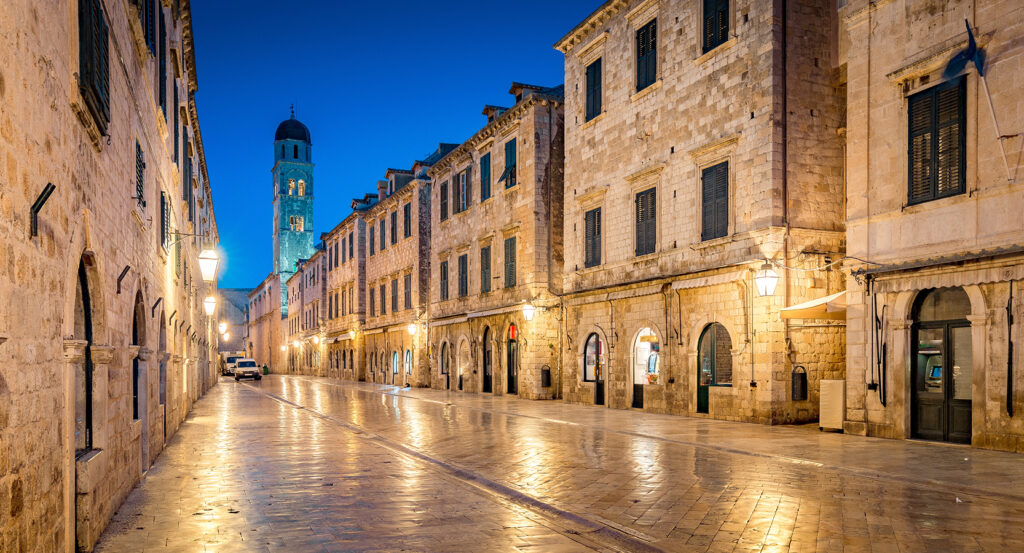
Why you should experience Dominican Monastery, Dubrovnik in Croatia.
The Dominican Monastery isn't just a sacred space, it's a living tribute to Dubrovnik's devotion, intellect, and resilience.
Tucked just inside Ploče Gate, its Gothic stone façade gives way to a world of serenity: cloisters lined with orange trees, echoing corridors scented with candle wax and salt air, and sunlight spilling through pointed arches onto centuries-old stone. Here, monks once balanced prayer with scholarship, transcribing manuscripts and debating philosophy beneath vaulted ceilings. The hum of the Old Town fades as you step inside, replaced by a profound stillness that feels both monastic and eternal. The monastery's quiet dignity mirrors the soul of Dubrovnik itself, austere yet graceful, humble yet radiant. Walking through its courtyard, you sense that faith here was never loud or showy; it was lived, studied, and quietly built into the rhythm of everyday life.
What you should know about Dominican Monastery, Dubrovnik.
Construction of the monastery began in the early 14th century, blending Gothic and Romanesque styles under the guidance of local and Italian architects.
Its vast cloister, completed in 1480, was designed by Michelozzo di Bartolomeo, the same Florentine architect who worked for the Medici, and remains one of the finest examples of late Gothic architecture on the Adriatic. The monastery once served as both a spiritual and intellectual stronghold, housing one of the region's earliest theological schools and an extraordinary library that still contains thousands of volumes, including illuminated manuscripts and incunabula. Its church, dedicated to St. Dominic, shelters masterpieces by some of the Renaissance's greatest painters, including Titian's St. Blaise, the Virgin, and the Infant Christ, as well as works by Paolo Veneziano and Dubrovnik's own Nikola Božidarević. Even after suffering damage during the 1667 earthquake and the siege of the 1990s, the monastery has been lovingly restored, its cloisters as peaceful as ever, a reminder that Dubrovnik's true power has always been its capacity to endure through grace.
How to fold Dominican Monastery, Dubrovnik into your trip.
To experience the Dominican Monastery is to step into Dubrovnik's contemplative heart.
Visit early in the morning, when the air is cool and the crowds are still gathered along Stradun. The walk from Ploče Gate sets the tone, stone walls closing in, footsteps echoing against marble, until the entrance appears, humble yet majestic. Once inside, linger in the cloister and listen to the soft trickle of the fountain; it's the kind of silence that rewires your senses. Wander the museum to see its collection of religious art, reliquaries, and the grand Titian altarpiece glowing in the half-light. If you're drawn to quiet places that still hum with centuries of life, this is one of Dubrovnik's most profound. End your visit seated on the cloister steps, watching sunlight shift through the arches as bells toll from the church tower. The Dominican Monastery isn't just a relic of faith, it's a sanctuary for reflection, beauty, and the enduring wisdom that built one of the world's most storied cities.
Where your story begins.
Foresyte Travel reveals places that feel extraordinary long before you arrive.
Experience premium editorial crafted for luxury travelers.




















































































































