Why Stradun matters.
Stradun, the gleaming marble spine of Dubrovnik's Old Town, is more than a street. It's a living stage where centuries of history and daily life unfold in a single, continuous performance.
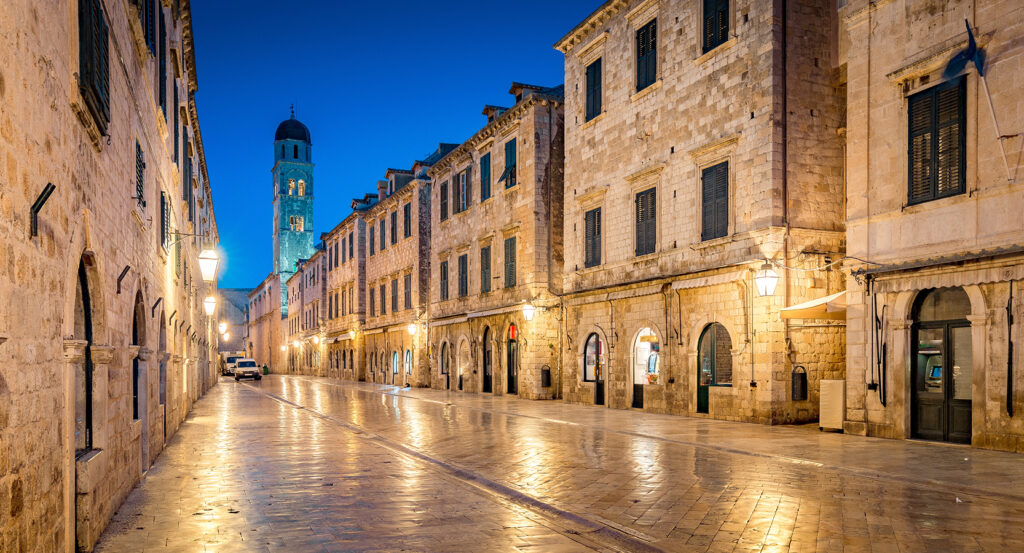
Step through Pile Gate, and the city's heartbeat greets you in the form of polished limestone underfoot, worn to a glassy sheen by centuries of footsteps. Light dances off the smooth stone as church bells ring from nearby towers and the scent of espresso mingles with sea air drifting in from the harbor. Baroque façades stand shoulder to shoulder along the boulevard, perfectly symmetrical and alive with balconies, shutters, and fluttering laundry lines. By day, Stradun hums with locals running errands, street musicians filling the air with violin or guitar, and travelers pausing in awe. By night, it transforms, bathed in the golden glow of lanterns, alive with laughter spilling from wine bars and open windows. Walking Stradun isn't just sightseeing; it's communion, a moment where architecture, history, and humanity all pulse together in rhythm.
What defines Stradun.
Stradun's elegant simplicity hides a history of resilience and reinvention.
The street was once a marshy channel separating Dubrovnik's island settlement from the mainland. In the 12th century, it was drained, paved, and unified into a single city, the defining act that gave birth to Dubrovnik's Old Town as we know it. The limestone paving stones you walk today date back to a 17th-century reconstruction, after the catastrophic earthquake of 1667 reduced much of the city to rubble. Local builders, guided by the Republic's architects, rebuilt Stradun with remarkable precision: every building was aligned to maintain perfect symmetry, their heights restricted to preserve light and air. The result was a civic masterpiece, rational, harmonious, and timeless. Stradun has witnessed royal processions, the bustle of traders from Venice and the Ottoman Empire, and even the shelling of the 1991 siege, during which its stones were scarred but never silenced. Each groove in its surface holds a story, polished smooth by the endurance of a city that refused to fall.
How Stradun fits.
Experiencing Stradun is about rhythm, not speed.
Begin at Pile Gate in the cool morning light, when the marble gleams silver and the cafés are just waking up. Walk its full 300 meters to Luža Square, where the clock tower and Sponza Palace mark the historical core of Dubrovnik's civic life. Stop for coffee at one of the shaded terraces along the way and watch the choreography of daily life, street performers, locals greeting one another with a nod, and visitors craning upward at the city's towering façades. Around midday, visit the Franciscan Monastery or the Rector's Palace just off the main thoroughfare before returning to Stradun for gelato or a glass of local wine. As sunset falls, the street transforms into something almost ethereal, its golden surface reflecting lantern light and laughter in equal measure. Stroll slowly, hand brushing against cool stone, and look back once before leaving. Stradun in Dubrovnik isn't just a street, it's the heartbeat of a city that has carried its light through darkness for nearly a millennium.
Where your story begins.
Foresyte Travel reveals places that feel extraordinary long before you arrive.
Enjoy editorial crafted for luxury travelers.
Foresyte may earn a commission when you book.