Why Sponza Palace matters.
Sponza Palace is one of Dubrovnik's greatest architectural treasures, a Renaissance masterpiece that has stood gracefully through centuries of history, diplomacy, and survival.
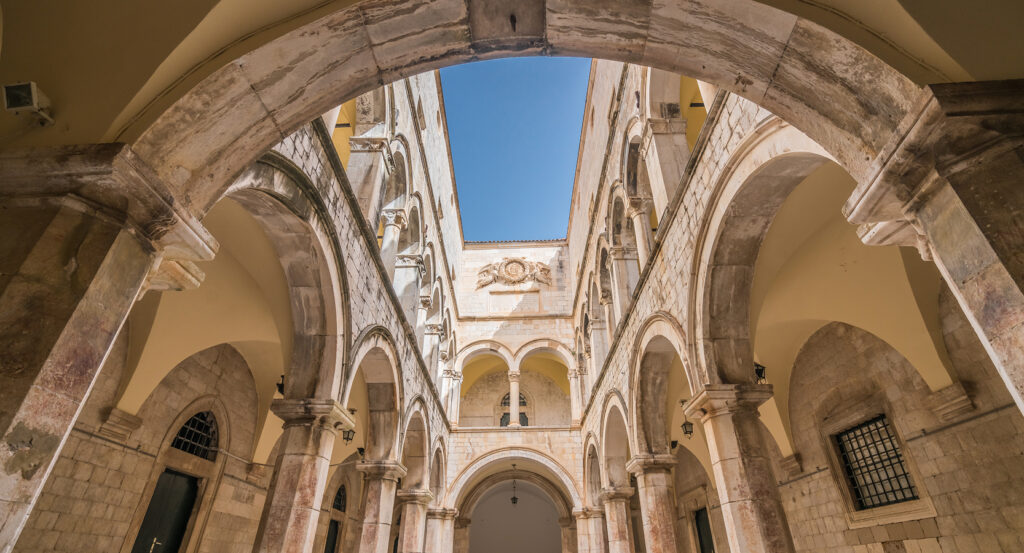
As you approach from Stradun, the palace seems to glow in the Adriatic light, its stone arcades a perfect blend of Gothic intricacy and Renaissance symmetry. Step inside, and the noise of the city fades into an atmosphere of timeless calm. The marble courtyard, framed by elegant columns and sculpted arches, was once the beating heart of the Republic's civic life, a crossroads where merchants, poets, and diplomats converged. The whisper of footsteps on polished stone echoes the centuries-old pulse of a city that thrived on openness and exchange. It's a space that feels simultaneously grand and intimate, the kind of beauty born not from excess, but from perfect proportion. At sunset, when golden light spills through the courtyard, you understand why Sponza has endured: it is the example of Dubrovnik's soul, refined, resilient, and deeply human.
What defines Sponza Palace.
Sponza Palace was built in the early 16th century as a customs house and trade center for the Republic of Ragusa, serving as a gateway between East and West.
Its name derives from the Latin “spongia,” meaning “to collect water,” a reference to the cisterns that once gathered rain in the courtyard, a symbol of sustenance in a city that depended on ingenuity to survive. The building's design, by Paskoje Miličević, is a triumph of Dubrovnik craftsmanship, blending Venetian Gothic windows with classical arches and a stone loggia that still stands in its original form. Miraculously, Sponza survived the devastating 1667 earthquake that leveled much of the Old Town, making it among the few Renaissance structures still intact. For centuries, it also housed the Republic's mint and treasury, later becoming the home of Dubrovnik's literary academy, where humanist scholars once gathered to recite poetry. Today, its upper halls hold the city's most solemn memorial, the exhibition dedicated to those who defended Dubrovnik during the Homeland War, a moving reminder that beauty and tragedy often share the same walls.
How Sponza Palace fits.
Visiting Sponza Palace is an immersion into the elegance and endurance that define Dubrovnik's history.
Begin your visit early in the day before the streets around Stradun fill with crowds; the soft morning light brings out the warm tones of the stone façade and illuminates its intricate carvings. Once inside, linger in the courtyard, it's open to the public and free to enter, and take time to admire the blend of Gothic tracery and Renaissance arches that inspired countless architects across the Adriatic. Step upstairs to explore the memorial rooms and let the quiet weight of history sink in. If you're visiting in the late afternoon, the golden hour transforms the palace into a photographer's dream, the marble glowing as if lit from within. Afterward, enjoy a coffee at one of the nearby cafés along Stradun, watching the rhythm of the city unfold as it has for centuries. Sponza Palace isn't just a building, it's Dubrovnik's living heartbeat, a rare place where the city's past and present still meet in perfect harmony.
Where your story begins.
Foresyte Travel reveals places that feel extraordinary long before you arrive.
Enjoy editorial crafted for luxury travelers.
Foresyte may earn a commission when you book.