
Why Omotesandō matters.
Omotesandō is a stately urban avenue where Jingumae's fashion character meets a ceremonial approach to Meiji Jingu, century-old zelkova planting and one of Tokyo's richest concentrations of contemporary architecture.
Set along the broad descent from Jingu-bashi near Meiji Jingu toward Aoyama-dori and just steps from Harajuku Station, the avenue cuts across Jingumae as a straight, tree-lined axis whose generous sidewalks preserve the scale established for shrine crowds more than a century ago. Mature zelkovas form a high canopy above traffic and pedestrians, giving the boulevard a strong seasonal structure as bare winter branches, spring foliage and dense summer leaves repeatedly change its proportions. Fashion flagships transform the walk into an architectural sequence, with glass, steel, concrete and sculptural facades appearing between the trees before smaller streets branch into Harajuku and Aoyama. The continuous slope keeps distant sections of the avenue visible and reinforces the original ceremonial direction toward Meiji Jingu even amid the surrounding concentration of retail and design. The result is a Tokyo street whose contemporary cultural power remains inseparable from the dimensions, gradient and planting established when it was created as the principal approach to a new national shrine.
What defines Omotesandō.
Omotesandō is best known for transforming a ceremonial approach created for Meiji Jingu into a major modern boulevard whose original dimensions still organize one of Tokyo's most architecturally ambitious commercial districts. Emperor Meiji died in 1912 and Empress Shoken in 1914, after which plans advanced to establish a shrine dedicated to them at Yoyogi. Meiji Jingu was completed on November 1, 1920, with 100,000 donated trees planted across its 70-hectare artificial forest and more than half a million people arriving for the enshrinement ceremonies that day. Omotesandō developed as the shrine's principal frontal approach within the Tokyo city-planning program of the Taisho period. Planning discussions produced unusually broad sidewalks to absorb large numbers of worshippers, and zelkovas were selected both for their suitability to a shrine approach and their association with the Kanto landscape. The completed road linked Jingu-bashi with the Aoyama side of the city and established the straight axis still defining the avenue. Its Japanese name preserves that original purpose directly: omote denotes the front and sando the approach to a shrine. Postwar occupation then changed the social geography surrounding the western end after Washington Heights placed hundreds of American military households on the former Yoyogi military grounds. Shops serving those residents appeared nearby, including the predecessor of Kiddy Land on Omotesandō in 1950, and the 1964 Tokyo Olympics accelerated the district's international commercial development after the Washington Heights land was returned. The avenue's later emergence as a global fashion address rests on an urban form created for a radically different purpose, with shrine access, street trees and broad pedestrian space supplying the physical structure inherited by contemporary Omotesandō.
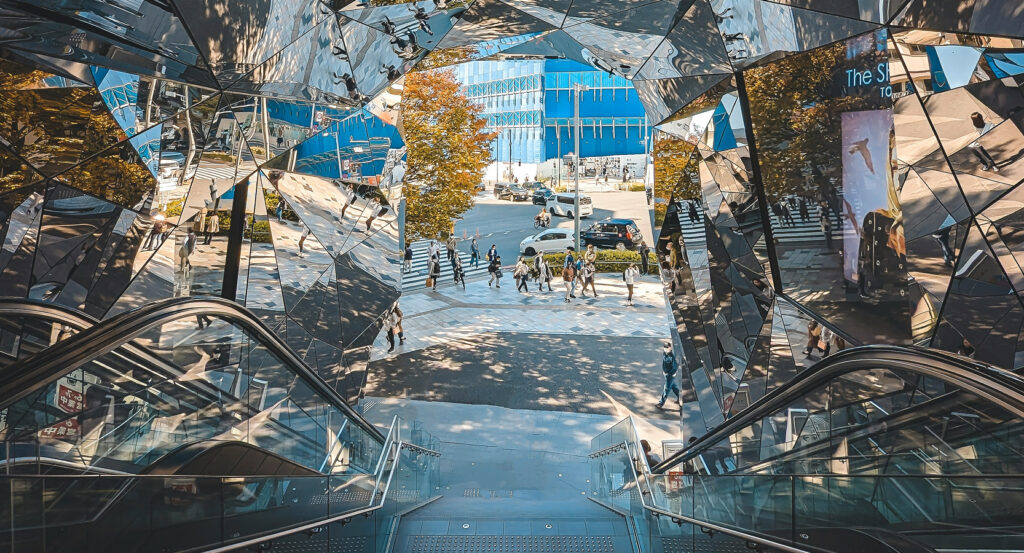
Architecture became a second mechanism of change as international fashion houses began commissioning buildings that treated the avenue itself as part of their design problem. Jun Aoki's Louis Vuitton Omotesando arrived in 2002 as an irregular stack of rectangular volumes, with its structural cage placed within narrow spaces between the units and exterior layers shifting among metal mesh, stainless steel and patterned glass. Herzog & de Meuron completed Prada Aoyama in 2003 on a nearby site, concentrating the permitted floor area vertically so part of the property remained open and wrapping the building in a structural rhomboid grid filled with convex, concave and flat glass panels. Tadao Ando subsequently addressed the avenue at a much longer scale through Omotesando Hills, keeping its principal mass close to the zelkova canopy and driving substantial floor area underground on the former Dojunkai Aoyama Apartments site. The sequence made architectural authorship a conspicuous component of fashion investment, giving individual companies buildings capable of operating simultaneously as shops, corporate symbols and works of urban design. Development continued without erasing the original boulevard as the common reference point, since facade height, reflections, setbacks and interior circulation repeatedly respond to the trees, sidewalks and slope outside. Omotesandō became a place where fashion architecture accumulated through independent commissions yet remained visually organized by the century-old avenue preceding them all.
How Omotesandō fits.
Omotesandō works as the anchor for a Jingumae and Minami-Aoyama route through three nearby institutions that connect private collecting, postwar modernism and the working studio of one of twentieth-century Japan's most consequential artists.
Begin at Nezu Museum, founded around the premodern Japanese and East Asian collection assembled by railway executive and tea practitioner Nezu Kaichirō. His son established the Nezu Museum Foundation in 1940 and opened the museum at the former family residence in 1941, but air raids destroyed its galleries, garden structures and tea house in 1945 after the collection itself had been evacuated. Exhibitions resumed in temporary quarters the following year, and the institution rebuilt repeatedly before Kengo Kuma designed the main building completed in 2009. The collection now contains 7,600 works, including seven National Treasures and 93 Important Cultural Properties, placing the bamboo-lined approach and expansive roof of Kuma's architecture around holdings extending across painting, calligraphy, sculpture, ceramics, lacquer, metalwork and tea utensils. Continue to Spiral, the 1985 cultural complex designed by Fumihiko Maki, whose architecture brought exhibition, performance, retail and commercial activity together within a building commissioned by Wacoal. Maki organized the composition through elementary geometric forms including squares, circles, equilateral triangles and cones, assembling them through a collage-like exterior and an interior sequence centered on the building's curving circulation. Its opening placed a major work by one of Japan's leading postwar architects directly on Aoyama-dori during the decade when the surrounding district was consolidating its association with design, fashion and contemporary culture. Spiral subsequently sustained that architectural premise through exhibitions, performances and creative programs, giving the avenue's wider design district an institution built around cultural production as well as commerce. Conclude at Taro Okamoto Memorial Museum, the surviving Aoyama home and studio where Taro Okamoto worked from 1954 until his death in 1996. Okamoto returned from wartime service to find his family home and earlier works destroyed by bombing, then commissioned his Paris-era friend Junzo Sakakura, a former Le Corbusier associate, to design a new studio on the Aoyama site; Yutaka Murata handled construction, and the building was completed in May 1954. Okamoto established his Institute for Research in Contemporary Art there and expanded into murals, sculpture, ceramics, product design, graphics and photography, with later projects including Tower of the Sun originating from this working base. Toshiko Okamoto drove the conversion of the property into a museum after his death, and it opened to the public on May 7, 1998 with Sakakura's original building preserved. The progression moves from Nezu Museum's transformation of a private collection into a major art institution through Spiral's fusion of postwar architecture and cultural production into Taro Okamoto Memorial Museum's preservation of the studio where one artist crossed repeatedly among media, revealing the extraordinary concentration of collecting, architecture and creative practice surrounding Omotesandō.
Where your story begins.
Foresyte Travel reveals places that feel extraordinary long before you arrive.
Enjoy editorial crafted for luxury travelers.
Foresyte may earn a commission when you book.

















































































































