Why you should experience The Lagoon at Palace of Fine Arts in San Francisco, California.
The Lagoon at Palace of Fine Arts is an evocative Marina District waterscape where neighborhood elegance, exposition era artistry, ecological memory, and cinematic reflection converge around one of San Francisco's most graceful public settings.
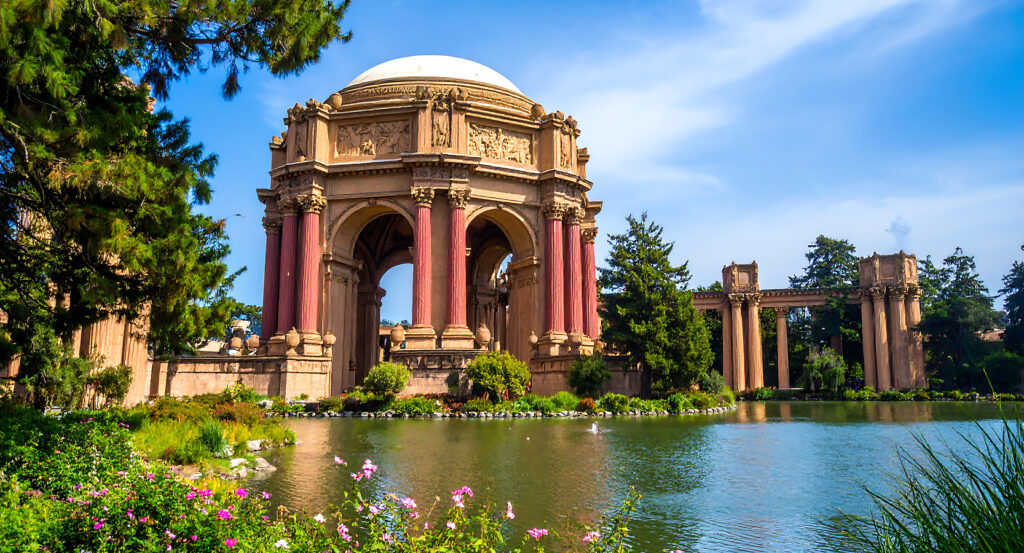
Set along Baker Street near Bay Street and just steps from Palace of Fine Arts Theatre, this tranquil lagoon frames Bernard Maybeck's grand rotunda, curving colonnades, weeping maidens, and mirror like water views within a composition designed to make architecture feel suspended between ruin, memory, and natural beauty. Waterfowl, eucalyptus, walking paths, and shifting reflections soften the scale of the surrounding structure while preserving the dreamlike atmosphere that made the Palace of Fine Arts the resonant centerpiece of the 1915 Panama Pacific International Exposition. The result is a historic lagoon defined by theatrical landscape design, ecological continuity, and one of San Francisco's most enduring images of beauty after disaster.
What you should know about The Lagoon at Palace of Fine Arts.
The Lagoon at Palace of Fine Arts is best known for being the reflective water setting created for Bernard Maybeck's Palace of Fine Arts at the 1915 Panama Pacific International Exposition, where a small artificial lagoon transformed a temporary exhibition palace into a contemplative landscape inspired by ancient Roman ruins, Greek architecture, Giovanni Battista Piranesi's engravings, and Arnold Böcklin's Symbolist painting Isle of the Dead. Built within a 636 acre world's fair celebrating the Panama Canal and San Francisco's recovery from the 1906 earthquake and fire, the lagoon was central to Maybeck's resonant design, providing a mirror surface for the 162 foot rotunda, 1,100 foot pergola, curved colonnades, and sculptural figures while creating a quiet zone for visitors moving between the crowded fairgrounds and the art galleries behind the rotunda. The water itself preserves an older environmental story because the lagoon occupies part of a former tidal wetland and slough once flushed by salt water from San Francisco Bay and fresh water from El Polin Spring and Tennessee Hollow Creek before exposition construction reshaped the marsh into a freshwater lake about the size of a city block. After the fair, the Palace of Fine Arts was the only major exposition structure to remain on site, later deteriorating until a complete reconstruction from 1964 to 1974 rebuilt the rotunda and colonnades in permanent materials, followed by San Francisco Landmark designation in 1977, National Register listing in 2005, and a major 2009 renovation that restored the lagoon, walkways, and seismic systems. The lagoon also became inseparable from the swans that Maybeck wanted as symbols of peace and tranquility, a tradition that lasted for more than a century through beloved birds including Blanche, whose life at the Palace made the water a resonant part of local memory as well as a formal architectural setting.
The power of the lagoon comes from the way it holds every layer of the site at once, from tidal marsh and exposition fantasy to civic rescue, reconstruction, wildlife habitat, wedding photographs, film scenes, and daily walks beneath the Marina sky. Reflections across the water preserve Maybeck's original intention that visitors experience the Palace from a distance before entering its colonnaded world, allowing the rotunda to appear less like a building than a vision rising from memory. Birds, reeds, paths, and changing light keep the setting alive, while the reconstructed architecture reminds visitors that San Francisco chose to preserve not simply a fairground relic, but an entire resonant landscape built around water, reflection, grief, recovery, and beauty.
How to fold The Lagoon at Palace of Fine Arts into your trip.
The Lagoon at Palace of Fine Arts works as the opening movement of a Marina District walk shaped by architecture, water, and San Francisco's northern shoreline.
Begin at Palace of Fine Arts Rotunda, where Maybeck's towering dome, colonnades, and sculptural details gain their full force when seen across the lagoon's reflective surface. Continue to Palace of Fine Arts Theatre, where the surviving exhibition complex shows how the exposition site evolved from temporary fair architecture into a permanent cultural venue embedded within the neighborhood. Conclude at Marina Green, where open lawns, bay winds, Alcatraz views, and the Golden Gate Bridge extend the experience from enclosed theatrical water garden to the full sweep of San Francisco Bay. The progression moves from reflection to architecture to open waterfront, revealing how The Lagoon at Palace of Fine Arts turns the Marina into a landscape of memory before the city opens outward toward the bay.
Where your story begins.
Foresyte Travel reveals places that feel extraordinary long before you arrive.
Experience premium editorial crafted for luxury travelers.