Why Parco Sempione matters.
Parco Sempione is a sweeping romantic park where Castello's historic character meets an English-style landscape of winding paths, water, wooded rises and long architectural sightlines between Castello Sforzesco and Arco della Pace.
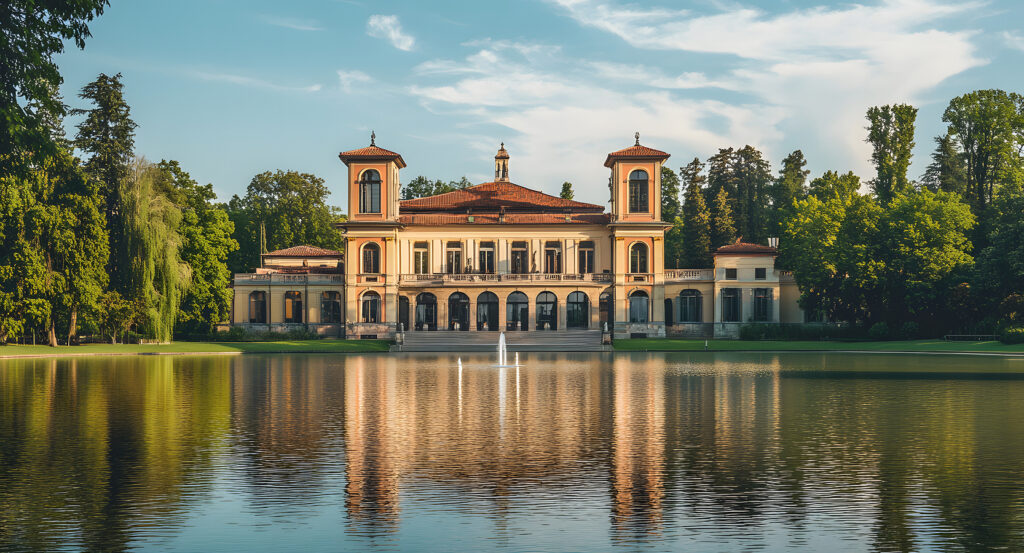
Set beyond Piazza Castello near Viale Emilio Alemagna and just steps from Foro Buonaparte, the park occupies a broad green expanse where the castle's fortified mass gives way to lawns, mature woodland, a lake and curving paths before the city closes around it again at the Arena and Arco della Pace. Artificial rises interrupt the level Milanese terrain, opening changing views across tree groups and water as the routes turn away from the surrounding street grid. The central lake, Ponte delle Sirenette and irregular paths create a landscape deliberately distinct from the formal geometry of Foro Buonaparte and the dense residential blocks beyond the perimeter. Castello Sforzesco anchors the southern edge as the Arco della Pace closes the principal northern sightline, placing the greenery between two of western Central Milan's strongest architectural masses. The result is a substantial urban landscape where woodland, water and controlled vistas turn former military ground into the green counterpart to the castle.
What defines Parco Sempione.
Parco Sempione is best known for transforming the former Piazza d'Armi behind Castello Sforzesco into the romantic public landscape designed by Emilio Alemagna between 1890 and 1893. The ground carried a much older association with the castle: Gian Galeazzo Visconti established a ducal barcho north of the fortress near the end of the fourteenth century, combining gardens with cultivated land. Carlo da Cremona enlarged the estate for Francesco Sforza from 1457, and deer, roe deer, hares, pheasants and partridges brought from the Varese, Seprio and Lake Como territories populated its hunting grounds. Wheat, millet, rye and oats grew in adjoining fields, and the estate also contained a fishpond and orchard. Leonardo da Vinci later organized ceremonies and festivities within the barcho during Ludovico il Moro's court, connecting the landscape with the ceremonial culture of Sforza Milan. Spanish fortification and centuries of military use subsequently erased that ducal world, with the surviving territory behind the castle becoming a parade ground for foreign garrisons. Cesare Beruto's 1889 regulatory plan reserved the ground for a public park as Milan simultaneously moved to preserve Castello Sforzesco. Alemagna rejected the regular geometry of the surrounding city and designed an English-style composition of artificial rises, tree groups, waterways and carriage avenues between 1890 and 1893. Two major sightlines organized the landscape, one joining the castle with Arco della Pace and another connecting the Arena with the Via XX Settembre direction. Parco Sempione emerged through a deliberate conversion of territory that had moved from ducal hunting estate to fortified military ground before becoming Milan's second major public park.
The Esposizione Internazionale del Sempione of 1906 temporarily converted the park into the center of an international exhibition devoted in large part to the opening of the Simplon Tunnel. Pavilions filled Parco Sempione and the adjoining Piazza d'Armi, linked by an elevated electric railway that transported crowds between the two exhibition territories. Sebastiano Giuseppe Locati designed the Acquario Civico for the event and gave its Liberty exterior aquatic ornament suited to the institution inside. The building opened on April 28, 1906 and survived the dismantling that removed the exposition's temporary architecture, later gaining a biological and applied hydrobiology station in 1908. Bombing in August 1943 caused severe damage before reopening followed in 1963 and another comprehensive renewal concluded in 2006. Later design culture added further architectural episodes across the park: Giovanni Muzio's Palazzo dell'Arte opened for the V Triennale in 1933, and Gio Ponti's steel Torre Littoria rose 108.60 meters for the same exhibition. Silvio Longhi, Ico Parisi and engineer Luigi Antonietti created another pavilion for the X Triennale in 1954, subsequently converted into the park library. These surviving structures turned Alemagna's nineteenth-century landscape into a setting where Milan's international exhibitions repeatedly deposited permanent architecture across the following century.
How Parco Sempione fits.
Parco Sempione works as the anchor for a daytime exploration around its perimeter using three sites that move from Napoleonic performance through nineteenth-century national commemoration into the institutional architecture of Italian design.
Begin at Arena Civica Gianni Brera, conceived by Luigi Canonica in 1805 as a vast venue for public festivities under Napoleonic rule. Construction began in 1806 using stone recovered from demolished Castello Sforzesco fortifications, and the amphitheater opened on August 18, 1807 before work reached completion in 1827. Its elliptical interior accommodated as many as 30,000 spectators and supported an extraordinary range of events, including equestrian displays, fireworks, balloon ascents and naumachie staged after flooding the arena with Naviglio water. William Frederick Cody brought his Wild West show there in 1894 and again during Milan's 1906 international exhibition, extending a Napoleonic ceremonial venue into the mass entertainment culture of the industrial city. The Comune acquired the Arena in 1870, sporting use expanded around the turn of the twentieth century and the complex received Gianni Brera's name in 2002. Continue to Arco della Pace, whose history began under Napoleon with Luigi Cagnola's project for an expansive entrance on the Sempione axis. Political reversal after the fall of the Napoleonic regime changed the meaning of the unfinished structure, and work resumed under Austrian authority with its commemorative program redirected toward the European peace settlement. Cagnola died before completion, leaving Francesco Londonio and Francesco Peverelli to continue the undertaking. Marble architecture, Corinthian columns, reliefs and bronze sculpture transformed the northern approach into an expansive terminus whose political meaning had changed during construction from Napoleonic triumph to Restoration peace. Conclude at Palazzo dell'Arte, built from 1931 to 1933 by Giovanni Muzio as the permanent Milanese home of the international decorative-arts exhibitions previously held at Villa Reale in Monza. Muzio used hard clinker on the long exterior mass and terminated the building with a semicircular apse, combining exhibition halls with porticoed entrances facing Viale Alemagna and the park. The V Triennale inaugurated the building in May 1933, and Giuseppe Pagano expanded it for the following exhibition in 1936, fixing Parco Sempione within the institutional development of Italian architecture and design. The progression moves from Canonica's Napoleonic amphitheater through Cagnola's politically redefined ceremonial arch into Muzio's permanent palace for the Triennale, connecting three architectural institutions that successively transformed the territory around Parco Sempione from imperial performance into national commemoration and modern design culture.
Where your story begins.
Foresyte Travel reveals places that feel extraordinary long before you arrive.
Enjoy editorial crafted for luxury travelers.
Foresyte may earn a commission when you book.