
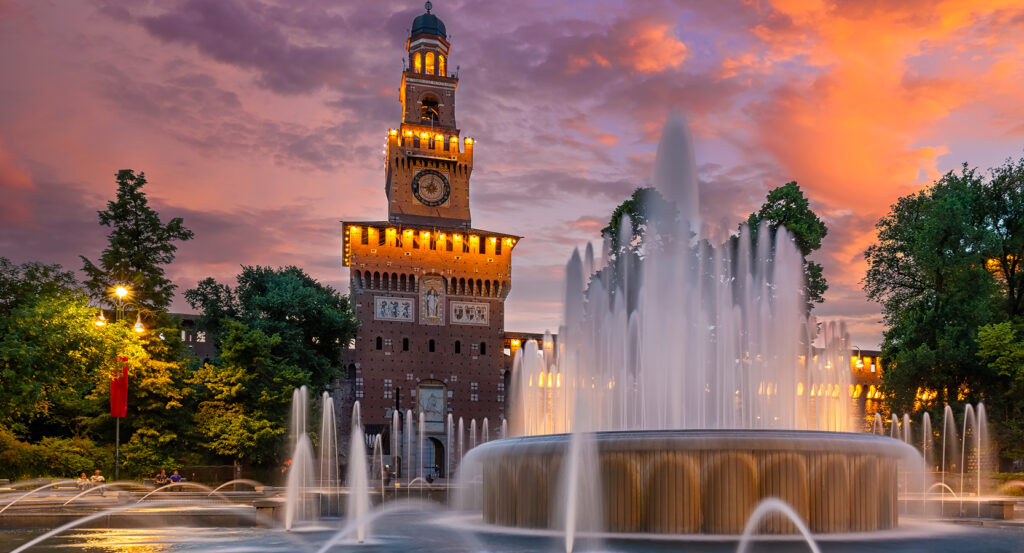
Why Castello Sforzesco matters.
Castello Sforzesco is a formidable historic fortress where Castello's grand character meets Visconti military power, Sforza court culture and the immense brick architecture that marks the western edge of Milan's historic center.
Set along Piazza Castello near Foro Buonaparte and just steps from Via Luca Beltrami, the fortress occupies a vast transitional zone where the semicircular nineteenth-century city front opens into crenellated walls, broad courtyards, defensive towers and the greenery of Parco Sempione extending behind the complex. The Torre del Filarete rises above the principal entrance between long brick curtains and the cylindrical Torrione dei Carmini and Torrione di Santo Spirito, creating a grand facade across the open approach from Via Dante. Successive courts draw the complex inward from the expansive Piazza d'Armi to the more enclosed Corte Ducale and Rocchetta, shifting the physical character from military scale toward the protected spaces of the former ducal residence. Parco Sempione begins immediately beyond the northern defenses, placing the castle between the compact masonry of Central Milan and one of the center's largest green expanses. The result is an immense architectural threshold whose towers, courtyards and defensive walls make the passage between historic Milan and Parco Sempione inseparable from the city's centuries of ducal rule.
What defines Castello Sforzesco.
Castello Sforzesco is best known for evolving from Galeazzo II Visconti's fourteenth-century fortress into the principal architectural stage of Sforza power and one of Renaissance Milan's richest court environments. Galeazzo II built the original rocca between 1360 and 1370 astride the medieval defenses at Porta Giovia, and Gian Galeazzo Visconti added quarters for salaried troops in 1392 before Filippo Maria Visconti connected the previously divided sections of the complex. The death of Filippo Maria in 1447 ended the Visconti dynasty, and the ensuing Ambrosian Republic partially demolished a fortress strongly associated with ducal authority. Francesco Sforza entered Milan with Bianca Maria Visconti on March 25, 1450 and immediately began rebuilding the castle, presenting the undertaking as both urban improvement and protection against external attack. Antonio Averulino, known as Filarete, joined Giovanni da Milano, Jacopo da Cortona and Marcoleone da Nogarolo in 1452 and designed the city-facing facade with its high central entrance tower before military architect Bartolomeo Gadio assumed direction. Galeazzo Maria Sforza subsequently developed the complex as a princely residence, and after his assassination in December 1476, Bona di Savoia commissioned the internal tower that still bears her name while serving as regent for Gian Galeazzo Maria Sforza. Ludovico il Moro later displaced Bona and drew Donato Bramante and Leonardo da Vinci into a court whose architectural and artistic commissions transformed the fortress into a Renaissance residence. Leonardo created the Sala delle Asse in 1498 as an enveloping painted arbor of intertwined mulberry branches, trunks and roots, linking one of his most ambitious Milanese decorative projects directly with Ludovico's court. Bartolomeo Suardi, known as Bramantino, received the 1490 commission for the Sala del Tesoro, extending the concentration of major artists working inside the Sforza residence. French pressure and the death of Beatrice d'Este in 1497 brought that intense courtly phase toward its close, leaving the castle as the largest surviving architectural concentration associated with the Visconti and Sforza dynasties.
Foreign occupation subsequently converted the former ducal residence into a military stronghold whose changing defenses and later recovery reshaped the building for another four centuries. Spanish authorities used the castle as a barracks after 1535 and surrounded it with an extensive fortified system, followed by Austrian control from 1706, French occupation from 1796 and renewed Austrian rule after 1814. The political settlement of unified Italy finally opened a different future for the complex, and Luca Beltrami began a sweeping recovery in August 1892 with demolition of the Ghirlanda and later Cavallerizza, reopening of the Carmine and Santo Spirito gates and restoration of the Torre di Bona, Rocchetta and Corte Ducale. His reconstruction of the vanished central entrance tower relied on visual sources that included the Madonna Lia and a graffito found at Cascina Pozzobonelli, culminating in the rebuilt Torre del Filarete in 1905. Recovery work also exposed Sforza-period terracotta windows, painted decoration in the Sala del Tesoro and Sala delle Asse and gilded elements in the Cappella Ducale. Civic art holdings then entered the recovered rooms, with the unified Museo Archeologico e Artistico opening in the Corte Ducale on May 10, 1900. Postwar reconstruction brought another decisive phase when BBPR reorganized the museum interiors, leading to the 1956 reopening of the Museo d'Arte Antica and a new approach to displaying medieval and Renaissance sculpture within the castle fabric. Michelangelo's Pietà Rondanini received a dedicated installation in the former Ospedale Spagnolo in 2015, adding the artist's final sculptural undertaking to a complex whose conversion from barracks into civic museums began more than a century earlier.
How Castello Sforzesco fits.
Castello Sforzesco works as the anchor for a daytime exploration through western Central Milan using three nearby sites that move from a Baroque senatorial residence through an ancient Benedictine precinct into a major civic monument created during the Napoleonic period.
Begin at Palazzo Litta, commissioned by Bartolomeo III Arese and built between 1642 and 1648 to a design by Francesco Maria Richini. Arese rose to become President of the Senate in 1660, and his residence developed into a center of Milanese political and social life around Richini's square courtyard with paired columns. Passage through the Visconti Borromeo and Litta families produced another architectural phase during the eighteenth century: Carlo Giuseppe Merlo created the theatrical scissor staircase, Giovanni Antonio Cucchi contributed Rococo interior painting and Bartolomeo Bolli completed the Corso Magenta facade in 1761 with giant pilasters, telamons supporting the balcony and the Litta arms above. Mozart, Giuseppe Parini and Carlo Goldoni belonged to the cultural world later associated with the palace. Continue to San Maurizio al Monastero Maggiore, attached to Milan's oldest and largest Benedictine female monastery, whose foundation reaches the eighth or ninth century. Expansion of the city walls under Bishop Ansperto during the ninth century brought the monastery inside Milan's defensive perimeter, and the later church adopted a double arrangement separating the public nave from the enclosed nuns' hall through a dividing wall. Sixteenth-century painting spread across both sections through artists associated with the Lombard Renaissance, turning the enclosed religious institution into one of the city's densest surviving painted interiors. The former monastery now incorporates the Civico Museo Archeologico, placing its medieval fabric beside substantial remains from Roman Mediolanum. Conclude at Arco della Pace, conceived within the remaking of the territory beyond the castle after the old military defenses lost their role. Luigi Cagnola developed the triumphal arch during the Napoleonic era as the ceremonial culmination of the route across the former parade ground, and political change redirected its commemorative program after the fall of Napoleon. Completed under Austrian rule, the arch eventually acquired a new association with peace and the European settlement following the Napoleonic wars, fixing successive political regimes into the same Neoclassical structure. Its position beyond Parco Sempione closes the long urban axis passing through the castle grounds toward Piazza Castello. The progression moves from Richini and Arese's seventeenth-century aristocratic residence through an ancient Benedictine institution transformed by Renaissance art into Cagnola's ceremonial architecture, extending Castello Sforzesco through three distinct concentrations of political, religious and civic patronage.
Where your story begins.
Foresyte Travel reveals places that feel extraordinary long before you arrive.
Enjoy editorial crafted for luxury travelers.
Foresyte may earn a commission when you book.




















































































































