
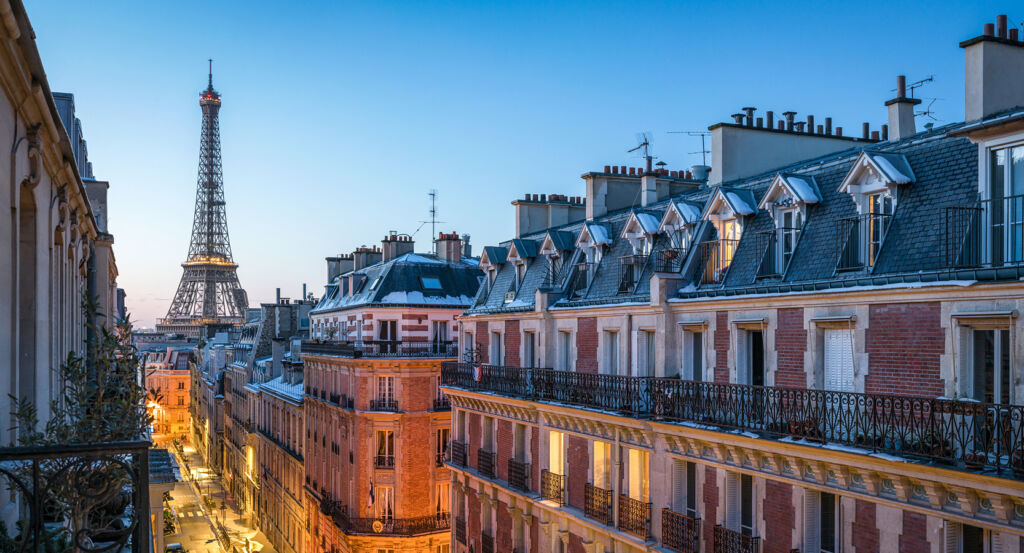
Why you should experience Pavillon Monceau in Paris, France.
Pavillon Monceau is a discreet boutique hotel where Plaine Monceau's cultivated refinement, nineteenth-century artistic inheritance, Haussmannian elegance and intimate neighborhood rituals preserve the quieter sophistication of western Paris.
Set along Rue Jouffroy d'Abbans near Rue de Tocqueville and just steps from Musée National Jean-Jacques Henner, the hotel inhabits a Haussmannian-style building whose pale stone façade, wrought-iron balconies and traditional proportions settle naturally into the mansion-lined streets of the 17th Arrondissement. Inside, 36 rooms and six junior suites are divided among seven categories across six floors, with selected accommodations opening onto balconies above the surrounding Parisian roofscape and contemporary interiors maintaining the property's compact residential scale. A Piano Bar creates the hotel's defining social room, while breakfast built around croissants, pains au chocolat, baguettes, country bread, cheeses and charcuterie reinforces an intentionally Parisian rhythm from morning into evening. The result is a hotel where small-scale hospitality, balcony-lined architecture and the cultivated character of Plaine Monceau converge within an address that feels intrinsically connected to its neighborhood.
What you should know about Pavillon Monceau.
Pavillon Monceau is best known for combining the scale of an independent Paris hotel with a new institutional chapter under Honotel, which acquired both the property and hotel operation in April 2026 as the group expanded its portfolio in the French capital. Honotel completed the acquisition through Cap Hospitality IV and Cap Hospitality V, investment vehicles managed by Hôtel Investissement Capital, while Suzanne Todd, director of Hôtel Investissement Capital, characterized Pavillon Monceau as a freestone Paris asset within a market that accounted for nearly half of French hotel transactions during the preceding year. The hotel itself contains 42 accommodations, specifically 36 rooms and six junior suites arranged across seven categories and six floors, with the 10-square-meter Single Balcony category introducing the property's compact end of the spectrum and larger categories extending through balcony rooms and junior suites. HappyCulture presents the building through its Haussmannian architectural identity, contemporary guestrooms and rooftop-facing balconies, while Paris je t'aime identifies the property through its elegant façade and longstanding jazz-bar character, connecting the hotel to a hospitality format built around intimate public rooms. Pavillon Monceau represents a comparatively small Paris hotel whose 2026 acquisition, 42-key inventory, Haussmannian setting, HappyCulture affiliation and Honotel investment platform place a neighborhood-scale property inside a substantially broader contemporary hospitality network.
HappyCulture gives Pavillon Monceau's hospitality program its strongest internal narrative through the Piano Bar, an evening room operating from 5 p.m. until midnight where the piano is explicitly available for patrons to play, turning a conventional hotel lounge into a participatory musical space. Pavillon Monceau extends that Parisian theme into breakfast from 7 to 10 a.m., with pastries made in Paris, croissants, pains au chocolat, crisp baguettes, country bread, cheeses and charcuterie forming a specifically French morning program served within the hotel's breakfast room. Paris je t'aime reinforces the musical lineage by identifying Pavillon Monceau's bar as a jazz bar, giving the current Piano Bar a documented cultural character beyond its function as a place for drinks and conversation. Together, HappyCulture, Pavillon Monceau and Paris je t'aime establish a coherent hospitality character around live musical possibility, Paris-made baking and intimate shared spaces, details that distinguish the property's operating character within its 42-room scale.
How to fold Pavillon Monceau into your trip.
Pavillon Monceau works as the anchor for a cultured afternoon tracing the artists, collectors and landscape traditions that shaped Monceau's reputation as one of Paris's great nineteenth-century enclaves.
Begin at Musée National Jean-Jacques Henner, where Marie Henner transformed the former Maison Dubufe into a museum devoted to Jean-Jacques Henner, donating the building and collection to the French state in 1923 before the institution opened in March 1924 and eventually assembled more than 2,200 works. Continue to Musée Cernuschi, where banker Henri Cernuschi installed 5,000 works acquired during his 1871 to 1873 journey through Asia inside a neoclassical mansion designed by William Bouwens van der Boijen, later leaving the house and collection to the City of Paris before the museum opened in 1898. Conclude at Parc Monceau, whose story reaches from the duc de Chartres's 1769 acquisition through Carmontelle's fantastical Anglo-Chinese garden beginning in 1773 and Adolphe Alphand's 1861 Second Empire transformation into the landscaped public garden that anchors the district today. The progression moves naturally from an artist's memorial through a financier's extraordinary collecting legacy into the historic garden that helped shape Monceau itself, placing Pavillon Monceau within a district where private patronage, art and landscape design have intersected for generations.
Where your story begins.
Foresyte Travel reveals places that feel extraordinary long before you arrive.
Experience premium editorial crafted for luxury travelers.














































































































