
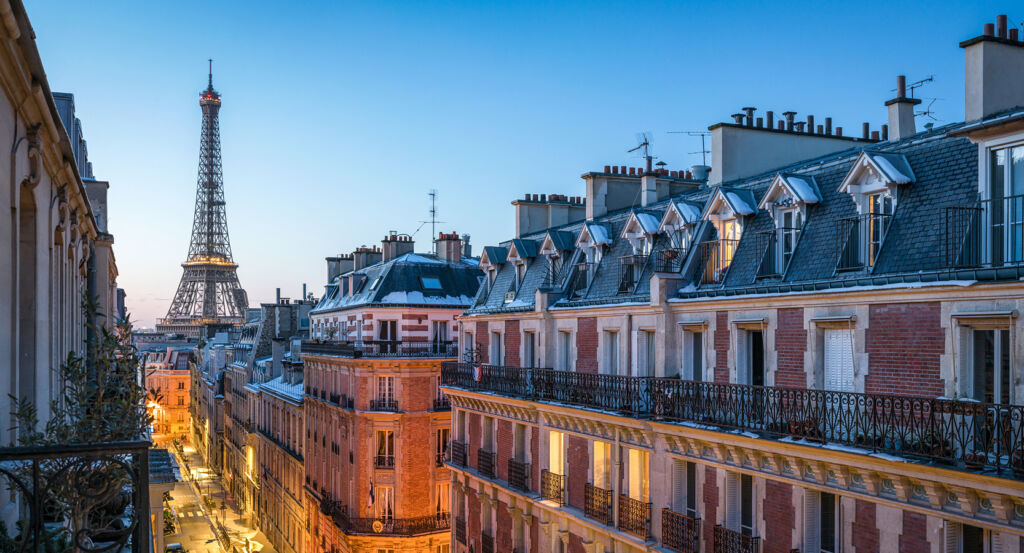
Why 17th Arrondissement matters.
17th Arrondissement is a many-sided enclave where northwestern Paris meets former villages, bourgeois avenues and industrial ground through districts whose contrasting architecture preserves the uneven expansion of the capital beyond its nineteenth-century limits.
Positioned between the 18th Arrondissement, 8th Arrondissement, and Neuilly-sur-Seine, the neighborhood occupies a broad northwestern sector stretching from the Arc de Triomphe and Ternes through Plaine Monceau, Batignolles and Épinettes to the communes of Clichy and Saint-Ouen. Grand avenues and stone apartment blocks define its western and southern reaches, then give way toward Batignolles to narrower commercial streets, former village alignments and residential passages whose smaller scale predates their absorption into Paris. Avenue de Villiers and Boulevard Malesherbes establish the primary encounter through long perspectives bordered by substantial late nineteenth-century residences, carrying the architectural ambitions of Plaine Monceau toward the former outer edge of the city. Batignolles introduces a distinct spatial mechanism through Rue des Batignolles, Rue des Dames and surrounding streets, where compact blocks preserve the proportions of a settlement that developed independently before annexation. Farther northeast, Épinettes tightens again around former industrial territory and the converging avenues of Clichy and Saint-Ouen, giving the Arrondissement a final shift in scale before Paris reaches its boundary. The result is a district whose unusual breadth makes the physical expansion of nineteenth-century Paris visible from west to east, preparing a history built from villages, speculative development, annexation and the infrastructure that bound them into the capital.
What you should know 17th Arrondissement.
17th Arrondissement is best known for uniting territories with sharply different origins when Paris expanded to its present municipal limits in 1860. Batignolles had belonged to Clichy before speculative development accelerated under the First Empire, when the entrepreneurs Navarre and Rivoire built small country houses with gardens across land still lying beyond the capital. Batignolles and neighboring Monceau counted 3,500 inhabitants by 1830, the year their growing settlements separated from Clichy to form the commune of Batignolles-Monceau. Railway construction introduced another decisive force after the first Saint-Lazare line opened in 1837, cutting through territory north of Central Paris and eventually placing extensive railway and freight infrastructure beside the expanding commune. The western side followed another trajectory around Ternes, which remained connected to Neuilly before the enlargement of Paris redistributed territory on both sides of the former city boundary. Annexation in 1860 absorbed Batignolles-Monceau and incorporated the Ternes sector into the new 17th Arrondissement, joining communities whose previous development had occurred under separate jurisdictions. Plaine Monceau subsequently became one of the Arrondissement's principal zones of high-status residential construction, with new streets and private houses extending across former open ground. Épinettes developed more densely after subdivision in the same era, and its proximity to railway and industrial employment gave the northeastern quarter a different social and architectural profile. The Arrondissement emerged from incorporation followed by intense construction, carrying traces of several settlements into a single Parisian district.
Art and engineering supplied a separate mechanism for giving the new Arrondissement an international role during the decades after annexation. Frédéric Auguste Bartholdi's Liberty Enlightening the World entered a crucial construction phase at the workshops of Gaget, Gauthier et Compagnie on Rue de Chazelles, where its copper skin was assembled over an iron structure engineered by Gustave Eiffel after Bartholdi's earlier consultation with Eugène Viollet-le-Duc. The statue's head appeared publicly during the Exposition Universelle of 1878 as work continued on the full figure inside the 17th Arrondissement. Its immense scale turned the construction site itself into a performance, with Parisians able to see the American monument rising above surrounding buildings before shipment. Standing 46 meters high and weighing 200 tons, the completed statue was formally presented to United States minister Levi P. Morton on July 4, 1884. Workers then dismantled the structure for transport across the Atlantic, where its components were reassembled in New York Harbor before the 1886 dedication. Rue de Chazelles linked the rapidly developing Plaine Monceau with one of the defining Franco-American engineering collaborations of the nineteenth century, embedding an internationally recognized work inside the industrial capabilities of the new Arrondissement.
How 17th Arrondissement fits.
17th Arrondissement works as the anchor for a daytime exploration connecting a Second Empire landscape project, a neo-Renaissance mansion converted into a banking institution and a twentieth-century church combining architecture, sculpture, ironwork and experimental stained glass.
Begin at Square des Batignolles, created after the 1860 annexation as Napoleon III and Baron Haussmann extended landscaped public space into the enlarged capital and commissioned engineer Adolphe Alphand to develop a network ranging from major parks to neighborhood squares. Alphand worked with engineer Jean Darcel, architect Gabriel Davioud and horticulturist Jean-Pierre Barillet-Deschamps on the Batignolles garden, shaping more than 16,000 square meters through winding paths, water and varied planting in the English landscape tradition; the project converted part of a former suburban settlement into one of the 24 Parisian gardens associated with Alphand's Second Empire program. Continue to Cité de l'Économie inside Hôtel Gaillard, commissioned by banker and collector Émile Gaillard after he acquired land in the developing Plaine Monceau in 1878. Architect Jules Février drew on the Renaissance architecture of Blois for the mansion completed in the 1880s, creating an elaborate setting for Gaillard's medieval and Renaissance collection; the Banque de France acquired the property in 1919, then Alphonse Defrasse and decorator Jean-Henri Jansen converted it into a branch opened in 1923, inserting a public banking hall above a two-level vault protected by a water-filled moat and movable floor. Conclude at Église Sainte-Odile, initiated in 1935 through the efforts of Eugène Loutil and Cardinal Verdier on land released after removal of the former fortifications. Thirty-one-year-old architect Jacques Barge developed a single nave beneath a sequence of domes and raised a 72-meter bell tower, drawing architectural inspiration from Romanesque churches of western France; François Décorchemont introduced his molded glass technique into major windows, joined by stained-glass artist Auguste Labouret, sculptor Anne-Marie Roux-Colas, ironworker Raymond Subes and decorator Robert Barriot in a coordinated decorative program completed across the church's extended construction period. The progression moves from Alphand translating imperial urban expansion into landscape design through Février and Defrasse carrying a collector's residence into twentieth-century banking architecture into Barge and his artistic collaborators building on ground released by the former fortifications, tracing three generations of architecture produced as the 17th Arrondissement moved from annexed outskirts into established Paris.
Where your story begins.
Foresyte Travel reveals places that feel extraordinary long before you arrive.
Enjoy editorial crafted for luxury travelers.
Foresyte may earn a commission when you book.














































































































