
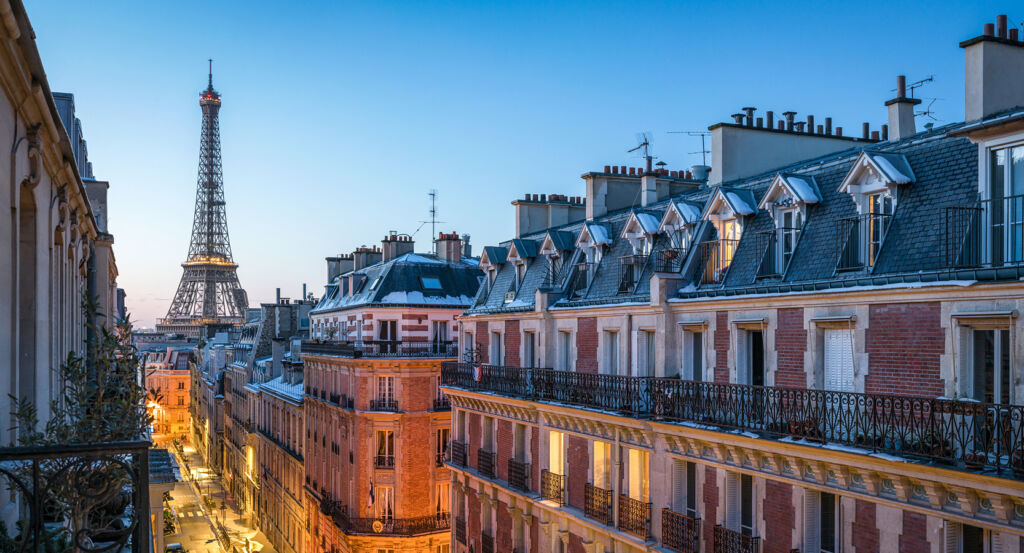
Why you should experience Petit-Montrouge in Paris, France.
Petit-Montrouge is a characterful southern Paris neighborhood where Haussmannian expansion, artistic heritage, scientific innovation, and residential authenticity converge across one of the capital's most enduring Left Bank communities.
Positioned between Plaisance, Parc-de-Montsouris, and Montparnasse, this historically rich neighborhood unfolds through broad nineteenth-century avenues, elegant apartment buildings, neighborhood cafés, leafy squares, lively markets, and quiet residential streets that preserve the atmosphere of the former suburban village absorbed into Paris during the Second Empire. Carefully proportioned Haussmann architecture stands alongside independent shops, historic churches, and long-established institutions whose continuity reinforces a distinctive neighborhood character shaped by generations of Parisians. The result is a neighborhood defined by architectural cohesion, everyday Parisian life, and one of the capital's finest examples of nineteenth-century urban expansion.
What you should know about Petit-Montrouge.
Petit-Montrouge is best known for its transformation following the 1860 annexation of the Commune of Montrouge into Paris under Napoleon III, when Baron Georges-Eugène Haussmann incorporated the former village into the newly created 14th Arrondissement and directed one of the capital's most comprehensive programs of urban redevelopment through new boulevards, coordinated residential construction, public institutions, schools, churches, markets, and modern infrastructure that permanently reshaped the southern edge of Paris. The neighborhood evolved from a semi-rural settlement beyond the former Wall of the Farmers-General into a fully integrated Parisian district as Haussmann's expansion introduced regulated apartment blocks, improved sanitation, gas lighting, transportation networks, and civic amenities, establishing Petit-Montrouge as a model of how the Second Empire transformed historic villages into cohesive urban neighborhoods while preserving elements of their original local identity.
That remarkable transition remains visible throughout Petit-Montrouge, where broad avenues intersect with older village streets that predate annexation, creating a layered urban landscape reflecting successive chapters of Parisian history. Historic churches, neighborhood squares, residential architecture, and enduring commercial streets continue illustrating how thoughtful nineteenth-century planning accommodated rapid population growth while fostering energetic local communities. Today, Petit-Montrouge stands among the clearest surviving examples of Haussmann's expansion beyond the historic city, preserving a neighborhood where village origins and metropolitan ambition continue to coexist.
How to fold Petit-Montrouge into your trip.
Petit-Montrouge works as an exploration of southern Paris's historic neighborhoods, cultural institutions, and landscaped public spaces.
Begin at Parc Montsouris, where one of Paris's great Second Empire parks establishes the neighborhood's elegant character before wandering through Petit-Montrouge's residential streets and historic avenues. Continue to Paris Catacombs, whose extraordinary underground ossuary reveals one of the capital's most fascinating chapters of engineering and urban history. Conclude at Fondation Cartier pour l'Art Contemporain, where internationally acclaimed contemporary exhibitions provide a compelling finale linking the neighborhood's historic fabric with modern artistic innovation. The progression moves naturally from celebrated landscape design to remarkable subterranean history before concluding through one of Paris's leading contemporary art institutions, revealing why Petit-Montrouge remains one of the capital's most rewarding neighborhoods for experiencing the evolution of modern Paris.
Where your story begins.
Foresyte Travel reveals places that feel extraordinary long before you arrive.
Experience premium editorial crafted for luxury travelers.














































































































