Why Perseus with the Head of Medusa matters.
Perseus with the Head of Medusa in Florence is among the most breathtaking confrontations of myth and mastery ever cast in bronze, a sculpture that feels as alive today as the moment it was unveiled.
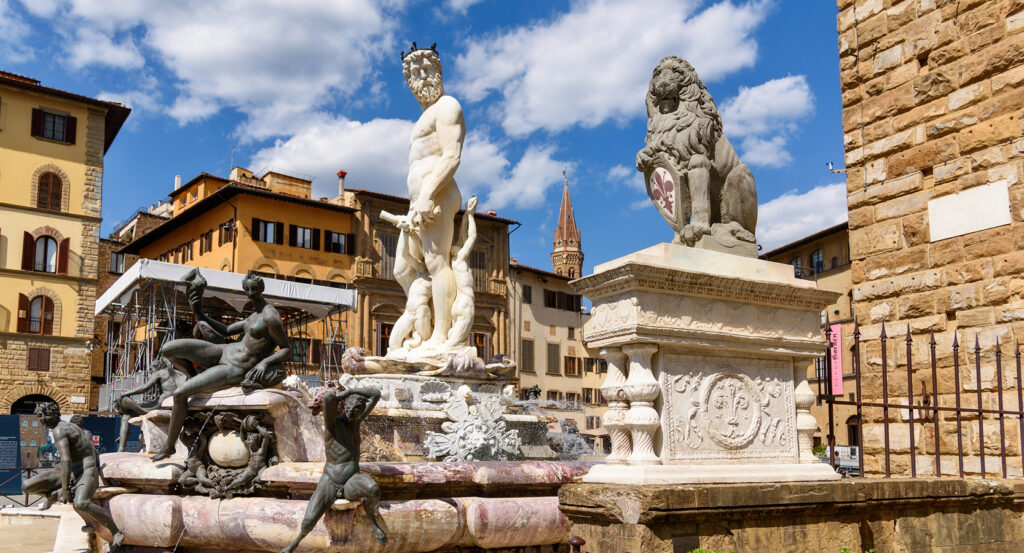
Standing beneath the Loggia dei Lanzi in Piazza della Signoria, Benvenuto Cellini's 1554 masterpiece commands the open air like a frozen moment of triumph. Perseus stands poised on Medusa's lifeless body, arm extended high as he holds her severed head aloft, bronze blood seeming to spill from the neck. Every detail pulses with drama, the taut muscles, the gleaming curves of the hero's armor, the serpents coiled in Medusa's hair. It's both beautiful and brutal, the Renaissance at its most daring. Under the shifting Florentine light, Perseus glows like molten metal, his expression serene even in violence. To stand before it is to witness a myth reborn through human genius, a balance of grace and terror, courage and creation, carved for eternity in bronze.
What defines Perseus with the Head of Medusa.
Perseus with the Head of Medusa was not just a work of art, it was a public manifesto, both political and personal.
Commissioned by Duke Cosimo I de' Medici for the Loggia dei Lanzi, Cellini's sculpture was meant to face Michelangelo's David and Bandinelli's Hercules and Cacus, asserting Medici dominance through art as much as power. The myth of Perseus, the hero who conquers chaos and turns his enemies to stone, became a metaphor for the Duke's rule over Florence. Yet behind that symbolism lies a story of obsession and struggle: Cellini spent nearly a decade on the statue, experimenting with the lost-wax casting technique that nearly failed mid-process when molten bronze solidified too soon. In a stroke of desperation, the artist stoked his furnace with furniture and even kitchen utensils to save the pour, and miraculously succeeded. Hidden within the statue's base is a self-portrait of Cellini, his face carved in relief among the ornate bronze details, a quiet signature of pride and defiance. The entire composition captures the Florentine ideal: intellect and artistry conquering chaos, as Perseus once conquered Medusa.
How Perseus with the Head of Medusa fits.
Experiencing Perseus with the Head of Medusa is best done slowly, as if walking into a story told in bronze.
Approach it from the edge of the Loggia dei Lanzi, where light cuts across the sculpture and reveals the contrast between polished skin and darkened armor. Circle the base, every angle reveals a different narrative: Medusa's twisted body below, Perseus's steady composure above, the writhing serpents forming a crown of frozen motion. Look for Cellini's self-portrait in the pedestal's bronze reliefs; it's easy to miss, but finding it transforms the work into something deeply personal. Visit early in the morning or at twilight, when the surrounding piazza is quieter and the bronze catches the day's first or last glow. For an unforgettable moment, step back toward the center of Piazza della Signoria and let the statue align with the Palazzo Vecchio behind it, art, myth, and power united in one view. Perseus with the Head of Medusa isn't merely a sculpture; it's Florence's declaration that even in darkness, beauty can reign victorious.
Where your story begins.
Foresyte Travel reveals places that feel extraordinary long before you arrive.
Enjoy editorial crafted for luxury travelers.
Foresyte may earn a commission when you book.