
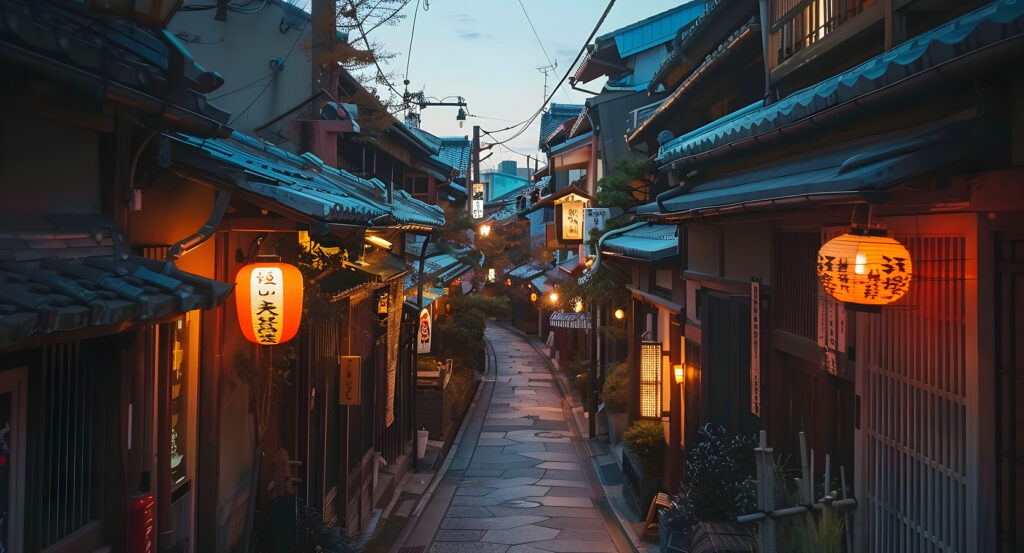
Why you should experience Pontocho Kaburenjo Theater in Kyoto, Japan.
Pontocho Kaburenjo Theater is Kyoto's heartbeat behind the curtain, the quiet stage where centuries of elegance still move with living grace.
Tucked discreetly off Pontocho Alley, it's easy to miss unless you know where to look. Yet inside, the air carries centuries of rhythm, the faint scent of tatami and cedar, the hush before the shamisen's first note. The theater is home to Pontocho's geiko and maiko, whose seasonal performances transform tradition into something breathing and immediate. Every spring and autumn, the stage glows with the Kamogawa Odori, Kyoto's famed dance festival, where silk sleeves ripple like water and gestures unfold like poetry in motion. To witness it is to glimpse Kyoto's soul without translation, not a reenactment of the past, but its continuation, flawless in form, fragile in time.
What you should know about Pontocho Kaburenjo Theater.
Built in 1927, Pontocho Kaburenjo Theater was modeled after the grandeur of the Minamiza but designed to preserve intimacy, a deliberate space for Kyoto's most refined performing art: Kyomai, or Kyoto-style dance.
The name kaburenjo means “rehearsal hall,” yet this one evolved far beyond its origins. Its wooden frame was crafted by local carpenters using interlocking joints that allow the structure to breathe with the seasons. The interior, lined with pale hinoki cypress, captures sound like a living instrument, the scrape of sandals across the stage, the rustle of kimono, the pulse of the drum. During the Kamogawa Odori, dancers perform under soft gold lighting that mimics the color of dusk along the Kamo River, a nod to the alley outside. Few visitors realize that every geiko and maiko of the Pontocho district trains here, their rehearsals unseen, their discipline spanning years before their first performance. The theater's architecture was nearly lost after World War II but was restored in 1953 through the dedication of Kyoto's artisans, who rebuilt it beam by beam using traditional tools. Its minimalist façade hides an auditorium that can seat over 400, yet the space feels smaller, almost private, a deliberate design choice meant to keep each performance within reach of breath and silence. Even the stage trapdoor, once used for dramatic entrances in kabuki plays, remains intact, a quiet relic of the alley's theatrical roots.
How to fold Pontocho Kaburenjo Theater into your trip.
Experiencing Pontocho Kaburenjo Theater is to enter Kyoto's living art form, not as an observer, but as a witness.
Visit in spring for the Kamogawa Odori, when the theater blooms into color and movement. Tickets can be reserved in advance through the Pontocho Kabukai Association; choose an evening show when the performances glow against the night's stillness. Arrive early to stroll through Pontocho Alley, the lanterns lit, the scent of grilled river fish in the air, before stepping into the theater's soft light. Once inside, photography stops and silence begins; the performance unfolds through gesture, music, and mood alone. Between acts, sip green tea served in ceramic cups made by Kyoto artisans, the taste grounding you in the moment. Afterward, walk out toward the river, the night feels different, the sound of the Kamo softer somehow. Even if you can't attend a performance, the theater itself is worth visiting during open exhibitions, where the architecture speaks its own language of balance and devotion. Pontocho Kaburenjo Theater is more than a stage; it's the living bridge between what Kyoto was and what it still dares to be, a city that never lets its beauty fall silent.
Where your story begins.
Foresyte Travel reveals places that feel extraordinary long before you arrive.
Experience premium editorial crafted for luxury travelers.

















































































































