
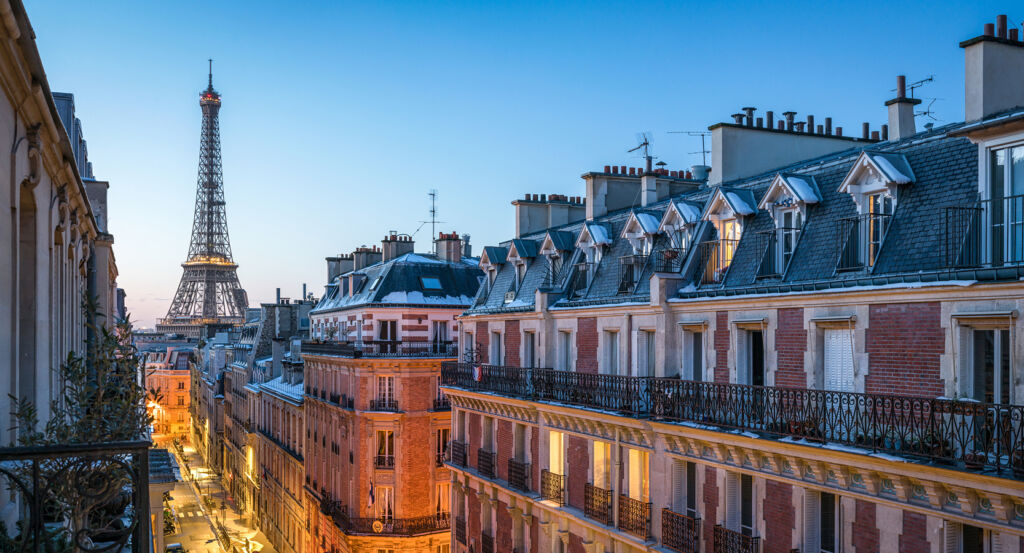
Why Pullman Paris Eiffel Tower matters.
Pullman Paris Eiffel Tower is a modernist hotel where Grenelle's postwar urban character meets Pierre Dufau architecture, Conrad Hilton's international expansion and six decades of large-scale hospitality beside the Champ de Mars.
Set along Avenue de Suffren near Rue Jean Rey and just steps from Champ de Mars, the hotel occupies a broad Grenelle parcel where the landscaped military grounds reach the Seine and the dense residential grid of the 15th Arrondissement. Pierre Dufau conceived the building as a long rectangular volume elevated above a red-granite base, with repetitive horizontal openings and an attic level beneath a projecting roof defining its postwar profile. The original composition placed expansive public interiors across the podium and used the upper structure to create an emphatically modern counterpoint to the older masonry buildings surrounding the site. Later interventions preserved the essential massing as glass, pale timber, mineral surfaces and open sightlines replaced successive generations of interior decoration. The result is a hotel whose architecture preserves the scale and confidence of Paris's postwar internationalization within a district otherwise shaped by nineteenth-century streets and the open landscape of Champ de Mars.
What defines Pullman Paris Eiffel Tower.
Pullman Paris Eiffel Tower is best known for beginning as the Paris Hilton, the first major modern hotel constructed in the French capital after the Second World War and an early expression of American chain hospitality on an unprecedented Parisian scale. Hilton International commissioned Pierre Dufau, a leading advocate of French modernism whose work also included the Palais des Sports at Porte de Versailles, to design the Avenue de Suffren building. Raymond Loewy developed the original interiors and furniture, bringing the Franco-American industrial designer behind projects for Studebaker, Air France and major American corporations into the hotel's creative authorship. The project cost 80 million francs and placed air conditioning, direct-dial telephones and remotely controlled televisions inside a building conceived around the technological expectations of international postwar travel. Conrad Hilton joined French tourism secretary Pierre Dumas for the inauguration on April 21, 1966, when a western-and-cowboy-themed celebration turned the opening into a major Paris social event. The building entered a city simultaneously pursuing the Seine expressways, the development of La Défense and other large-scale modernization projects that altered the architectural language of postwar Paris. Hilton operated the property through subsequent decades as the hotel passed through later ownership and management structures. Accor assumed operation in early 2009 and introduced the Pullman name, connecting the building with a French hotel marque that Accor was repositioning internationally. A €47 million reconstruction program followed during 2013 and 2014 as the company prepared the property as a flagship for the renewed brand. Morgan Stanley Real Estate Investing and QuinSpark acquired the hotel from Amundi Immobilier for €330 million in March 2024, beginning another ownership chapter six decades after Dufau's original commission. Batipart Europe, CDC Investissement Immobilier, Société Générale Assurances and QuinSpark acquired the property in April 2026 through a joint investment vehicle valued near €430 million, with Accor continuing hotel management. The transaction initiated another major reconstruction program intended to elevate the property to five-star positioning by 2028, extending a history in which successive operators and owners have repeatedly used Dufau's postwar building as a platform for large-scale reinvention.
How Pullman Paris Eiffel Tower fits.
Pullman Paris Eiffel Tower works as the modernist anchor for an outing connecting Paul Rivet's museum-laboratory devoted to humanity, Honoré de Balzac's surviving Passy residence and subterranean wine cellars carved from the former quarries beneath the western Seine slopes.
Begin at Musée de l'Homme, created by anthropologist Paul Rivet inside the Passy wing of the Palais de Chaillot and inaugurated on June 20, 1938 by President Albert Lebrun and education minister Jean Zay. Rivet united anthropology, prehistory and ethnology with a research laboratory, university teaching and Yvonne Oddon's library, creating a museum-laboratory whose intellectual structure departed from conventional collection display. Staff members including Boris Vildé and Anatole Lewitsky subsequently formed the Musée de l'Homme resistance network after the German occupation in 1940. A six-year reconstruction culminated in the institution's 2015 reopening with its research and public functions reorganized inside the 1937 palace. Continue to Maison de Balzac, the surviving Passy residence where Honoré de Balzac lived from 1840 to 1847 under the pseudonym Monsieur de Breugnol as he worked intensively on La Comédie humaine. The writer occupied an apartment with access to a garden and two separate street exits, an arrangement that suited his effort to avoid creditors during years of severe financial pressure. Medieval troglodytic spaces survive beneath the property, preserving physical evidence of Passy before its incorporation into Paris in 1860. Louis Baudier de Royaumont established a museum there in 1908, and the City of Paris acquired the house in 1949, preserving the last surviving Paris residence occupied by Balzac. Conclude at M. Musée du Vin, whose vaulted underground spaces originated in quarries beneath the former Passy hillside before the Minims converted them into wine cellars during the sixteenth and seventeenth centuries. The religious community established vineyards around its convent, producing wine on slopes whose history survives in Rue Vineuse and Rue des Vignes. Revolutionary suppression ended the convent, yet the underground galleries endured through subsequent uses. Bottles for the Eiffel Tower restaurant were stored there during the 1950s, returning wine to the former monastic cellars. The Conseil des Échansons de France transformed the galleries into a wine museum during the 1980s, building a collection devoted to French viticulture and winemaking inside the surviving quarry network. The progression moves from an interdisciplinary institution created to study humanity through science and culture through the preserved working residence of a foundational French novelist and culminates beneath Passy in former quarry galleries whose monastic, commercial and museum histories trace centuries of Parisian wine culture.
Where your story begins.
Foresyte Travel reveals places that feel extraordinary long before you arrive.
Enjoy editorial crafted for luxury travelers.














































































































