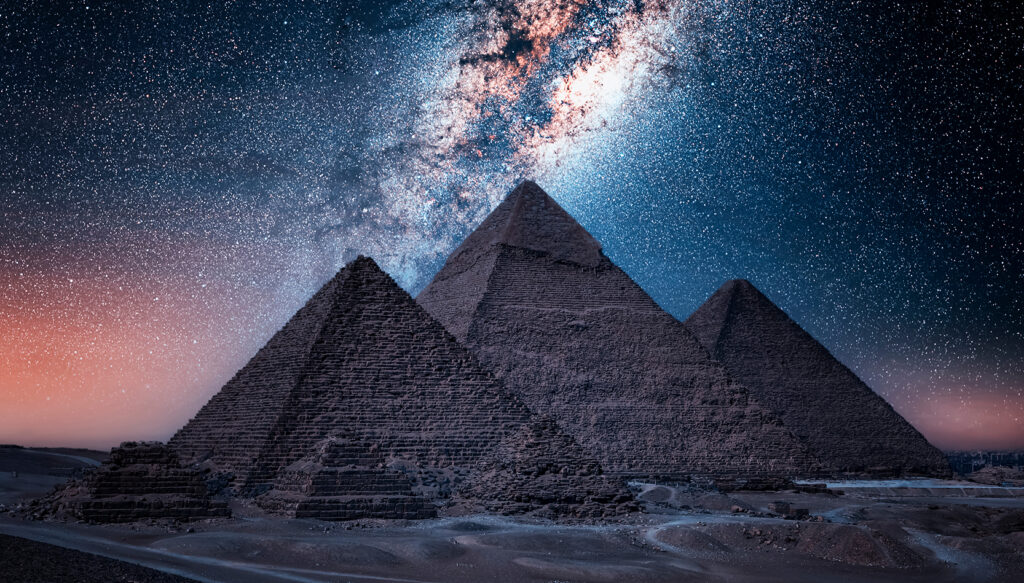
Why Giza Necropolis matters.
Giza Necropolis is an Old Kingdom royal burial complex where Giza's desert plateau meets the architectural ambitions of Egypt's Fourth Dynasty, the development of expansive stone construction and the funerary institutions of the pyramid-building pharaohs.
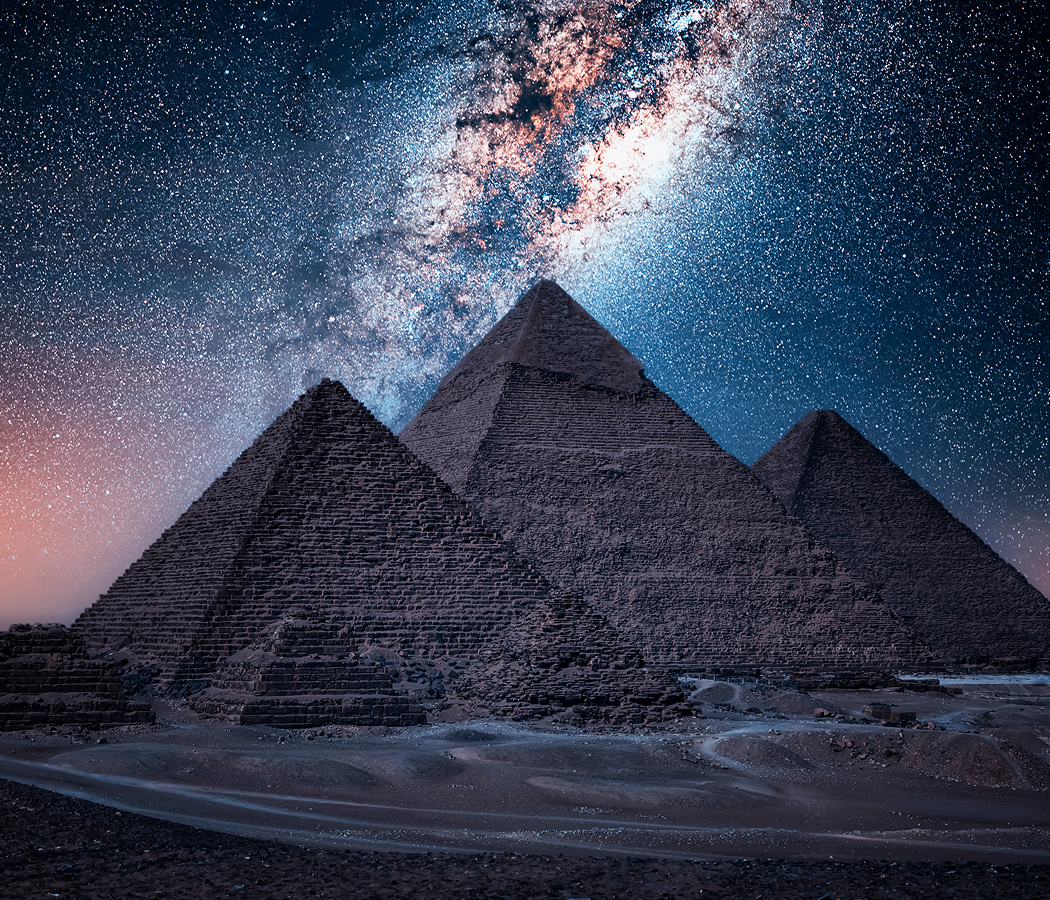
Rising above Al Haram Road near the western edge of Giza and a short drive from Al Haram Square, the necropolis occupies a limestone plateau overlooking the Nile Valley, with the three principal pyramid complexes extending across elevated desert terrain above the agricultural plain and metropolitan Cairo. The Great Pyramid dominates the northern portion of the plateau, accompanied by smaller royal pyramids and surrounding mastaba cemeteries. The pyramids of Khafre and Menkaure extend southwestward across the limestone bedrock. Causeways descend toward funerary temples positioned along the plateau's eastern edge. The result is an archaeological landscape whose arrangement preserves the relationship between royal burial, sacred architecture and the geography of ancient Memphis.
What defines Giza Necropolis.
Giza Necropolis is best known for the Great Pyramid of Khufu, the pyramids of Khafre and Menkaure, and the Great Sphinx, constructed during the Fourth Dynasty of Egypt's Old Kingdom. The plateau became a principal royal burial ground during the reign of Khufu, who succeeded Sneferu in the twenty-sixth century BCE. Sneferu's pyramid-building projects at Meidum and Dahshur had established important precedents for large-scale royal stone construction. Khufu's architects developed a pyramid complex incorporating an expansive tomb, subsidiary structures and an extensive cemetery for members of the royal court. The Great Pyramid originally reached 146.6 meters, making it the tallest human-made structure in the world for more than three millennia. Its construction required the quarrying, transportation and placement of millions of limestone blocks. The project depended upon a centralized administrative system capable of organizing labor, food supplies, building materials and transportation along the Nile. Khufu's successor Djedefre constructed his principal pyramid at Abu Rawash, north of Giza. Khafre subsequently returned royal pyramid construction to the Giza plateau, developing a complex distinguished by its elevated position and associated expansive sculpture. Menkaure built the smallest of the three principal pyramids, incorporating substantial granite elements into his funerary architecture. Royal relatives and high officials received burials in surrounding mastaba cemeteries, whose decorated chapels preserved their titles and religious obligations. The plateau's construction history extended through successive generations as burial practices and funerary institutions developed. Later Egyptian rulers restored, modified and reused portions of the site, maintaining its religious importance beyond the Old Kingdom. Greek and Roman travelers encountered the pyramids as surviving achievements of ancient Egyptian kingship. Modern archaeological investigations have expanded knowledge of the workers, administrative institutions and construction systems responsible for the complexes. The necropolis forms part of the UNESCO World Heritage property Memphis and its Necropolis, recognized in 1979.
Hemiunu, a senior official associated with Khufu's reign, held responsibilities traditionally connected with the administration of the Great Pyramid's construction. The pyramid's internal arrangement includes the descending passage, ascending passage, Grand Gallery and King's Chamber. Granite blocks form the King's Chamber, where an empty stone sarcophagus occupies the principal burial space. Relieving chambers above the room distribute structural loads through the surrounding masonry. The Grand Gallery rises through the pyramid's interior as a steeply inclined passage with corbelled walls. Outside the principal structure, boat pits and subsidiary pyramids formed part of Khufu's wider funerary complex. Excavations south of the Great Pyramid uncovered dismantled cedar timbers belonging to a royal boat, subsequently reconstructed as the Khufu ship. Khafre's pyramid retains portions of its original limestone casing near the summit, revealing the smooth exterior finish that once covered the monuments. Its valley temple incorporates substantial granite pillars and stone flooring associated with royal funerary ceremonies. The Great Sphinx, carved directly from the plateau's limestone bedrock, combines a lion's body with a human head traditionally associated with Khafre. Menkaure's complex includes subsidiary pyramids and a valley temple where excavations uncovered royal statues. Sculptural groups depicting Menkaure with deities and royal figures demonstrate the relationship between kingship and religious representation. Mastaba tombs preserve reliefs depicting agricultural production, offerings, craftsmen and the activities of elite households. The workers' settlement at Heit el-Ghurab contained bakeries, administrative buildings and accommodation associated with the organization of pyramid construction. Its archaeological remains connect the monuments with the substantial human and logistical systems required to build them.
How The Great Pyramid of Giza fits.
Giza Necropolis works as the archaeological centerpiece for a greater Cairo itinerary connecting Egypt's early experiments in pyramid construction, the development of royal funerary architecture and the political institutions of the ancient capital at Memphis.
Begin at Saqqara, the extensive necropolis associated with ancient Memphis and the burial traditions of Egypt's early dynasties. Its Step Pyramid of Djoser was constructed during the Third Dynasty under the direction of Imhotep, who developed an expansive stone complex from earlier mastaba forms. The pyramid consists of six superimposed stages enclosed within a ceremonial precinct. Colonnaded passages, courtyards and ritual buildings preserve the architectural organization of early royal funerary institutions. Later pyramids and decorated tombs demonstrate the continuing use of Saqqara across successive dynasties. The site establishes the architectural foundations of Egypt's pyramid-building tradition. Continue to Dahshur, the royal necropolis south of Saqqara containing two major pyramids constructed for Sneferu. The Bent Pyramid preserves a change in slope between its lower and upper sections, revealing adjustments made during its construction. Its surviving exterior casing provides substantial evidence of the smooth limestone surfaces originally applied to royal pyramids. The nearby Red Pyramid represents an important achievement in the development of the true pyramid form. Its internal chambers and structural arrangement demonstrate advances in large-scale masonry construction. The two monuments connect experimentation in pyramid geometry with the engineering achievements of the Fourth Dynasty. Conclude at Mit Rahina, the archaeological area associated with ancient Memphis, Egypt's capital during much of the Old Kingdom. The settlement occupied a strategic position near the division between Upper and Lower Egypt, supporting royal administration and religious institutions. Its surviving remains include substantial sculptures associated with the temple of Ptah, the city's principal deity. A colossal limestone statue of Ramesses II preserves the scale of royal sculpture produced during the New Kingdom. The archaeological area connects the pyramid necropolises with the political and religious center that sustained their construction. The progression moves from the earliest expansive stone pyramid through experiments in true-pyramid engineering and culminates at the ancient capital, connecting Giza Necropolis with the development of Egyptian kingship and state administration.
Where your story begins.
Foresyte Travel reveals places that feel extraordinary long before you arrive.
Enjoy editorial crafted for luxury travelers.
Foresyte may earn a commission when you book.