Why Restaurant 212 matters.
Restaurant 212 is a two-MICHELIN-starred culinary institution where the Grachtengordel's historic canal-house heritage meets Richard van Oostenbrugge and Thomas Groot's transformation of Dutch fine dining, an influential approach to chef-led hospitality and the technical precision of contemporary European gastronomy.
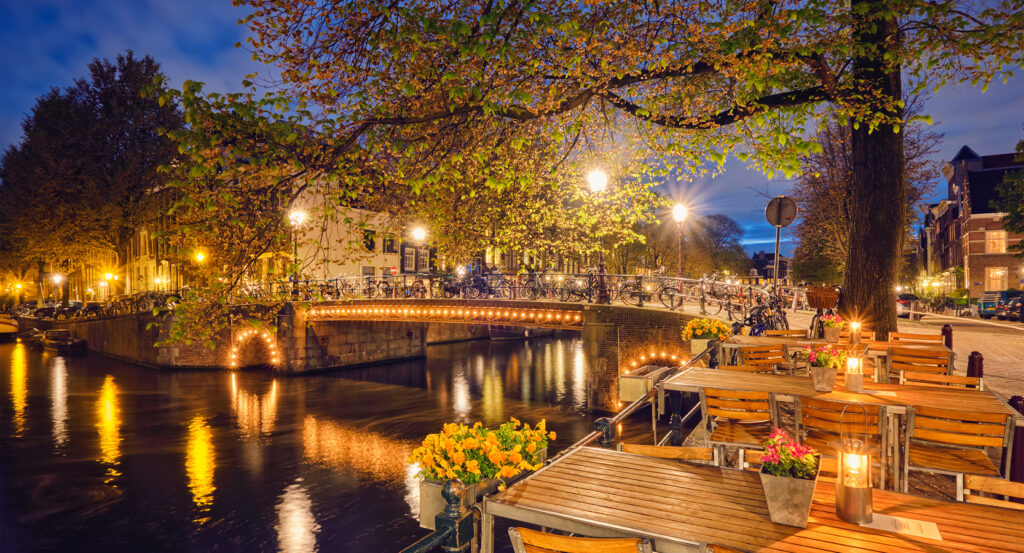
Located at Amstel 212, near the intersection with Herengracht and within walking distance of Rembrandtplein, the restaurant occupies a traditional canal house overlooking one of Amsterdam's principal waterways, surrounded by historic residences and the expansive architecture of the eastern canal district. Its discreet street entrance opens into an intimate contemporary interior where natural oak, polished metal and restrained architectural detailing establish a carefully composed atmosphere. The dining room accommodates sixteen guests across six tables, including curved upholstered banquettes arranged around a central open kitchen that brings the culinary team into direct view. Soft lighting, neutral surfaces and precisely positioned furnishings establish a sense of privacy, with the compact arrangement preserving visual connections between the preparation of food and its presentation. The result is an exceptionally intimate dining environment whose historic canal-house setting, contemporary materials and carefully organized seating establish a distinctive expression of Amsterdam's modern restaurant culture.
What defines Restaurant 212.
Restaurant 212 is best known for challenging the conventions of Dutch fine dining through an independent restaurant that transformed the relationship between professional chefs and their guests. Its founders, Richard van Oostenbrugge and Thomas Groot, developed their professional partnership at Bord'Eau, the celebrated restaurant within Amsterdam's Hotel De L'Europe. Van Oostenbrugge served as executive chef, with Groot occupying a central position within the kitchen's leadership, establishing a working relationship shaped by classical French technique and increasingly ambitious contemporary cooking. Their collaboration helped Bord'Eau achieve two MICHELIN stars, placing the restaurant among the Netherlands' most accomplished gastronomic establishments. Despite this professional success, the chefs developed a shared ambition to establish an independent restaurant organized around their own interpretation of hospitality and culinary creativity. Their departure from Bord'Eau on December 31, 2017, concluded an important chapter in their careers and established the foundation for a more unconventional enterprise. Restaurant 212 opened on January 8, 2018, introducing a dining format that immediately distinguished it from Amsterdam's established fine-dining institutions. The original restaurant eliminated conventional dining tables, arranging guests around an open kitchen where the chefs prepared and presented food within direct conversational distance. This approach established Amsterdam's first restaurant organized entirely around a tableless dining concept, replacing the traditional separation between kitchen and dining room with a continuous culinary encounter. The name derived directly from the building's street number, connecting the new enterprise with its position along the Amstel. Its original service structure also challenged conventional fine-dining practices, allowing diners to select individual courses and consult directly with the sommelier concerning wines from the cellar. Daphne Oudshoorn contributed to the development of this personalized wine service, supporting the founders' ambition to create a more direct relationship between culinary preparation and hospitality. The restaurant's immediate success culminated on December 17, 2018, when MICHELIN awarded its first star for the 2019 guide, recognizing the founders' independent achievement less than a year after opening. Its reputation strengthened further through the influential Lekker restaurant rankings, where 212 climbed from fifty-seventh to twentieth place in the 2020 edition, becoming the guide's largest upward mover. The restaurant received a second MICHELIN star in the 2021 guide, restoring the level of recognition the chefs had previously achieved together at Bord'Eau and establishing their independent venture among the country's leading restaurants. A major transformation followed a fire in 2022, which prompted a comprehensive renovation of the property and an opportunity to reconsider the original dining format. Amsterdam-based design studio Concrete directed the interior redesign, completing a substantially reconfigured restaurant in December 2022. The renovation replaced the original counter arrangement with six intimate tables, introducing curved seating and a more luxurious environment that preserved direct engagement with the culinary team. The redesigned space occupied 134 square meters, establishing a compact architectural setting in which the relationship between guests, chefs and service remained central to the experience. The reopening introduced a seven-course menu that extended the founders' commitment to culinary precision through a more structured dining experience. Their growing hospitality enterprise subsequently developed additional restaurant concepts, demonstrating the commercial and creative influence of the partnership beyond its original flagship. Gault&Millau awarded Restaurant 212 a score of 18.5 out of 20, recognizing the technical sophistication and distinctive character of its contemporary cooking. In October 2026, the restaurant retained its two MICHELIN stars, maintaining its position among Amsterdam's four remaining establishments holding that distinction. Its historical importance emerges from this progression through professional independence, rapid critical recognition, architectural reinvention and sustained culinary achievement, establishing Restaurant 212 as a consequential institution in the evolution of Dutch fine dining.
How Restaurant 212 fits.
Restaurant 212 works as the culinary culmination of an exploration of Amsterdam's historic Amstel corridor, connecting the city's evolving relationship with international art, its celebrated river crossings and the theatrical institutions that have shaped its cultural identity.
Begin at H'ART Museum, the international exhibition institution occupying the historic Amstelhof complex on the eastern bank of the river. The building originated in 1681 as a charitable residential institution for elderly women, establishing a substantial architectural presence within Amsterdam's seventeenth-century urban expansion. Its transformation into a museum preserved the expansive character of the complex, incorporating historic courtyards and substantial interior spaces into a contemporary exhibition environment. Formerly known as Hermitage Amsterdam, the institution ended its relationship with the State Hermitage Museum in Saint Petersburg in March 2022 and adopted its present name in September 2023. Partnerships with institutions including the Centre Pompidou, British Museum and Smithsonian American Art Museum established a new international exhibition program, connecting Amsterdam with major collections and cultural organizations. Continue to Magere Brug, the celebrated wooden drawbridge connecting the banks of the Amstel near Kerkstraat and Nieuwe Kerkstraat. A narrow crossing occupied the site during the late seventeenth century, establishing an important pedestrian connection between neighborhoods developing on opposite sides of the river. The bridge acquired its familiar name, meaning Skinny Bridge, through the unusually restricted width of its original structure. Successive reconstructions accommodated the city's changing transportation needs, with the present bridge dating to 1934 and preserving the recognizable character of a traditional Dutch movable crossing. Its white timber structure and evening illumination have established the bridge as one of Amsterdam's most recognizable river landmarks, with expansive views along the surrounding embankments. Conclude at Royal Theatre Carré, the historic performance venue established by circus impresario Oscar Carré on the eastern bank of the Amstel. Carré commissioned the expansive theater in 1887 as a permanent home for his internationally celebrated circus, introducing an ambitious entertainment building to a city whose performance culture was expanding rapidly. The auditorium's architectural design accommodated equestrian spectacles, establishing a distinctive relationship between theatrical construction and the practical requirements of nineteenth-century circus performance. Subsequent decades brought variety shows, operetta, musical theater, ballet and international performers, transforming the original circus venue into one of the Netherlands' most important theatrical institutions. A threatened demolition in 1968 prompted efforts to preserve the building, securing the continued presence of a cultural landmark whose programming now encompasses contemporary performance and major international productions. The progression connects the architectural transformation of a historic charitable institution with Amsterdam's enduring river infrastructure and concludes at a theatrical landmark that captures the city's evolving performance culture.
Where your story begins.
Foresyte Travel reveals places that feel extraordinary long before you arrive.
Enjoy editorial crafted for luxury travelers.