Why Restaurant Flore matters.
Restaurant Flore is a two-MICHELIN-starred culinary institution where Amsterdam's historic Binnenstad's mercantile heritage meets Bas van Kranen's transformation of Dutch fine dining, the gastronomic legacy of Hotel De L'Europe and a pioneering commitment to sustainable food production recognized by the MICHELIN Green Star.
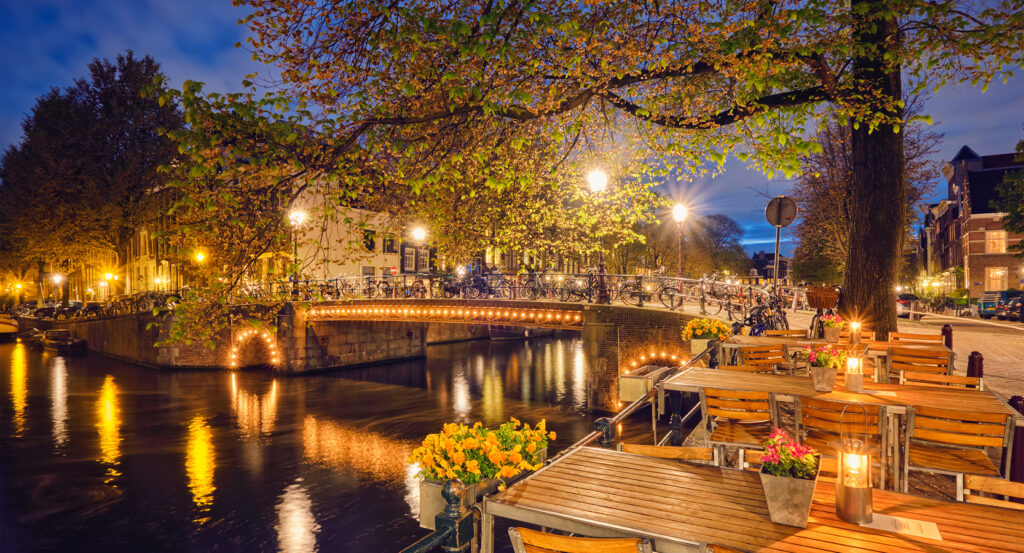
Located at Nieuwe Doelenstraat 2-14, near the intersection with Rokin and a short walk from the Munttoren, the restaurant occupies a prominent position within Hotel De L'Europe overlooking the Amstel, where Amsterdam's medieval street network converges with its historic waterways. Its discreet entrance leads through the hotel's public rooms into a contemporary interior distinguished by natural materials, subdued lighting and carefully composed architectural details. The principal dining room accommodates thirty guests at eleven tables, with generous windows framing the canal landscape and the surrounding historic buildings. A dedicated kitchen table provides a more immediate encounter with the culinary team, and a separate private dining room accommodates intimate gatherings within the larger hospitality complex. The result is an exceptionally refined waterfront restaurant whose restrained contemporary interiors, intimate seating and direct connection to Amsterdam's historic center establish a distinctive environment for modern Dutch gastronomy.
What defines Restaurant Flore.
Restaurant Flore is best known for redefining the relationship between haute cuisine and environmental responsibility through the transformation of one of Amsterdam's established fine-dining institutions. Its development originated at Bord'Eau, the celebrated restaurant within Hotel De L'Europe, whose gastronomic reputation had been established under Richard van Oostenbrugge and Thomas Groot. The departure of those chefs at the end of 2017 created an opportunity for a new culinary direction, bringing Bas van Kranen into a prominent position within the hotel's restaurant operations. Van Kranen had already received Gault&Millau's Young Chef of the Year distinction in 2017, establishing his professional reputation before assuming leadership of the historic dining room. His initial work preserved Bord'Eau's demanding technical standards, allowing the restaurant's culinary direction to evolve through a gradual reassessment of ingredients, presentation and hospitality. The hotel's broader redevelopment subsequently provided the opportunity for a more fundamental transformation, connecting its restaurant with a contemporary interpretation of luxury centered on environmental responsibility. Restaurant Flore emerged in 2021 as the successor to Bord'Eau, introducing the concept of conscious fine dining under Van Kranen's executive leadership. The new character established a direct relationship between culinary ambition and the environmental consequences of food production, extending responsibility from ingredient selection into the organization of the kitchen itself. The transformation also brought a substantial reconsideration of the restaurant's established French culinary foundations, placing the Netherlands' agricultural landscape and marine resources at the center of its creative development. The decision to eliminate dairy from the kitchen became particularly consequential, requiring a systematic reconsideration of the butter, cream and other ingredients traditionally fundamental to European haute cuisine. This change influenced sauce construction, pastry development and the technical education of the culinary team, establishing a new foundation for the restaurant's cooking. MICHELIN recognized the transformation in 2022 by awarding Flore two stars and a Green Star, placing the restaurant among a select group of European establishments distinguished for both culinary excellence and sustainable practices. The simultaneous recognition was especially significant because it demonstrated the compatibility of demanding gastronomic standards with a comprehensive reassessment of conventional restaurant sourcing. Van Kranen's relationships with specialist producers subsequently became central to the restaurant's professional development, extending the kitchen's influence into conversations concerning biodiversity, agricultural methods and responsible fishing. The establishment's growing reputation contributed to a wider movement within Dutch gastronomy that treated environmental responsibility as an essential consideration in the development of contemporary fine dining. Gault&Millau named Flore Vegetable Restaurant of the Year in 2024, recognizing the kitchen's distinctive contribution to vegetable-centered gastronomy. The restaurant also developed a substantial wine program under sommelier Antonello Nicastri, whose work connected its culinary direction with specialist winemakers and a more considered approach to beverage pairing. Nicastri received Gault&Millau's Sommelier of the Year distinction in 2026, strengthening the restaurant's reputation for service alongside its culinary achievements. A further institutional development followed through a series of collaborative dinners involving internationally distinguished chefs, creating opportunities to examine different approaches to ingredient provenance and sustainable cooking. Flore's fifth-anniversary program in 2026 extended that exchange through special events and preparations for a dedicated publication exploring the restaurant's development. The anniversary marked a significant stage in Van Kranen's progression from the leadership of an established luxury restaurant to the creation of an internationally recognized institution whose professional influence reaches beyond the dining room.
Bas van Kranen's culinary program is organized around the natural growing cycles of the Netherlands, translating the country's agricultural and marine biodiversity into a technically sophisticated interpretation of contemporary European cooking. The kitchen divides its annual development into three principal seasonal periods, allowing the character of the menu to follow the availability of ingredients at their natural peak. Spring's wild garlic and autumn's porcini mushrooms demonstrate the importance of these changing harvests, establishing a direct relationship between the restaurant's creative calendar and the surrounding landscape. Landzicht, the biodynamic farm in Strijen, contributes to this approach through vegetables cultivated under agricultural practices emphasizing soil health and ecological balance. North Sea fisherman Hendrik Kramer provides a complementary connection to the marine environment, supporting a seafood repertoire shaped by responsible procurement and the characteristics of individual catches. The kitchen's most consequential technical development emerges from its treatment of vegetables as primary gastronomic ingredients, using fermentation, smoking, drying and controlled maturation to build complexity from plant material. Its fully plant-based menu incorporates more than eighty Dutch plants, establishing an unusually broad foundation for exploring the textures, aromas and natural chemical properties of regional produce. Fermentation develops acidity and savory depth, providing a means of constructing concentrated flavors through the transformation of ingredients during carefully controlled periods of maturation. Drying and smoking introduce complementary methods of preservation and aromatic development, allowing the kitchen to work with ingredients across successive stages of their natural life cycles. The resulting preparations demonstrate a systematic approach to vegetable cookery in which different components of the same plant contribute distinct culinary functions. Van Kranen's international technical influences include Japanese methods of ingredient preservation and flavor concentration, particularly where they complement the natural characteristics of Dutch produce. His omnivorous menu applies the same principles to responsibly raised animals and sustainably harvested seafood, with game appearing during colder months and marine ingredients receiving greater emphasis during spring and summer. One preparation centers on mackerel matured for a week before charcoal grilling, developing the fish's texture and concentrated marine character through a combination of controlled aging and direct heat. A pumpkin-seed mole introduces a substantial savory foundation, demonstrating how ingredients associated with international cooking traditions contribute to the treatment of a Dutch coastal species. The kitchen's interest in natural complexity also appears in compositions bringing together numerous vegetables, herbs and fruits, developing contrasting bitter, floral, acidic and aromatic qualities through the relationships between individual plants. This approach requires close collaboration between growers and chefs because changes in soil conditions, harvest timing and seasonal availability directly influence the composition of the menu. The restaurant's beverage program extends that investigation through carefully developed nonalcoholic pairings, using the acidity, aromatic structure and texture of individual drinks to support the changing character of successive courses. Flore's culinary distinction emerges from this comprehensive relationship between ecological sourcing and technical invention, establishing a form of fine dining in which agricultural knowledge, ingredient preservation and gastronomic precision operate as interconnected disciplines.
How Restaurant Flore fits.
Restaurant Flore works as the culinary culmination of an exploration of Amsterdam's historic commercial center, connecting the preservation of university collections with the surviving architecture of the medieval city defenses and the domestic history of the seventeenth-century canal elite.
Begin at Allard Pierson, the museum and heritage institution of the University of Amsterdam situated on Oude Turfmarkt. Its archaeological collections developed through the acquisition of antiquities assembled by Constant Willem Lunsingh Scheurleer, whose financial difficulties during the economic crisis of 1929 led to the sale of his private museum collection. The Allard Pierson Foundation acquired the material for the university, establishing the public museum on November 12, 1934. Princess Beatrix inaugurated its relocation to the former Nederlandsche Bank building in 1976, introducing the collections into an expansive setting overlooking the historic waterway. A major institutional transformation in 2019 united the archaeological museum with the university's Special Collections, bringing antiquities, rare books, manuscripts, maps and archival materials into a broader center for cultural heritage. Continue to Munttoren, the surviving medieval gate tower overlooking Muntplein at the meeting point of the Singel and Amstel waterways. The structure originated as part of the Regulierspoort, constructed between 1480 and 1487 within Amsterdam's defensive walls. A devastating fire in 1618 destroyed much of the original gate complex, leaving the western tower as the principal surviving element. Architect Hendrick de Keyser designed its distinctive Renaissance upper structure in 1620, introducing an octagonal form and elegant spire that became a recognizable feature of the city's skyline. The tower acquired its present name after the adjoining guardhouse was used for coin production between 1672 and 1674, preserving a direct architectural connection to Amsterdam's monetary history. Conclude at Museum Van Loon, the historic canal-house museum situated on Keizersgracht within Amsterdam's seventeenth-century urban expansion. Architect Adriaen Dortsman designed the residence in 1672, establishing a substantial townhouse whose first occupant was Ferdinand Bol, a painter trained under Rembrandt. The Van Loon family acquired the property during the nineteenth century, connecting the residence with a prominent Amsterdam dynasty whose earlier members had participated in the founding of the Dutch East India Company. Maurits van Loon opened the house to the public in 1973, preserving its historic interiors and substantial collections of family portraits, furniture, silverware and porcelain. The formal garden and adjoining coach house complete an unusually extensive domestic ensemble, revealing the architectural organization and material culture of Amsterdam's wealthy canal-house residents. The progression connects the preservation of Amsterdam's intellectual collections with its medieval commercial infrastructure and concludes within the domestic world of the families who shaped the city's seventeenth-century prosperity.
Where your story begins.
Foresyte Travel reveals places that feel extraordinary long before you arrive.
Enjoy editorial crafted for luxury travelers.
Foresyte may earn a commission when you book.