
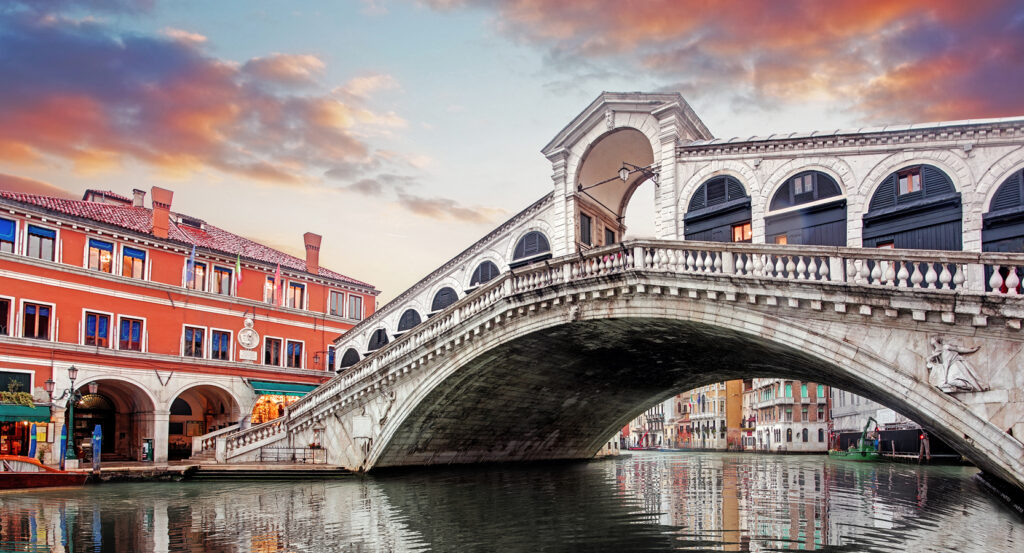
Why you should experience Palazzo dei Camerlenghi in Venice, Italy.
Palazzo dei Camerlenghi is Venice's ledger made manifest in stone, a building where commerce, power, and architecture converge on the edge of the Grand Canal.
Positioned just beneath the soaring span of the Rialto Bridge, its façade clings to the canal's curve with quiet insistence, facing centuries of gondolas, merchants, and tide. Standing before it, you feel the pulse of the city's mercantile heart: marble reflecting in water, arched windows mirroring the flow of trade, and a sense of authority tuned by proportion and place. This is not merely a palace but a monument to accountability, Venice in its rigorous, radiant moment.
What you should know about Palazzo dei Camerlenghi.
Palazzo dei Camerlenghi was the official house of Venice's fiscal magistrates, the “Camerlenghi” who managed state funds, oversaw trade-dues and safeguarded the treasury of the Serenissima.
Constructed in its Renaissance form between 1525 and 1528 under architect Guglielmo dei Grigi (inspired by the style of Codussi and Lombardo), the building was designed to project the dual virtues of stability and elegance. Its pentagonal plan follows the bend of the Grand Canal, a subtle acknowledgement that commerce and architecture must move in tandem. The ground floor famously served as a cell for insolvent debtors, their presence beneath the financial offices signaling the serious cost of commercial failure. On the upper floors, magistrates' offices were lined with donated paintings of religious themes, each retiring official leaving behind a visual tribute of virtue and service. Whilst much of the original polychrome marble and porphyry façade decoration has been lost, the rhythm of its arched fenestration and the heavy cornices still speak of a building designed with both measure and meaning. Today it houses offices of Italy's regional audit court, preserving its lineage of public accountability even as its interiors remain largely closed to casual visitation.
How to fold Palazzo dei Camerlenghi into your trip.
From the steps of the Rialto Bridge, turn your gaze to the graceful curve of the palace's façade along the Grand Canal.
Pause at the corner where the bridge meets the canal and note how the building's form wraps around the water, the curve not a compromise but an affirmation of Venice's fluid logic. Walk the Fondamenta della Preson beside the palace where the water-level entrance once received those who failed to meet their debts. Stand for a moment by the arched windows and imagine the trade figures inside tallying coin, calculating risk, orchestrating the Republic's financial motion. If you can, visit in the morning when the light catches the façade's eastern face and the canal ripples beneath. Photograph it again at dusk, the soft golden light turns the white stone warm and the water darkens to indigo, creating a mirror-image of past and present. Though the interiors are not generally open, its exterior is among the most evocative corners of Venice's commercial axis: the Rialto, the Grand Canal, the whispered deals that built a maritime empire. Palazzo dei Camerlenghi isn't simply a façade by the water, it's a ledger in architecture, recording the city's wealth, its risks, and the discipline behind its beauty.
Where your story begins.
Foresyte Travel reveals places that feel extraordinary long before you arrive.
Experience premium editorial crafted for luxury travelers.




















































































































