
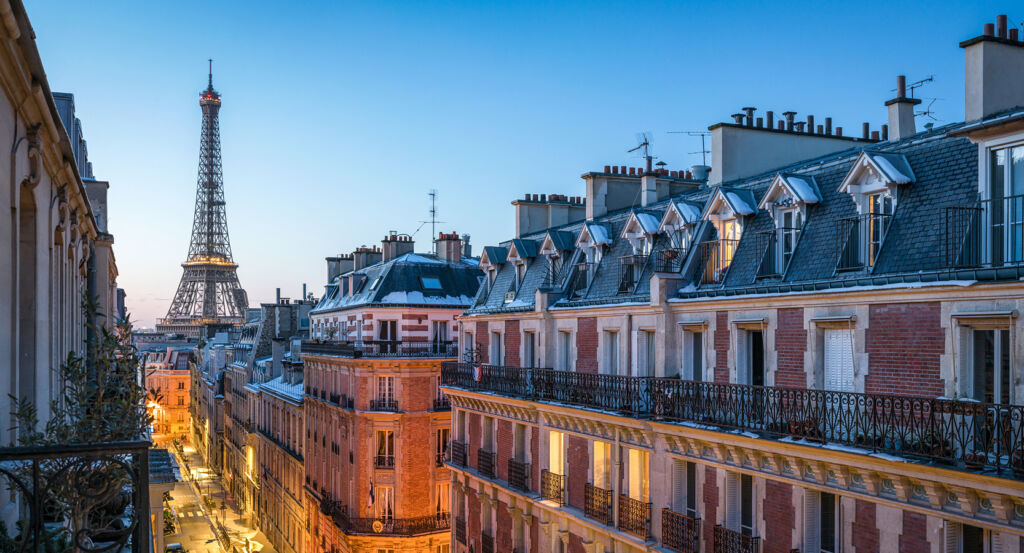
Why Rue Bonaparte matters.
Rue Bonaparte is a distinguished Saint-Germain-des-Prés corridor where artistic mastery, intellectual heritage, architectural grandeur, and Left Bank elegance converge along one of Paris' most celebrated historic streets.
Running through Saint-Germain-des-Prés between the Seine and Jardin du Luxembourg, this graceful corridor unfolds through world-renowned art schools, historic cafés, elegant hôtels particuliers, celebrated galleries, refined boutiques, and beautifully preserved seventeenth and nineteenth century architecture that reflects centuries of cultural achievement. Monumental façades, intimate courtyards, independent bookstores, and lively terraces create a streetscape where painters, sculptors, philosophers, writers, and architects have continually shaped the character of the Left Bank. Every section of the corridor reveals another chapter in the extraordinary evolution of one of Europe's greatest intellectual neighborhoods. The result is a corridor defined by artistic excellence, architectural distinction, and one of Paris' most inspiring cultural avenues.
What defines Rue Bonaparte.
Rue Bonaparte is best known for uniting some of France's most influential artistic and intellectual institutions along a corridor renamed in honor of Napoleon Bonaparte in 1852, while preserving an unparalleled concentration of landmarks that have shaped the history of European art for more than three centuries. The avenue is anchored by the École nationale supérieure des Beaux-Arts, whose origins trace to the Royal Academy of Painting and Sculpture founded in 1648 before evolving into one of the world's most influential art schools, educating generations of masters including Jean-Honoré Fragonard, Edgar Degas, Gustave Moreau, Henri Matisse, Pierre Bonnard, and Georges Seurat. The corridor also preserves the grand Abbey of Saint-Germain-des-Prés, founded by King Childebert I in 543 as one of the oldest surviving churches in Paris, while neighboring institutions including the Académie nationale de médecine, the Société de Géographie, and numerous publishers, galleries, and literary salons established the street as one of France's foremost centers of scholarship and cultural life. During the nineteenth and twentieth centuries Rue Bonaparte became closely associated with artists and writers including Jean-Paul Sartre, Simone de Beauvoir, Pablo Picasso, Alberto Giacometti, and Eugène Delacroix, whose nearby studio and residence now form the Musée Eugène Delacroix. Together, these institutions transformed the corridor into one of Europe's most enduring centers of artistic education, intellectual exchange, and architectural heritage.
The remarkable continuity between medieval monastic foundations, royal academies, nineteenth century artistic innovation, and modern cultural institutions continues distinguishing Rue Bonaparte as one of Paris' greatest intellectual corridors. Historic lecture halls, exhibition galleries, elegant residences, and carefully preserved public buildings demonstrate how generations of artists, scholars, architects, and philosophers reshaped global culture from addresses along this single avenue. Few streets anywhere in Europe preserve such an extraordinary concentration of institutions that have influenced painting, sculpture, architecture, literature, medicine, geography, and higher education across successive centuries.
How Rue Bonaparte fits.
Rue Bonaparte works as an exploration through Saint-Germain-des-Prés' celebrated artistic landmarks and intellectual institutions.
Begin at the École nationale supérieure des Beaux-Arts, where centuries of artistic excellence establish the remarkable cultural significance of the corridor before strolling along Rue Bonaparte through the heart of the Left Bank. Continue to Musée Eugène Delacroix, whose intimate studio and garden illuminate the life of one of France's defining Romantic painters only moments from the avenue. Conclude at Église de Saint-Germain-des-Prés, where the oldest surviving church in Paris provides a memorable finale celebrating nearly fifteen centuries of architectural, religious, and cultural history. The progression moves naturally from artistic education to creative mastery before culminating in one of France's oldest monuments, revealing why Rue Bonaparte remains one of Paris' most extraordinary historic corridors.
Where your story begins.
Foresyte Travel reveals places that feel extraordinary long before you arrive.
Experience premium editorial crafted for luxury travelers.
Foresyte Travel may earn a commission when you book through the link on this page.














































































































