
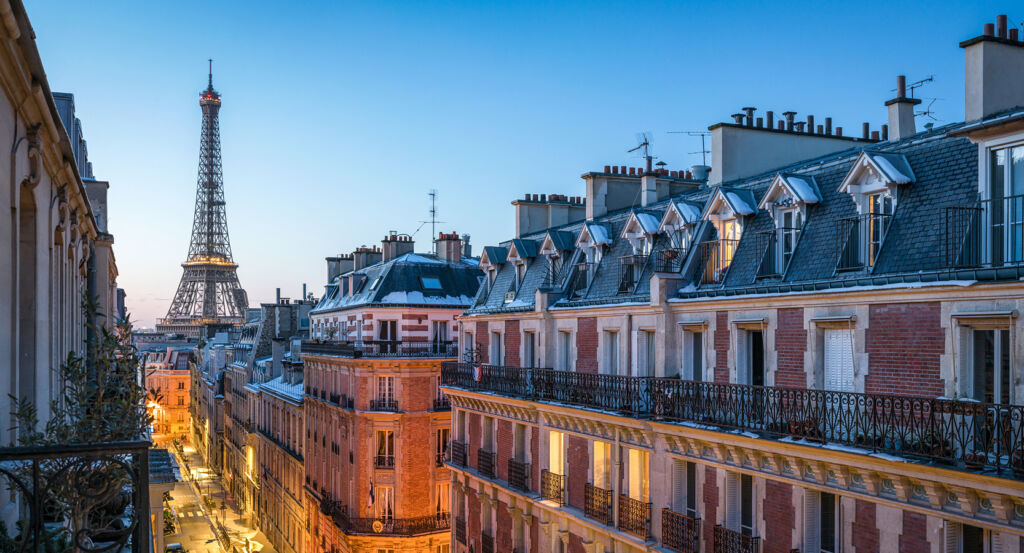
Why you should experience Rue d'Arcole in Paris, France.
Rue d'Arcole is a historic Notre-Dame corridor where imperial history, Gothic grandeur, civic heritage, and timeless Parisian character converge along one of the capital's most iconic streets.
Running through Notre-Dame between Place de l'Hôtel de Ville and Notre-Dame Cathedral, this elegant corridor unfolds through grand civic architecture, celebrated historic landmarks, refined cafés, independent boutiques, and beautifully preserved nineteenth century buildings that frame one of Paris' most unforgettable urban approaches. Broad perspectives, harmonious Haussmann façades, lively public spaces, and uninterrupted views toward the cathedral create a streetscape where centuries of political, religious, and architectural history remain vividly intertwined. Every section of the corridor reflects the remarkable transformation of medieval Paris into a modern capital while preserving its historic soul. The result is a corridor defined by grand beauty, historical significance, and one of the city's most celebrated ceremonial streets.
What you should know about Rue d'Arcole.
Rue d'Arcole is best known for commemorating Napoleon Bonaparte's victory at the Battle of Arcole in 1796 while forming the grand nineteenth century approach to Notre-Dame Cathedral created during Baron Haussmann's sweeping reconstruction of Central Paris under Napoleon III. Opened in 1858 after the demolition of dense medieval neighborhoods surrounding the cathedral, the corridor established the grand visual axis that continues defining one of the world's most recognizable urban landmarks while dramatically improving circulation across the Île de la Cité. The avenue also preserves the historic relationship between Notre-Dame Cathedral, whose construction began in 1163 under Bishop Maurice de Sully and continued for nearly two centuries before becoming one of the greatest masterpieces of French Gothic architecture, and the Hôtel-Dieu de Paris, founded in the seventh century as the city's oldest hospital and one of Europe's oldest continuously operating medical institutions. Following the devastating cathedral fire of 15 April 2019, Rue d'Arcole became one of the principal public gathering places where thousands witnessed the disaster before serving as a symbolic vantage point throughout the internationally supported restoration led by chief architect Philippe Villeneuve, culminating in the cathedral's reopening in 2024. The corridor captures not only imperial urban planning but also one of the most significant conservation achievements in modern architectural history.
The avenue's carefully proportioned nineteenth century design continues directing attention toward Notre-Dame's western façade, illustrating Haussmann's conviction that grand architecture should be experienced through dramatic urban perspectives. Civic institutions, historic bridges, and remarkably preserved public spaces reinforce the corridor's role as one of Paris' great ceremonial approaches, while the successful restoration of the cathedral has renewed Rue d'Arcole's importance as a place where the city's medieval origins, imperial transformation, and contemporary resilience intersect with extraordinary clarity.
How to fold Rue d'Arcole into your trip.
Rue d'Arcole works as an exploration through Notre-Dame's celebrated monuments and historic civic landmarks.
Begin at Hôtel de Ville, where Paris' grand Renaissance Revival city hall introduces the civic importance of the neighborhood before following Rue d'Arcole toward one of the world's greatest Gothic monuments. Continue to Notre-Dame Cathedral, whose extraordinary architecture and recent restoration reveal more than eight centuries of artistic, engineering, and religious achievement. Conclude at Sainte-Chapelle, where Louis IX's thirteenth century masterpiece of Rayonnant Gothic architecture provides a memorable finale celebrating the remarkable architectural legacy preserved on the Île de la Cité. The progression moves naturally from civic history to Gothic grandeur before culminating in one of Europe's finest medieval chapels, revealing why Rue d'Arcole remains one of Paris' most extraordinary historic corridors.
Where your story begins.
Foresyte Travel reveals places that feel extraordinary long before you arrive.
Experience premium editorial crafted for luxury travelers.














































































































