
Why Notre-Dame Cathedral matters.
Notre-Dame Cathedral is a soaring Gothic cathedral where Île de la Cité's medieval character meets eight centuries of French religious history, structural experimentation and sculptural architecture beside the Seine.
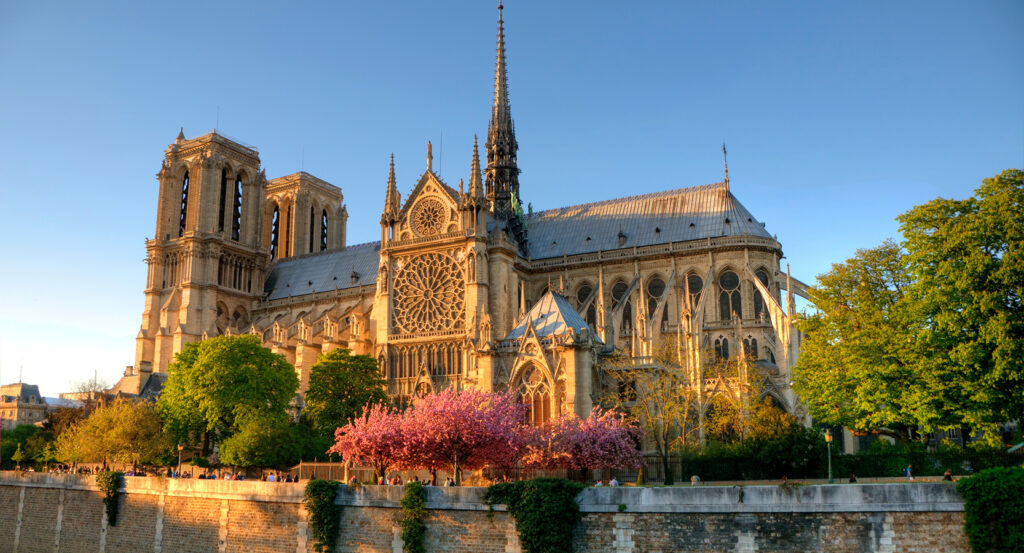
Set along Parvis Notre-Dame near Rue d'Arcole and just steps from Quai de Montebello, the cathedral occupies the eastern half of Île de la Cité where the broad forecourt, Seine embankments, Hôtel-Dieu and compact streets around the apse open a dramatic architectural clearing within Paris's historic river island. Twin 69-meter towers rise above the western front as flying buttresses arc around the choir toward Square Jean XXIII and the river. Three deeply sculpted portals, the Gallery of Kings and the western rose organize the principal facade into successive horizontal registers before the towers pull the composition upward. Bridges on both sides connect the precinct directly with the Right and Left Banks, making the cathedral visible across long river approaches before its chapels, transepts and buttresses emerge at closer range. The result is an immense medieval precinct whose facade, river setting and surrounding public ground make the cathedral inseparable from the physical center of Paris.
What defines Notre-Dame Cathedral.
Notre-Dame Cathedral is best known for the Gothic cathedral begun under Bishop Maurice de Sully in 1163 and developed through two centuries of architectural experimentation as Paris became a major European religious and intellectual center. Sully replaced the earlier cathedral of Saint-Étienne with a far larger church designed for the growing population and the movement of worshippers through Île de la Cité. The choir and double ambulatory rose between 1163 and 1182, followed by the first nave bays, aisles and galleries through 1190. Construction advanced west between 1190 and 1225 as the remaining nave bays and principal facade took form, and work through 1250 completed the upper facade, towers, enlarged high windows and lateral nave chapels. A second architectural generation then altered the transepts and eastern structure: Jehan de Chelles worked on the north transept and its rose from 1250, Pierre de Montreuil developed the south transept and choir buttresses, and Pierre de Chelles, Jean Ravy, Jean le Bouteiller and Raymond du Temple extended work through the fourteenth century. The cathedral also became connected with Louis IX's acquisition of the Passion relics, which entered Paris in 1239 and passed through Notre-Dame before their installation at Sainte-Chapelle. Those relics returned to the cathedral treasury after the Revolution, placing the Crown of Thorns within a religious institution already central to Capetian Paris. Revolutionary damage later stripped sculpture and converted the cathedral to the Cult of Reason before nineteenth-century concern over its deterioration intensified. Victor Hugo's 1831 novel Notre-Dame Cathedral helped renew public attention, followed by the restoration entrusted to Jean-Baptiste Lassus and Eugène Viollet-le-Duc. Viollet-le-Duc continued the campaign for two decades, reconstructing the Gallery of Kings, introducing the celebrated chimeras and erecting the 96-meter spire that transformed the cathedral's silhouette. Notre-Dame consequently preserves the work of successive medieval builders alongside a nineteenth-century reconstruction that itself became part of the building's architectural history.
The fire of April 15, 2019 opened another chapter when flames destroyed the medieval timber roof and Viollet-le-Duc's spire, initiating a five-year campaign that combined emergency stabilization with reconstruction and conservation. Carpenters recreated the roof structures and rebuilt the spire to Viollet-le-Duc's design, returning its timber frame to a height of 96 meters before the golden rooster was installed in December 2023. Stone surfaces, vaults, chapels and interior decoration underwent extensive cleaning and conservation as work moved toward reopening. The grand organ survived the fire and was dismantled, cleaned and restored, preserving an instrument whose history reaches the fifteenth century and whose present form carries the nineteenth-century work of Aristide Cavaillé-Coll across 8,000 pipes. Guillaume Bardet designed new bronze liturgical furnishings, and Jean-Charles de Castelbajac created vestments for the reopening ceremonies. Archbishop Laurent Ulrich reopened the cathedral on December 7, 2024, and the following day the new high altar was consecrated with relics of Marie Eugénie Milleret, Madeleine Sophie Barat, Catherine Labouré, Charles de Foucauld and Vladimir Ghika sealed within it. Restoration continued after reopening, with work addressing the apse, flying buttresses, gallery stained glass and sacristy exterior. The cathedral now carries the physical evidence of medieval construction, nineteenth-century reinvention and the immense reconstruction undertaken after the 2019 fire within the same continuously functioning religious building.
How Notre-Dame Cathedral fits.
Notre-Dame Cathedral works as the anchor for a daytime exploration of Île de la Cité using three nearby sites that move from Capetian sacred kingship through the medieval machinery of royal government into a nineteenth-century garden created from the former archiepiscopal precinct.
Begin at Sainte-Chapelle, commissioned by Louis IX after his acquisition of the Crown of Thorns from Baldwin II of Constantinople in 1239 and another group of Passion relics in 1241. The relics cost 135,000 livres tournois, half the kingdom's annual income, and the king responded with a palatine chapel completed in less than seven years as a grand reliquary beside his residence. Fifteen stained-glass bays rise to 15 meters and contain 1,113 scenes spanning biblical history through the arrival of the relics in Paris, with the upper chapel reserved for the king and distinguished members of his court. Revolutionary damage stripped the building of its original reliquaries before Duban, Lassus and Boeswillwald directed its influential restoration between 1840 and 1863. Continue to Conciergerie, the surviving medieval component of the Palais de la Cité where royal residence and central government occupied the western end of the island. The palace lost its residential function during the fourteenth century as Parliament and royal administration remained, and part of the complex became a prison under the authority of the concierge. The Revolutionary Tribunal moved into the former Grand'Chambre in March 1793; Marie Antoinette arrived during the night of August 1 to 2 and remained imprisoned until her trial and execution in October. Louis XVIII commissioned an expiatory chapel on the site of her cell in 1816, adding Bourbon commemorative architecture to medieval halls subsequently restored under Antoine Marie Peyre and later campaigns. Conclude at Square Jean XXIII, whose ground behind Notre-Dame belonged to the former archiepiscopal palace before nineteenth-century demolition opened the cathedral's eastern architecture toward the Seine. Land transferred from the state to the city became a public garden under Prefect Rambuteau, planted in five rows and organized around a Neo-Gothic fountain designed by Alphonse Vigoureux with sculpture by Louis Merlieux. Viollet-le-Duc's adjoining sacristy and presbytery followed between 1845 and 1849 as the wider precinct was being reshaped to expose the cathedral from the river and bridges. The progression moves from Louis IX's royal reliquary through the Palais de la Cité's conversion from medieval government into Revolutionary imprisonment and concludes with the nineteenth-century opening of the cathedral's eastern precinct, developing three successive transformations of the island surrounding Notre-Dame.
Where your story begins.
Foresyte Travel reveals places that feel extraordinary long before you arrive.
Experience premium editorial crafted for luxury travelers.
Foresyte Travel may earn a commission when you book through the link on this page.














































































































