
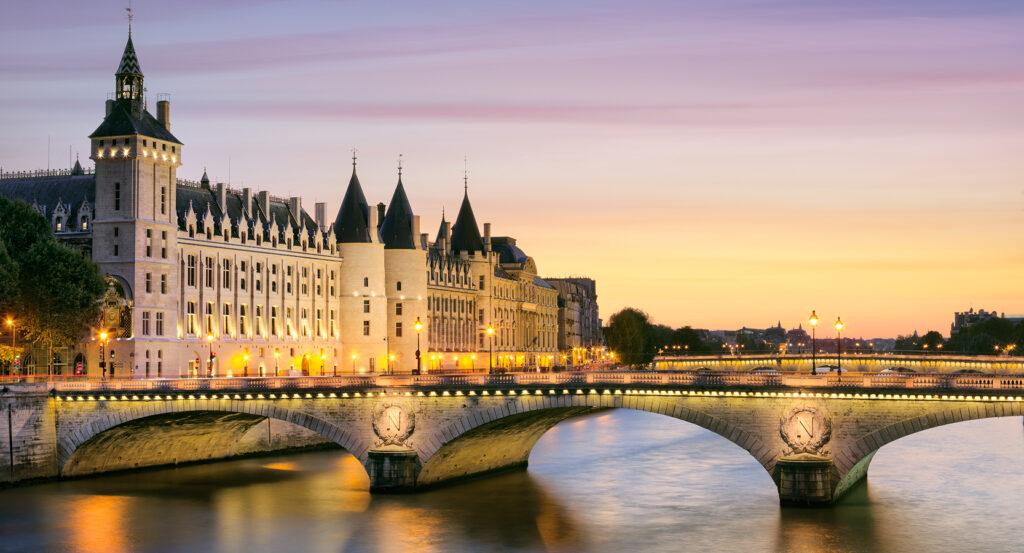
Why Conciergerie matters.
Conciergerie is a formidable medieval palace where Île de la Cité's institutional character meets Capetian kingship, Gothic state architecture and the prison that became inseparable from the French Revolution.
Set along Quai de l'Horloge near Boulevard du Palais and just steps from Pont au Change, the riverside palace occupies the northern edge of Île de la Cité where crenellated towers, steep slate roofs and pale stone walls rise directly above the Seine between the dense judicial complex and the river embankment. The cylindrical Tour de César and Tour d'Argent anchor the waterfront beside the later Tour de l'Horloge, creating one of the island's strongest surviving medieval silhouettes. Boulevard du Palais separates the complex from the eastern streets around Notre-Dame as the Seine opens long views toward both banks and the bridges converging around the island. Inside, low vaulted medieval rooms reveal a scale concealed behind the riverside frontage, shifting abruptly from the exterior's fortified mass into immense Gothic interiors. The result is a rare surviving fragment of royal Paris where the architecture of medieval government remains physically joined to spaces transformed by centuries of judicial and penal use.
What defines Conciergerie.
Conciergerie is best known for preserving the lower halls of the Palais de la Cité, the Capetian royal residence whose expansion under Louis IX and Philippe IV placed monarchy, justice and centralized government within one immense complex on Île de la Cité. Earlier Roman governors and Frankish kings had occupied the western island before the Capetians established their palace there at the end of the tenth century. Louis IX reorganized the residence during the thirteenth century as specialized administrative, financial and judicial institutions expanded around the Crown. His works included the Sainte-Chapelle, Trésor des Chartes, Galerie Mercière and a reception hall beside the Seine, turning the palace into both royal residence and machinery of government. Philippe IV continued that undertaking after 1285 through an extensive reconstruction suited to the increasingly centralized monarchy. Construction of the Salle des Gens d'Armes began in 1302 beneath the Grand'Salle, producing an immense vaulted refectory for palace personnel whose four aisles rest on powerful stone piers. The adjoining Salle des Gardes supported the Grand'Chambre built between 1302 and 1305, which became the official seat of the Parlement de Paris in 1314. Tour de César and Tour d'Argent housed administrative functions beside these rooms, binding the Seine frontage directly to the institutions operating above and behind it. Kitchens added under Jean II between 1350 and 1364 served the royal household and remain among the principal surviving service spaces of the palace. By 1314 the complex concentrated the sovereign and the apparatus of an increasingly sophisticated state at the geographic center of Paris, leaving the Conciergerie as the strongest surviving architectural evidence of that political transformation.
The departure of the kings from the palace during the late fourteenth century shifted the surviving complex toward the judicial and penal functions that shaped its second great historical chapter. Parlement and central royal administrations remained after the residential court moved elsewhere, and a royal concierge responsible for justice within the palace converted part of the premises into the prison that supplied the Conciergerie name. Count Gabriel de Montgomery entered its cells in 1574, followed across later centuries by François Ravaillac, the Marquise de Brinvilliers, Cartouche, Robert-François Damiens and Jeanne de Valois-Saint-Rémy. The Revolutionary Tribunal moved into the former Parlement Grand'Chambre in March 1793, converting the chamber into the Salle de la Liberté as political prosecution intensified. Marie-Antoinette was transferred from the Temple to the Conciergerie in August 1793 and remained there until her execution on October 16. Charlotte Corday, Madame Roland, Olympe de Gouges, Georges Danton, Camille Desmoulins and Madame Élisabeth also passed through the Revolutionary penal system associated with the palace, and Maximilien Robespierre spent his final hours there after his arrest in July 1794. Public prosecutor Antoine Quentin Fouquier-Tinville organized Revolutionary Tribunal prosecutions before facing the same institution and execution in 1795. Louis XVIII ordered an expiatory chapel on the site associated with Marie-Antoinette's cell in 1816, turning part of the prison into a Bourbon memorial. Restoration campaigns beginning under Antoine Marie Peyre recovered the medieval halls during the nineteenth century; historical-monument protection followed in 1862, public access to part of the complex in 1914 and the final cessation of prison activity in 1934.
How Conciergerie fits.
Conciergerie works as the anchor for a daytime exploration of Île de la Cité using three nearby sites that move from Louis IX's palatine reliquary through Henri IV's planned royal square into the bridge project that physically consolidated the island's western tip.
Begin at Sainte-Chapelle, commissioned by Louis IX after his acquisition of the Crown of Thorns from Baldwin II of Constantinople in 1239 and twenty-two further Passion relics in 1241. The Crown alone cost 135,000 livres tournois, equal to half the annual income of the royal domain, and the chapel rose between 1242 and 1248 as an architectural reliquary capable of translating that acquisition into Capetian political prestige. Two vertically stacked chapels separated palace personnel below from the king and court above, where fifteen windows reaching fifteen meters contain 1,113 stained-glass scenes extending from biblical history to the relics' arrival in Paris. Revolutionary damage prompted an extensive nineteenth-century restoration campaign, making the building a major proving ground for emerging French conservation practice. Continue to Place Dauphine, created under Henri IV in 1607 after the king gave the western island ground to Achille I de Harlay for development. Its triangular plan was originally enclosed by coordinated houses using red brick and pale stone, extending the architectural order associated with the new royal squares into land created around the Pont-Neuf works. The square took its name from the Dauphin, future Louis XIII, and later hosted a 32-meter temporary triumphal structure designed by Charles Le Brun for Louis XIV and Marie-Thérèse's ceremonial entry in 1660. Viollet-le-Duc directed the removal of buildings across the triangle's eastern base in 1874 to expose the Palais de Justice, permanently opening the enclosure toward the judicial complex. Conclude at Pont-Neuf, whose first stone was laid by Henri III on May 31, 1578 and whose construction created a new permanent connection between both banks across the western end of Île de la Cité. Built in stone and left free of the houses carried by older Parisian bridges, it introduced an unusually open relationship between roadway, river and city. Construction also absorbed three smaller islands into Île de la Cité, enlarging the western tip that later supported Place Dauphine and the ground now occupied by Square du Vert-Galant. Henri IV's equestrian monument subsequently established another royal focus above the bridge, with François-Frédéric Lemot's 1818 bronze replacing the statue destroyed during the Revolution. The progression moves from Louis IX's conversion of sacred relics into palatine architecture through Henri IV's planned royal square into the bridge that physically enlarged and reorganized the island, developing three successive interventions through which royal power reshaped the territory surrounding Conciergerie.
Where your story begins.
Foresyte Travel reveals places that feel extraordinary long before you arrive.
Experience premium editorial crafted for luxury travelers.
Foresyte Travel may earn a commission when you book through the link on this page.














































































































