
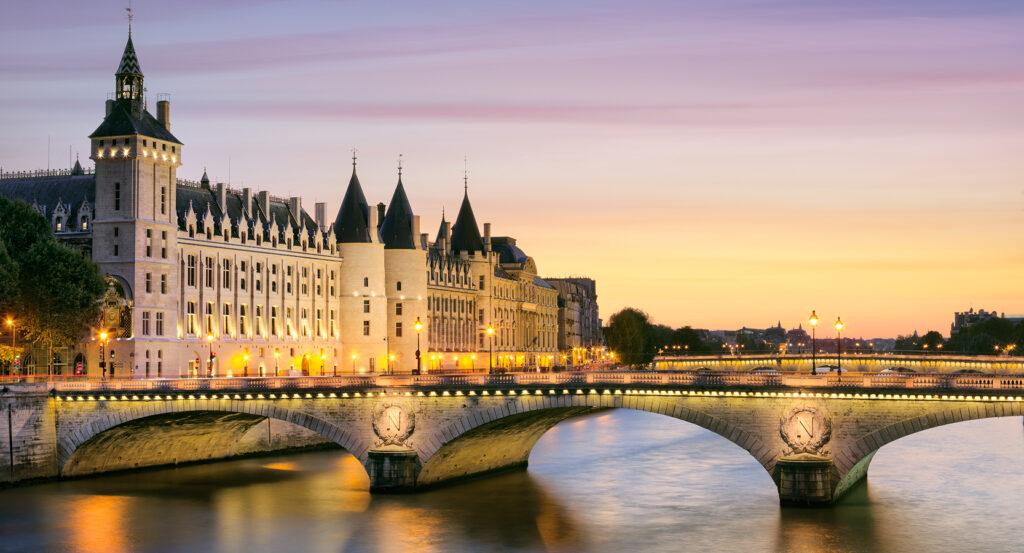
Why Palais de la Cité matters.
Palais de la Cité is a formidable royal complex where Île de la Cité's medieval character meets the birthplace of Capetian government, Gothic architecture conceived for monarchy and the judicial institutions that succeeded the royal court.
Set along Boulevard du Palais near Quai de l'Horloge and just steps from Pont au Change, the complex occupies the western half of Île de la Cité where Gothic riverside towers, immense nineteenth-century judicial wings, enclosed courtyards and the Sainte-Chapelle rise between the Seine's two channels. The Conciergerie presents the strongest medieval frontage through the Tour de César, Tour d'Argent, Tour Bonbec and square Tour de l'Horloge overlooking the river. Boulevard du Palais divides this massive architectural precinct from the denser eastern island around the Marché aux Fleurs and Notre-Dame, with bridges opening immediate sightlines toward both banks. The western end expands toward Place Dauphine and Pont-Neuf, allowing the palace fabric to occupy the broadest portion of an island otherwise compressed by quays and narrow streets. The result is an immense architectural precinct where river defenses, royal Gothic construction and later judicial expansion preserve the physical scale of the institutions that governed France from the center of medieval Paris.
What defines Palais de la Cité.
Palais de la Cité is best known for becoming the principal Capetian seat in Paris and developing during the thirteenth and fourteenth centuries into an architectural center of royal, judicial, financial and administrative power. A fortified complex already occupied the western end of Île de la Cité during late Roman Paris, and the site passed through Frankish rulers before the Capetians converted the inherited stronghold into a palace near the end of the tenth century. Louis IX radically enlarged its political and ceremonial meaning during the thirteenth century as increasingly specialized institutions of monarchy developed around the royal residence. His greatest commission was the Sainte-Chapelle, constructed in less than seven years to house the Crown of Thorns and other Passion relics acquired for the monarchy, with its upper chapel functioning as a grand reliquary attached to the king's apartments. Louis IX also established the Trésor des Chartes, Galerie Mercière and Salle sur l'Eau within the expanding precinct. Philippe IV subsequently launched an immense reconstruction suited to a monarchy exercising increasingly centralized government, with work led under Enguerrand de Marigny and substantially complete by 1313. The new Grand-Salle occupied 1,785 square meters, its upper level divided into two naves and lined with statues of French kings, turning dynastic succession into architectural decoration for royal ceremonies and justice. Directly beneath stood the Salle des Gens d'Armes, constructed from 1302 as a four-nave vaulted hall serving the palace household, whose clerks, officers and servants numbered close to 2,000. Judicial and financial chambers occupied dedicated sections of a palatial enclosure that had expanded to close to five hectares, separating functions of government on a scale unprecedented within the earlier residence. Philippe IV's rebuilding consequently transformed the Palais de la Cité from a royal home into an architectural instrument of Capetian monarchy, concentrating dynastic representation and the expanding machinery of royal government within the western end of the island.
The palace retained its governmental importance after royal residence shifted elsewhere, turning spaces created for monarchy into the nucleus of a judicial complex that remained on the island for centuries. Jean II expanded the financial administration and built the Tour de l'Horloge during the fourteenth century; Charles V commissioned Henri de Vic to install Paris's first public clock there in 1371. Royal residence moved toward the Louvre and Hôtel Saint-Pol under Charles V, leaving judicial institutions to occupy increasing portions of the former palace. Charles VII ceded the complex to the Parlement in 1431, fixing the site's association with one of the kingdom's highest courts. Fire devastated the Grand-Salle in 1618, after which Salomon de Brosse developed the Salle des Pas-Perdus, and further fires in 1737 and 1776 prompted additional reconstruction. The Revolution suppressed the Parlement in 1790, and the Revolutionary Tribunal moved into the palace in 1793, trying more than 4,000 suspects as the Conciergerie prison beneath held hundreds of detainees. Marie-Antoinette spent her final weeks there before her execution, and the Restoration later created a commemorative chapel on the site associated with her cell. Joseph-Louis Duc and Honoré Daumet became central to the vast nineteenth-century enlargement of the Palais de Justice, whose western facade, new courts and circulation spaces surrounded surviving medieval structures with an architectural expression of the modern judiciary. Fire during the Paris Commune in May 1871 destroyed major interiors and forced another reconstruction, leaving the present complex as the cumulative product of monarchy, Parlement, Revolution and nineteenth-century justice occupying the same extraordinary site.
How Palais de la Cité fits.
Palais de la Cité works as the anchor for a daytime exploration across Île de la Cité and the adjoining Right Bank using three nearby sites that move from Henri IV's early seventeenth-century royal planning through the medieval cathedral of Paris into a surviving animated Gothic tower later incorporated into Haussmann's reconstructed city.
Begin at Place Dauphine, initiated by Henri IV in 1607 after construction of Pont-Neuf enlarged and reorganized the western tip of Île de la Cité. The king transferred the ground to Achille I de Harlay for development as a triangular place lined by houses originally coordinated through red brick and pale stone, naming the new enclosure for the future Louis XIII. Its creation belonged to the same royal intervention that completed Pont-Neuf in 1606, establishing a stone bridge without houses and connecting the Louvre territory with the Left Bank through the island. The eastern side of Place Dauphine disappeared in 1874 to expose the new western front of the Palais de Justice, permanently changing the relationship between Henri IV's square and the older palace precinct. Continue to Notre-Dame Cathedral, where Bishop Maurice de Sully began the present cathedral in 1163 and launched a construction campaign extending across two centuries. The choir and eastern portions advanced first before work moved west through the nave and great facade, with later generations adding the transept fronts, chapels and flying buttresses that established the cathedral's mature Gothic form. Nineteenth-century restoration brought Eugène Viollet-le-Duc into another major phase of the building's architectural history, followed by the restoration campaign required after the 2019 fire. The cathedral reopened in December 2024, returning the eastern half of Île de la Cité to its historic role as the grand counterweight to the former royal precinct in the west. Conclude at Tour Saint-Jacques, constructed between 1509 and 1523 as the animated Gothic bell tower of Saint-Jacques-de-la-Boucherie. The church stood within the Grande Boucherie district and counted Nicolas Flamel among the prominent parishioners buried there before its sale as a stone quarry in 1797 spared only the tower. Paris acquired the surviving structure in 1836, and Haussmann's extension of Rue de Rivoli and opening of Boulevard de Sébastopol later isolated it within a new public garden under Théodore Ballu. Blaise Pascal's barometric work became attached to the tower through experiments comparing atmospheric pressure at different elevations, and a meteorological station established there during the late nineteenth century continued its scientific association. The progression moves from Henri IV's geometric reordering of the island through Maurice de Sully's Gothic cathedral into a medieval parish tower preserved and reframed by nineteenth-century Paris, extending the former royal palace through three distinct mechanisms that altered the center of the capital.
Where your story begins.
Foresyte Travel reveals places that feel extraordinary long before you arrive.
Experience premium editorial crafted for luxury travelers.
Foresyte Travel may earn a commission when you book through the link on this page.














































































































