
Why Sainte-Chapelle matters.
Sainte-Chapelle is a radiant Gothic sanctuary where Île de la Cité's royal character meets Louis IX's extraordinary reliquary, soaring walls of medieval glass and the surviving architecture of the Capetian Palais de la Cité.
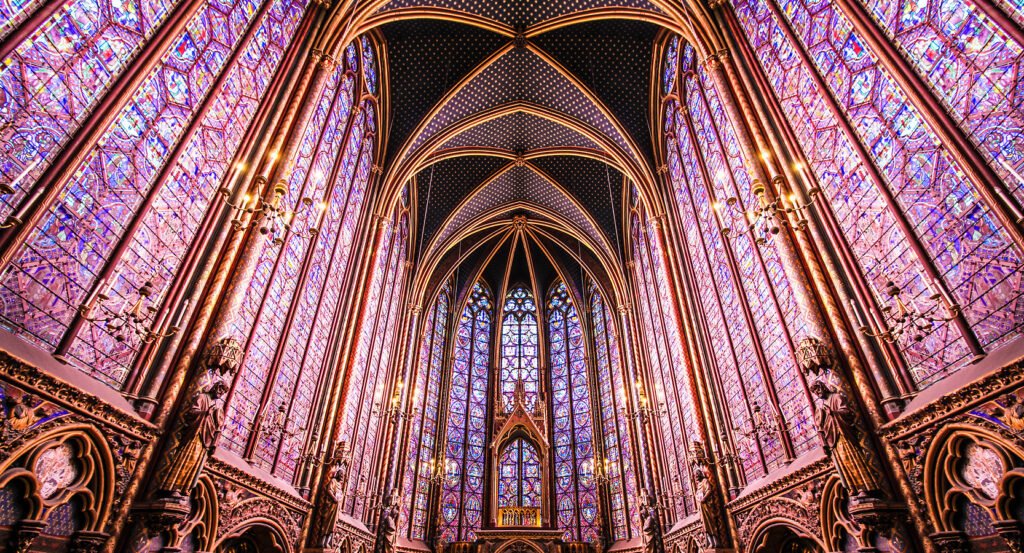
Set along Boulevard du Palais near Quai des Orfèvres and just steps from the Cour du Mai, the chapel rises inside the Palais de Justice precinct where Gothic masonry, formal courtyards and later judicial buildings compress centuries of royal and state architecture onto the western half of Île de la Cité. A slender exterior reinforced by buttresses and tall traceried windows gives little warning of the upper chapel's vast glazed surfaces. The lower chapel forms a low, richly painted vestibule beneath the royal sanctuary, using clustered columns and internal struts to support the structure overhead. Above it, narrow masonry piers recede between towering windows as stained glass dominates the enclosure from pavement to vault. The result is a remarkably concentrated royal chapel where structural daring, colored glass and the surviving Palais de la Cité place medieval monarchy within one of Paris's most complete Gothic interiors.
What defines Sainte-Chapelle.
Sainte-Chapelle is best known for being the grand reliquary Louis IX created inside the Palais de la Cité after acquiring the Crown of Thorns and other Passion relics from Baldwin II, Latin emperor of Constantinople. Louis obtained the Crown of Thorns in 1239, and his subsequent acquisitions between 1239 and 1241 cost 135,000 livres tournois, close to half the annual income of the royal domain. The relics elevated the Capetian monarchy's sacred claims, positioning Paris as a major center of Christian kingship as Louis prepared for the Seventh Crusade. Construction of the chapel proceeded between 1242 and 1248, replacing the palace chapel of Saint-Nicolas within a larger transformation of the royal complex. The architect remains uncertain, with Pierre de Montreuil, Thomas de Cormont and Robert de Luzarches among the names historically proposed. The building adopted two vertically stacked sanctuaries whose social organization mirrored the palace itself: personnel used the lower chapel, and the upper chapel served the king, his family and the canons charged with the relics. A gallery connected that upper sanctuary directly with the royal apartments, turning access to the relic treasury into an architectural extension of Capetian rule. Louis departed for the Seventh Crusade in 1248, the same year the chapel entered its completed sacred role. Sainte-Chapelle consequently joined relic acquisition, crusading monarchy and palace architecture within a single royal commission whose scale was determined by objects that Louis regarded as physical links to Christ's Passion.
The upper chapel develops that royal program across fifteen immense stained-glass windows containing 1,113 scenes, with two-thirds of the glazing surviving from the thirteenth century. Windows reaching fifteen meters in the nave and thirteen meters in the choir carry biblical cycles from Genesis through the kings and prophets of the Old Testament to Christ's Passion, followed by the history of the relics' arrival in France. Royal imagery enters repeatedly through fleurs-de-lis, Castilian castles, coronations and representations of Louis IX himself, binding biblical history to Capetian kingship. Twelve apostle statues stand against the piers between the windows, accompanied by more than one hundred different vegetal motifs across the upper chapel's sculptural decoration. Charles VIII ordered replacement of the western rose in 1485, preserving the Apocalypse as its subject within a new Flamboyant tracery system. Fires in 1630 and 1776 preceded severe disruption during the Revolution, after which the chapel served as a flour store and then an archive depot between 1803 and 1838; lower sections of glazing disappeared as windows were altered for storage. Félix Duban, Jean-Baptiste Lassus and Émile Boeswillwald subsequently directed the vast restoration undertaken between 1840 and 1863, with Louis Steinheil preparing stained-glass designs and Antoine Lusson executing replacement panels. Their work turned Sainte-Chapelle into an influential laboratory for nineteenth-century monument conservation, giving the surviving medieval glazing a second history almost as consequential as its thirteenth-century creation.
How Sainte-Chapelle fits.
Sainte-Chapelle works as the anchor for a daytime exploration across Île de la Cité and the adjoining Right Bank using three nearby sites that move from the medieval administrative palace through a surviving Flamboyant church tower into the parish that served generations of artists and courtiers attached to the Louvre.
Begin at Conciergerie, whose surviving medieval rooms preserve the expansion of the Palais de la Cité under Philip IV after the royal complex had reached a new level of institutional importance under his grandfather Louis IX. The Salle des Gens d'Armes, begun in 1302, created an immense vaulted hall for palace personnel, accompanied by the Salle des Gardes and later kitchens constructed under John II 1353. Royal residence gradually shifted away during the fourteenth century, yet Parliament and central administration remained; a portion of the complex became a prison under the royal concierge, supplying the name Conciergerie. The Revolutionary Tribunal occupied the former Grand'Chambre in March 1793, and Marie-Antoinette arrived as a prisoner during the night of August 1 to 2 before her October trial and execution. Continue to Tour Saint-Jacques, the Flamboyant Gothic bell tower constructed between 1509 and 1523 for Saint-Jacques-de-la-Boucherie, a church associated with the butchers' district and the pilgrimage routes toward Santiago de Compostela. The church became national property during the Revolution and was sold for stone in 1797 under the condition that its tower survive. Paris purchased the isolated structure in 1836, and Théodore Ballu later directed extensive restoration as Adolphe Alphand created the surrounding square in 1856, among the earliest green spaces associated with Haussmannian Paris. A meteorological laboratory operated in the tower from the late nineteenth century, adding scientific use to a structure whose original church had vanished. Conclude at Saint-Germain-l'Auxerrois, where a Christian presence reaches the Merovingian period and the surviving church developed through successive medieval campaigns beside the Louvre. Its proximity to the royal residence made it the parish of the kings of France, and artists living within the Louvre entered the same parish community. Pierre Lescot designed a choir screen 1541 with relief sculpture by Jean Goujon, linking two central figures in the Renaissance transformation of the Louvre with its neighboring church. Charles Le Brun, Jacques Lemercier, Jacques Ange Gabriel and other artists were buried there before the Revolution, extending the royal parish into a burial place for practitioners who shaped French art and architecture. The progression moves from Philip IV's expansion of Capetian administration through the survival and nineteenth-century reinvention of Saint-Jacques-de-la-Boucherie's tower into a Louvre parish shaped by royal service and artistic patronage, extending Sainte-Chapelle's world of monarchy across three institutions formed around the machinery and culture of royal Paris.
Where your story begins.
Foresyte Travel reveals places that feel extraordinary long before you arrive.
Experience premium editorial crafted for luxury travelers.
Foresyte Travel may earn a commission when you book through the link on this page.














































































































