
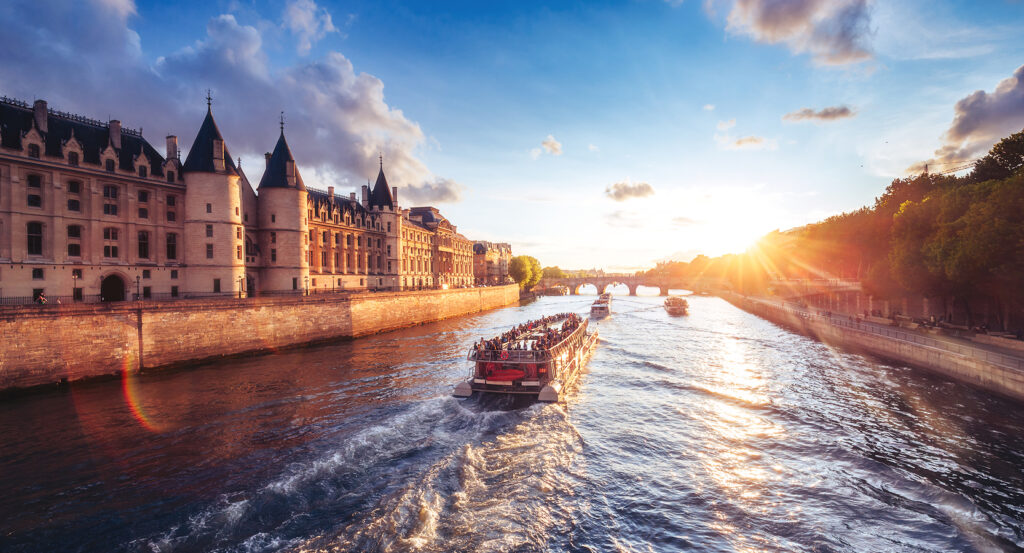
Why Pont Neuf matters.
Pont Neuf is a theatrical river crossing where Île de la Cité's royal character meets the oldest surviving bridge across the Seine, a stone arcade that binds both banks to the island beneath Henri IV's equestrian memorial.
Set along the western tip of Île de la Cité near Quai de l'Horloge and just steps from Place Dauphine, the bridge crosses two branches of the Seine between continuous quays, riverside trees, the Louvre frontage and the stone institutions of the Left Bank. Twelve masonry arches carry the roadway across the water in two unequal spans divided by the island, with semicircular refuges projecting above the piers and opening broad views along the river. The downstream side widens around Place du Pont-Neuf and the equestrian Henri IV before descending toward the pointed garden of Square du Vert-Galant. Quai des Orfèvres, Quai de l'Horloge, Quai du Louvre and Quai de Conti meet the bridge at different angles, making the crossing a physical hinge between the island and both historic banks. The result is a river crossing whose exposed stone, uninterrupted sightlines and royal centerpiece preserve the urban ambition that changed how Parisians encountered the Seine at the opening of the seventeenth century.
What defines Pont Neuf.
Pont Neuf is best known for overturning the established model of the Parisian bridge through a broad stone crossing built without the continuous houses that crowded earlier bridges. Henri III laid its first stone on May 31, 1578 as the project sought to connect both banks through the western end of Île de la Cité. Political turmoil during the Wars of Religion interrupted construction from 1588 until 1598, leaving Henri IV to revive a project inherited from the previous reign. Work resumed in 1599 under Guillaume Marchant and François Petit and reached completion in 1607, giving the Seine a continuous stone crossing composed of two sections meeting on the island. Seven arches cross the larger northern branch and five span the southern branch, with projecting semicircular refuges above the piers creating protected places beside the roadway. The absence of houses distinguished Pont Neuf from older Parisian bridges and opened long views toward the Louvre, the riverbanks and the western point of the island. Raised pedestrian walks further separated foot traffic from horses and carriages, making the structure a new form of public street above the Seine. Construction also absorbed three small islands at the western end of Île de la Cité, enlarging the point and supplying ground connected with Henri IV's development of Place Dauphine. Marie de Médicis commissioned an equestrian statue of Henri IV in 1604 from Giambologna and Pietro Tacca; the bronze reached Paris after the king's assassination and was erected on the bridge in 1614, establishing the first royal equestrian statue placed in a Parisian public space. Pont Neuf consequently joined engineering, royal planning and public circulation in a project that altered both the physical form of Île de la Cité and the relationship between Paris and its river.
A hydraulic machine installed against the bridge soon added another technological function to the new crossing. Henri IV commissioned Flemish engineer Jean Lintlaër in 1603 to construct a pump beside the second arch on the Right Bank, drawing Seine water upward for the Louvre and Tuileries. Completed during the bridge's final construction period, the pavilion stood on piles beside a large waterwheel and carried a sculptural representation of Christ and the Samaritan woman at Jacob's well. That image supplied the machine with the name Pompe de la Samaritaine, a designation inherited centuries later by the department store established nearby by Ernest Cognacq. Robert de Cotte reconstructed the pump between 1712 and 1719, and Jacques-Germain Soufflot and Ange-Jacques Gabriel participated in another restoration during the 1770s. Demolition followed in 1813, ending more than two centuries of hydraulic activity beside the bridge. The original Henri IV statue had already been destroyed during the Revolution, and François-Frédéric Lemot created the bronze equestrian figure installed in its place in 1818. Another dramatic reinterpretation arrived from September 22 to October 5, 1985, when Christo and Jeanne-Claude enveloped Pont Neuf in 41,800 square meters of fabric secured by 13 kilometers of rope and 12 tonnes of steel cable, temporarily converting the entire historic structure into a single work of contemporary art.
How Pont Neuf fits.
Pont Neuf works as the anchor for a daytime exploration of western Île de la Cité using three sites that move from Henri IV's royal urban planning through the physical creation of the island's present western point into the surviving chapel of the medieval Capetian palace.
Begin at Place Dauphine, initiated by Henri IV in 1607 after construction of Pont Neuf supplied newly consolidated ground at the western end of Île de la Cité. The king transferred the site to Achille I de Harlay, first president of the Parlement of Paris, for development as a triangular royal square named for the Dauphin, the future Louis XIII. Houses originally followed a coordinated scheme of red brick and pale stone, extending the architectural program associated with Henri IV's new Parisian squares into property built for private occupants. The royal equestrian statue stood outside the square on Pont Neuf, placing the sovereign directly amid the principal circulation route. Viollet-le-Duc directed major changes in 1874 that removed houses closing the triangle's eastern base and opened the present view toward the Palais de Justice. Continue to Square du Vert-Galant, whose low riverbank ground reveals how construction of Pont Neuf changed the geography of Île de la Cité itself. Three small islands downstream of the medieval island were joined to it during the bridge works at the end of the sixteenth century, extending the western point beneath the future Henri IV memorial. The tip became a municipal garden in 1884 and received the king's nickname, Vert-Galant, preserving another association with the monarch responsible for completing the bridge. Its position close to water level exposes the physical distinction between the island's elevated quays and the accreted ground projecting into the Seine, with the Louvre, Institut de France and Pont des Arts unfolding across the surrounding river corridor. Conclude at Sainte-Chapelle, commissioned by Louis IX within the Capetian royal palace to house the Crown of Thorns acquired from Baldwin II of Constantinople in 1239 and a larger collection of Passion relics assembled by 1241. Construction took less than seven years, producing a two-level palatine chapel whose upper sanctuary was reserved for the king and distinguished members of his court. Fifteen immense stained-glass bays contain 1,113 scenes extending from biblical history to the arrival of the relics in thirteenth-century Paris, surrounding an interior conceived around the royal reliquary. Revolutionary damage stripped the chapel of its original liturgical function before Félix Duban, Jean-Baptiste Lassus and Émile Boeswillwald directed the major restoration campaign of 1840 to 1863. The progression moves from Henri IV's creation of a royal square through the consolidation of river islands beneath his bridge into Louis IX's earlier palatine chapel, carrying the western Île de la Cité from seventeenth-century urban reconstruction back to the Capetian monarchy that had established the island as a center of royal power.
Where your story begins.
Foresyte Travel reveals places that feel extraordinary long before you arrive.
Experience premium editorial crafted for luxury travelers.
Foresyte Travel may earn a commission when you book through the link on this page.














































































































