
Why Pont des Arts matters.
Pont des Arts is a graceful river crossing where Saint-Germain-des-Prés's artistic character meets the Louvre, the Institut de France and an open pedestrian platform suspended across one of the Seine's most architecturally concentrated reaches.
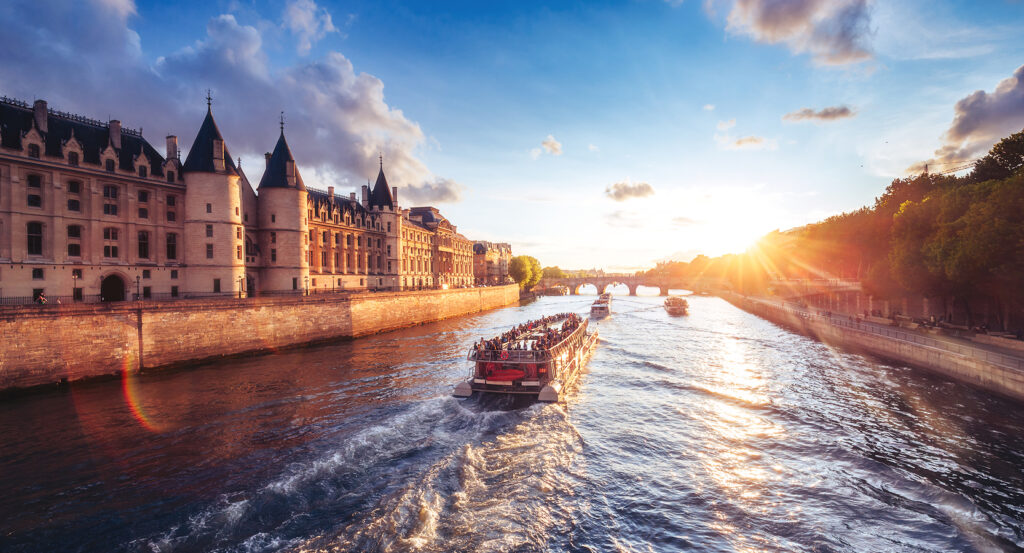
Set across the Seine between Quai de Conti and Quai François Mitterrand and just steps from the Institut de France, the slender metal footbridge occupies a privileged river corridor where the Louvre's long southern facade, stone embankments, moored boats and the domed Collège des Quatre-Nations frame an uninterrupted passage between the two banks. Seven shallow steel arches support a timber deck whose low profile keeps the river and surrounding architecture continuously visible. The western sightline extends past Pont du Carrousel toward the Eiffel Tower as Pont Neuf, Île de la Cité and the historic riverfront organize the view eastward. Benches distributed across the deck turn the crossing into a place for lingering above the water, distinct from the traffic-bearing bridges surrounding it. The result is a rare Central Parisian passage where engineering restraint and extraordinary riverfront architecture make movement across the Seine inseparable from the cityscape itself.
What defines Pont des Arts.
Pont des Arts is best known for introducing metal bridge construction to Paris through a pioneering pedestrian crossing commissioned during the Consulate and built between 1801 and 1804. First Consul Napoleon Bonaparte entrusted the project to engineer Louis-Alexandre de Cessart, whose 1801 proposal used metal arches at a moment when British engineering offered the principal precedents for large iron structures. Jacques Dillon revised Cessart's scheme before execution, replacing the proposed timber piers with masonry supports and developing the structure realized across the Seine. Nine cast-iron arches originally carried the elevated timber deck, establishing the first iron bridge in Paris and one of France's early major experiments with the new structural medium. The crossing aligned the Louvre, then called the Palais des Arts, with the former Collège des Quatre-Nations across the river, giving the bridge the name that survives. Its pedestrian character was fundamental from the beginning: shrubs, flower containers and benches turned the deck into a suspended promenade above the Seine. Passage initially required a toll of one sou, and more than 65,000 people crossed on its inauguration day, demonstrating the immediate public attraction of the new connection. Modification of Quai de Conti in 1852 altered the left-bank end, reducing two of the original arches to one. Pont des Arts entered the inventory of historic monuments in 1975, by which point nearly two centuries of engineering history had accumulated within a structure conceived during Bonaparte's transformation of Paris.
The bridge standing over the Seine now emerged from structural failure and a reconstruction that deliberately preserved the visual character of its predecessor. Bombardment during both world wars and repeated vessel collisions weakened the nineteenth-century crossing, with major strikes occurring in 1961 and 1970 before authorities closed it in 1977. A barge collision in 1979 brought down a 60-meter section, ending the service life of the original structure and leading to its dismantling. Louis Arretche designed the replacement erected between 1982 and 1984, exchanging fragile cast iron for steel without abandoning the slender arched profile associated with the historic bridge. Seven arches replaced nine, widening the navigational passages and aligning the supports with neighboring Pont Neuf. The rebuilt footbridge was inaugurated in 1984 and retained the timber deck, benches and exclusive pedestrian use that had distinguished its predecessor. A later cultural chapter developed across that deck through large-scale public art, including Ousmane Sow's celebrated outdoor sculpture exhibition, which helped establish the bridge as an exhibition setting as well as a crossing. Renovation beginning in 2023 renewed the timber flooring, benches and lamp standards, followed by structural consolidation in 2026. Pont des Arts now joins the proportions and pedestrian purpose of its Napoleonic predecessor with Arretche's twentieth-century engineering, preserving the continuity of an urban form even after the physical replacement of its original structure.
How Pont des Arts fits.
Pont des Arts works as the anchor for a daytime exploration across the Seine using three nearby sites that move from the royal transformation of a medieval fortress through an Enlightenment manufacturing palace into a small Left Bank garden carrying sculpture from the nineteenth and twentieth centuries.
Begin at Cour Carrée du Louvre, whose immense enclosure developed after François I abandoned the medieval fortress inherited from Philippe Auguste and initiated its Renaissance reconstruction. Pierre Lescot created the western wing under Henri II, establishing an architectural language subsequently extended as successive monarchs enlarged the palace. Henri IV's Grand Dessein sought to quadruple the courtyard and connect the Louvre with the Tuileries, and Louis XIV continued the expansion before transferring the royal court to Versailles. The completed quadrangle consequently preserves architecture accumulated across several reigns, with the Renaissance Lescot Wing facing later fronts that extended its ordering principles across a vastly enlarged royal palace. Archaeological excavations associated with the Grand Louvre project reached the Cour Carrée during the 1980s, adding physical evidence from earlier phases to a precinct already spanning centuries of royal construction. Continue to Monnaie de Paris, where Louis XV transferred the royal mint onto the former Hôtel de Conti property and entrusted Jacques-Denis Antoine with a palace that combined state representation with industrial production. Foundation work began in 1769, Controller-General Joseph Marie Terray laid the first stone on April 30, 1771 and the mint formally occupied Quai de Conti on December 20, 1775. Antoine organized workshops around the Grand Monnayage and developed the riverfront in a rigorous Neoclassical language, working with artists including Jean-Baptiste Pigalle and Jean-Jacques Forty. The complex also absorbed the petit Hôtel de Conti, Jules Hardouin-Mansart's earliest known work, joining seventeenth-century domestic architecture with an eighteenth-century manufacturing institution whose artistic production continues on the site. Conclude at Square Gabriel Pierné, created in 1938 at the end of Rue de Seine behind the Institut de France. Its centerpiece predates the garden: Alexandre-Évariste Fragonard designed the Fontaine du Marché-aux-Carmes in 1830 with allegorical faces of Commerce and Abundance for the covered market at Place Maubert. Demolition of that market brought the fountain to its present location in 1930, eight years before the square was established. Marcello Tommasi's bronze Carolina arrived in 1968, the same year the garden received the name of composer, organist and conductor Gabriel Pierné, adding twentieth-century sculpture and musical commemoration to the older fountain beneath an avenue of Japanese cherry trees. The progression moves from successive monarchs enlarging the Louvre through Antoine's union of Neoclassical state architecture and coin production into Fragonard and Tommasi's works inside a twentieth-century garden, developing three distinct chapters in the artistic and institutional history concentrated around Pont des Arts.
Where your story begins.
Foresyte Travel reveals places that feel extraordinary long before you arrive.
Experience premium editorial crafted for luxury travelers.
Foresyte Travel may earn a commission when you book through the link on this page.














































































































