
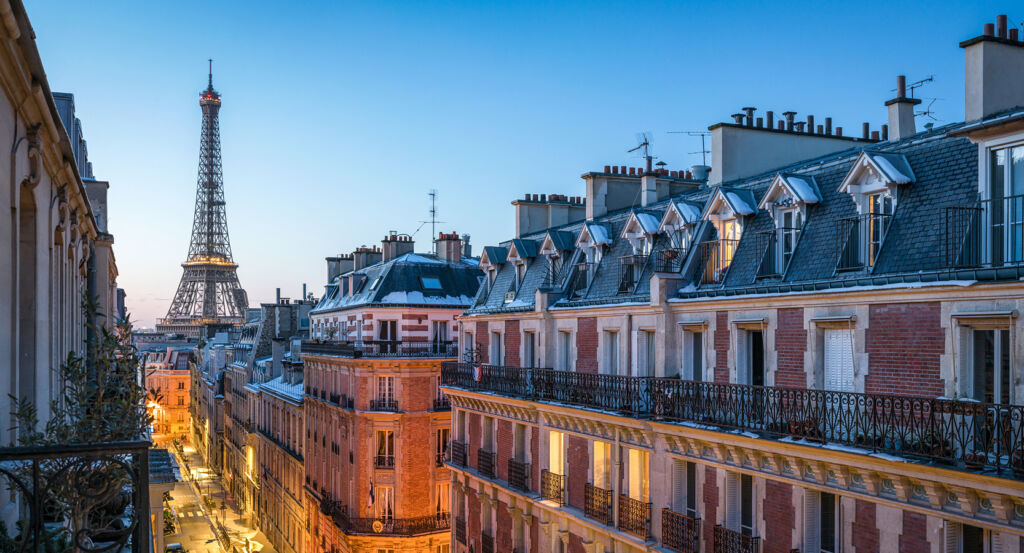
Why you should experience Rue de Clichy in Paris, France.
Rue de Clichy is a dynamic Saint-Georges corridor where Belle Époque entertainment, artistic innovation, musical heritage, and energetic Parisian life converge along one of the capital's most influential cultural streets.
Running through Saint-Georges between Place de Clichy and Place de la Trinité, this energetic corridor unfolds through renowned theaters, historic music venues, celebrated cafés, elegant Haussmann façades, distinguished hotels, and thriving neighborhood businesses that reflect more than two centuries of artistic and commercial evolution. Grand nineteenth century architecture, illuminated marquees, lively terraces, and an enduring creative atmosphere create a streetscape where performers, composers, painters, and audiences have shaped one of Paris' most celebrated entertainment districts. Every section of the corridor reveals another layer of the neighborhood's extraordinary cultural legacy. The result is a corridor defined by artistic excellence, architectural distinction, and one of Paris' most historically significant avenues.
What you should know about Rue de Clichy.
Rue de Clichy is best known for serving as one of the principal gateways to the artistic world of Montmartre and Nouvelle Athènes, where generations of painters, composers, writers, and performers helped redefine modern culture during the nineteenth and early twentieth centuries. Originally following the historic road leading toward the village of Clichy, the corridor became a focal point of Baron Haussmann's expansion before attracting landmark institutions including the Casino de Paris, whose origins date to 1880 and whose stage welcomed Joséphine Baker, Mistinguett, Maurice Chevalier, Tino Rossi, Line Renaud, and Zizi Jeanmaire. Nearby Théâtre de Paris, established in 1730 before assuming its current form in 1919, premiered works by Jean Cocteau, Marcel Pagnol, Sacha Guitry, Jean Anouilh, and countless leading dramatists, while the surrounding neighborhood became home to artists including Edgar Degas, Gustave Moreau, Alexandre Dumas fils, and composer Georges Bizet, whose final residence stood only moments away. During the Belle Époque the avenue also developed into one of Paris' most important hospitality and commercial corridors, serving travelers arriving from Saint-Lazare Station while connecting the Grands Boulevards with the cafés, cabarets, and studios that made the northern Right Bank the creative heart of modern Paris.
The corridor continues preserving a remarkable concentration of theatrical, musical, and architectural heritage through institutions that remain central to Parisian cultural life. Historic performance venues continue hosting internationally acclaimed productions while elegant Haussmann façades, Belle Époque commercial buildings, and long-established entertainment institutions demonstrate the extraordinary transformation of Rue de Clichy into one of the capital's defining cultural arteries. Few Parisian streets so completely unite theater, music, literature, painting, and urban history within a single continuous boulevard.
How to fold Rue de Clichy into your trip.
Rue de Clichy works as an exploration through Saint-Georges' celebrated theaters, artistic landmarks, and Belle Époque heritage.
Begin at Musée Gustave Moreau, where the painter's extraordinary home and studio introduce the remarkable artistic legacy surrounding Rue de Clichy before strolling through one of Paris' great cultural corridors. Continue to Théâtre de Paris, whose distinguished productions celebrate centuries of French theatrical excellence while preserving one of the neighborhood's defining institutions. Conclude at Casino de Paris, where a renowned stage that has welcomed many of France's greatest performers provides a memorable finale celebrating the musical and entertainment traditions that continue defining this remarkable avenue. The progression moves naturally from artistic creation to dramatic performance before culminating in one of Paris' most iconic music halls, revealing why Rue de Clichy remains one of the capital's most celebrated cultural corridors.
Where your story begins.
Foresyte Travel reveals places that feel extraordinary long before you arrive.
Experience premium editorial crafted for luxury travelers.














































































































