
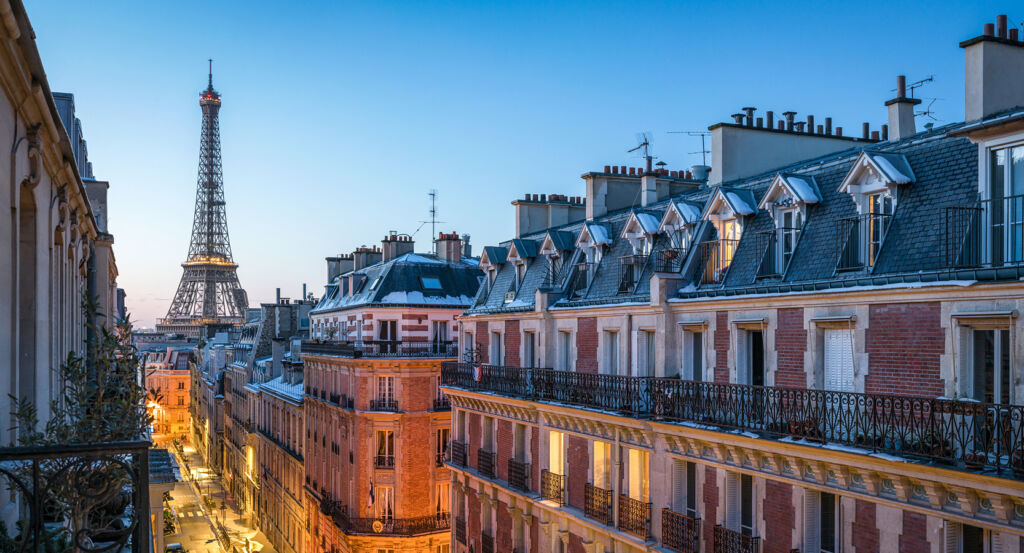
Why Saint-Victor matters.
Saint Victor is an intellectually charged enclave where the Latin Quarter meets the Seine through medieval streets, university architecture and riverfront institutions layered across ground shaped by Roman Paris, monastic scholarship and centuries of scientific activity.
Positioned between the Sorbonne quarter, Jardin des Plantes, and the Seine, the neighborhood occupies a southeastern pocket of the Latin Quarter where Rue Monge, Rue des Écoles and Quai Saint-Bernard descend across terrain connecting the Montagne Sainte-Geneviève with the river. Steep changes in elevation, narrow inherited streets and broad institutional parcels give the district unusual spatial range, shifting within minutes from compressed stone corridors to open university courts and long views across the Seine. Rue des Écoles establishes the primary encounter through an academic axis whose nineteenth-century scale crosses much older routes descending from the hill toward the river. Rue Monge deepens the physical character as its broad alignment cuts through an archaeological landscape whose earlier street patterns and buried structures belong to Lutetia and medieval Paris. Quai Saint-Bernard supplies a distinct riverfront dimension, opening the quarter toward the Seine after an interior sequence dominated by masonry, university buildings and closely spaced residential blocks. The result is a neighborhood where topography, scholarship and successive eras of construction remain tightly compressed, preparing a history centered on the abbey that made Saint Victor one of medieval Europe's consequential centers of intellectual life.
What defines Saint-Victor.
Saint Victor is best known for the Abbaye Saint-Victor, founded in 1109 by philosopher and theologian Guillaume de Champeaux after he withdrew from teaching at Notre-Dame and established a community beyond the eastern edge of the medieval city. The foundation rapidly developed into a major center of theological study, joining monastic discipline with an intellectual culture closely connected to the emergence of Paris as a European center of learning. Louis VI supported the community, and a diploma issued by Louis VII in 1138 confirmed donations to the abbey, strengthening an institution whose estates and influence expanded through the twelfth century. Hugh of Saint Victor became one of its defining scholars, developing an extensive body of theological and philosophical writing that treated secular learning as part of a broader path toward sacred knowledge. Richard of Saint Victor carried the school into another generation through writings on theology and mystical contemplation, extending its intellectual reach across medieval Europe. The abbey assembled a celebrated library as its scholarly reputation grew, connecting manuscript culture directly with the teaching conducted inside the community. Its influence declined across later centuries before the Revolution closed the abbey in 1790. Demolition followed, with the complex disappearing by 1810 and leaving the Saint Victor name attached to the surrounding quarter long after its principal medieval institution had vanished.
Commerce on a metropolitan scale supplied a separate mechanism for remaking the abbey ground after the Revolution. Paris had established its first Halle aux Vins in the area in 1665, creating a specialized market of halls and warehouses for wine merchants beside the Seine. Expansion accelerated after the abbey disappeared, and work beginning in 1811 carried a second wine market across the former monastic property, adjoining land of Alez and neighboring houses. Completed through successive campaigns by 1845, the complex extended between present-day Rue Jussieu, Rue Cuvier, Quai Saint-Bernard and Rue des Fossés Saint-Bernard, converting a major portion of Saint Victor into infrastructure for the capital's wine trade. Scientific education gradually reclaimed the territory for another purpose: the Paris Faculty of Sciences opened premises on Rue Cuvier in 1894, and Marie Curie conducted research there between 1906 and 1913. The state assigned the immense wine-market site to the Faculty of Sciences after the Second World War as demand for scientific teaching expanded. Urbain Cassan led an initial construction phase before Édouard Albert assumed control of the new university project in 1962, developing the elevated structural grid that became the architectural signature of the Jussieu campus. Work stopped in 1972 with Albert's plan incomplete, leaving Saint Victor with an extraordinary physical sequence from medieval abbey ground to metropolitan market and modern scientific campus.
How Saint-Victor fits.
Saint Victor works as the anchor for a daytime exploration connecting the surviving arena of Roman Lutetia, a Cistercian college created during the rise of the medieval university and an interwar civic hall built for the French mutualist movement.
Begin at Arènes de Lutèce, built between the first and second centuries as a hybrid arena and theater whose seating accommodated thousands of spectators for dramatic performances, gladiatorial combat and animal hunts, placing mass entertainment within the Roman city developing on the Left Bank. Centuries of burial concealed the structure until construction of Rue Monge exposed part of it in 1869; another discovery followed when the Compagnie générale des omnibus prepared a tram depot during the 1880s, prompting Victor Hugo, historian Victor Duruy and preservation advocates to press for protection before the surrounding square opened in 1892 and restoration continued under Louis Capitan until 1918. Continue to Collège des Bernardins, founded in 1245 by Étienne de Lexington, abbot of Clairvaux, after Pope Innocent IV encouraged Cistercians to pursue studies in Paris during the extraordinary expansion of European university culture. The complex developed around a vast Cistercian nave, residences, gardens and a church completed in 1360, receiving generations of monks from across Europe before Revolutionary suppression led to its sale as national property in 1791; later uses included a prison, warehouse, school and fire station, followed by a six-year restoration under Hervé Baptiste and Jean-Michel Wilmotte that culminated in its reopening in 2008. Conclude at Maison de la Mutualité, completed in 1932 to designs by Victor Lesage and Claude Mitgen as a purpose-built center for the mutualist movement at the corner of Rue Saint-Victor and Rue de Pontoise. Its interwar architecture joined a major auditorium with spaces conceived for congresses and collective organizations, placing a new form of civic assembly inside a district long associated with institutions of learning; the Ministry of Culture later protected the building as a historic monument, preserving an architectural marker of the social organizations that expanded across France during the early twentieth century. The progression moves from Roman mass performance through a Cistercian institution created amid the ascent of university Paris into an interwar center for organized civic association, revealing how successive communities built places for collective gathering around Saint Victor across nearly two millennia.
Where your story begins.
Foresyte Travel reveals places that feel extraordinary long before you arrive.
Experience premium editorial crafted for luxury travelers.
Foresyte Travel may earn a commission when you book through the link on this page.














































































































