
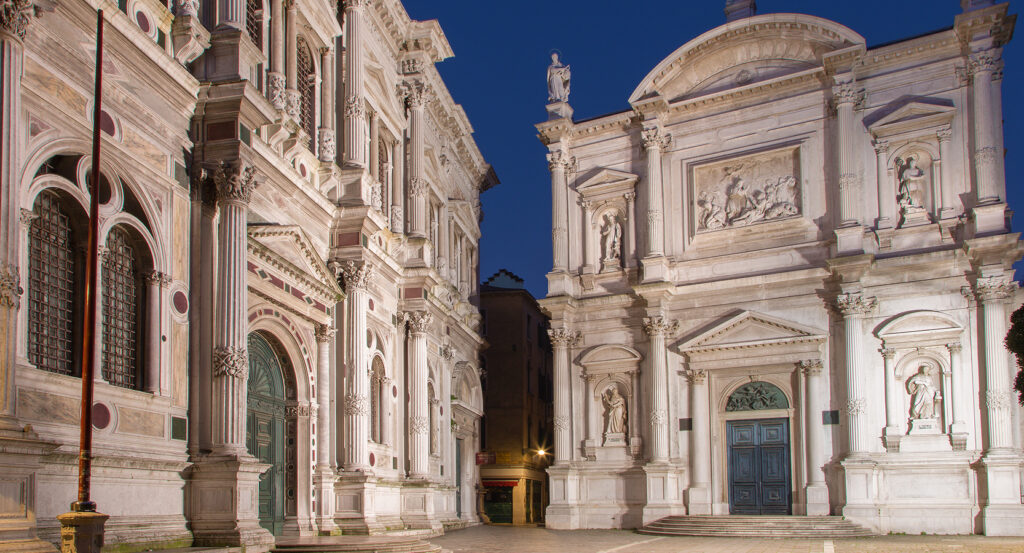
Why you should experience The Grand Staircase at Scuola Grande di San Rocco in Venice, Italy.
The Grand Staircase at Scuola Grande di San Rocco is a symbolic ascent from the earthly to the divine.
Known as the Scala di Tiziano, this marble stairway is where the spiritual rhythm of the building begins to shift, guiding visitors from the quiet devotion of the Lower Hall toward the celestial light of Tintoretto's Upper Hall. The air feels different here: cooler, hushed, alive with echo. The steps, worn smooth by centuries of pilgrims and patrons, curve gently upward beneath a ceiling that glows with soft, golden light. Above, gilded moldings and frescoed panels foreshadow the grandeur awaiting in the Sala Superiore. As you ascend, the architecture itself seems to breathe, each step a meditation, each landing a pause between contemplation and revelation. The staircase captures the Scuola's soul: humility rising toward transcendence, marble and light carrying the faithful toward heaven.
What you should know about The Grand Staircase at Scuola Grande di San Rocco.
Despite its name, The Grand Staircase never painted here, yet the staircase bears his legacy in spirit.
When the Scuola was first designed in the early 16th century, The Grand Staircase's influence over Venetian art was absolute. His mastery of light, color, and human emotion inspired every artist who followed, including Tintoretto. The staircase was conceived as a visual and spiritual bridge between two worlds: the physical realm below and the visionary one above. Its marble balustrades were carved by Venetian artisans in the style of Sansovino, whose architectural grace echoed Titian's painterly balance. The play of shadow along the curved steps was designed to mimic the chiaroscuro of Titian's canvases, darkness giving birth to illumination. During the building's completion in the 1560s, the Scuola's architects aligned the stairwell's windows so that morning light would pour diagonally across the steps, creating a visual metaphor for enlightenment. Few realize that the stairwell also houses one of Tintoretto's transitional works, Saint Roch Healing the Plague-Stricken, positioned so that ascending visitors first meet the saint's mercy before reaching his glorification above.
How to fold The Grand Staircase at Scuola Grande di San Rocco into your trip.
Experience the staircase not as a corridor, but as a moment of transformation.
After exploring the Lower Hall, pause before the base of the stairs and look upward. Let your eyes follow the marble balustrades as they spiral toward the gilded ceiling. Move slowly, the acoustics amplify even the softest step, creating a rhythm that feels like prayer. Halfway up, turn back and look down toward the Sala Terrena; the warm wood and dim light below seem to retreat into shadow, while ahead, the glow from the Upper Hall beckons with celestial promise. If visiting in the morning, notice how sunlight through the narrow windows shifts across the steps, casting geometric patterns that seem almost deliberate, a painter's composition rendered in stone. Take a moment to stand on the upper landing before entering the Sala Superiore. This threshold, poised between Tintoretto's earthbound scenes below and his divine masterpieces above, holds a quiet power, it is where devotion becomes vision. The Grand Staircase is not just a means of passage; it is the soul's ascent rendered in marble and light.
Where your story begins.
Foresyte Travel reveals places that feel extraordinary long before you arrive.
Experience premium editorial crafted for luxury travelers.




















































































































