Why Scuola Grande di San Rocco matters.
Scuola Grande di San Rocco is one of Venice's most extraordinary sanctuaries of art and faith, a place where devotion and genius intertwine beneath gilded ceilings and shadowed light.
Tucked away near the Church of San Rocco in the San Polo district, this 16th-century confraternity building is often overlooked by those rushing toward the Grand Canal, yet it holds a universe of wonder within its marble walls. Stepping inside feels like entering a painting, one vast, luminous vision orchestrated by the hand of a single master: Jacopo Tintoretto. Between 1564 and 1588, Tintoretto devoted nearly a quarter of his life to transforming the Scuola's interiors into a celestial theatre of light and drama. The result is among the most breathtaking ensembles of Renaissance art in existence, more than fifty canvases unfolding across walls and ceilings in a symphony of gold, crimson, and shadow. To stand in the Great Upper Hall is to feel surrounded by divine storytelling, scenes of the Passion, the Annunciation, and the Crucifixion unfurl in luminous chiaroscuro, their energy radiating like light through stained glass. Every brushstroke seems alive, electric, filled with the fervor of a man painting not for patrons but for God himself. The Scuola isn't just an art museum; it's a spiritual experience, a living tribute to Venice's unyielding faith and unending brilliance.
What defines Scuola Grande di San Rocco.
The Scuola was born from the brotherhoods that shaped Venetian life, charitable confraternities that blended civic duty, spiritual devotion, and quiet prestige.
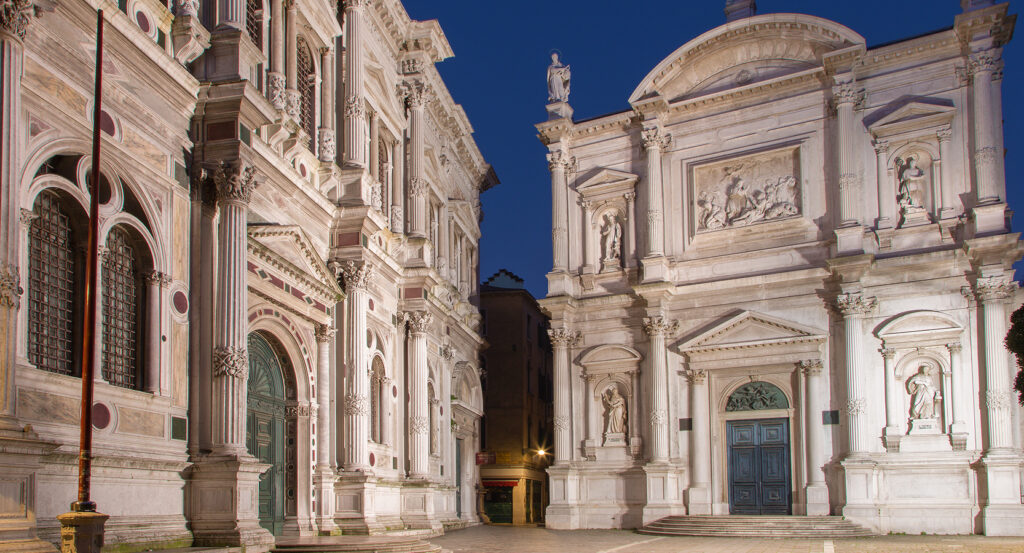
Founded in 1478 and named after Saint Roch, the patron saint of plague victims, Scuola Grande di San Rocco became one of the most powerful of its kind, providing aid during outbreaks of the Black Death and other times of crisis. Its architecture, designed by Bartolomeo Bon and completed by Scarpagnino, reflects the confident harmony of the High Renaissance, balanced, monumental, and radiant with marble. Yet it was Tintoretto's arrival that transformed it from noble institution to eternal legend. In 1564, when the Scuola announced a competition to paint the ceiling of the Great Upper Hall, Tintoretto stunned his rivals by unveiling a completed canvas of Saint Roch in Glory before the contest even began, a bold act that won him the commission and defined his career. Over the next two decades, he would cover every inch of the Scuola's walls and ceilings with his visionary style, dynamic, almost cinematic compositions that capture both divine ecstasy and human anguish. His cycle of paintings, spanning from the Annunciation to the Resurrection, has been compared to Michelangelo's Sistine Chapel, not in imitation, but in scale, ambition, and power. Few visitors realize that beneath the art lies a space still deeply sacred: the relics of Saint Roch himself rest in the adjoining church, believed to have protected Venice during plagues. The building's acoustics, designed for prayer and choral music, lend every footstep a reverent echo. Even the light, filtered through tall windows and reflected by the paintings' golden tones, seems choreographed, shifting softly through the day like a living halo. The Scuola's survival through centuries of floods and decay feels almost miraculous, a fitting fate for a place dedicated to mercy and endurance.
How Scuola Grande di San Rocco fits.
Visiting Scuola Grande di San Rocco is one of Venice's most intimate and awe-inspiring encounters, a revelation that unfolds quietly, away from the city's louder spectacles.
Begin your visit in the ground-floor Hall of the Chapter, where Tintoretto's early works glow in the half-light. From there, ascend the grand staircase, its marble steps and carved balustrades illuminated by sculptural reliefs, to the Great Upper Hall. Pause here, and let your eyes travel slowly across the vast ceiling: scenes from the life of Christ cascade in golden light, their intensity heightened by the shifting shadows of the afternoon sun. The longer you linger, the more the paintings reveal, faces emerging from darkness, gestures caught mid-motion, divine light piercing mortal gloom. Bring a small mirror or rent one from the ticket desk, it allows you to gaze at the ceiling's details without straining your neck, a trick Venetians themselves once used. Don't miss the Adoration of the Shepherds or The Flight into Egypt, where Tintoretto's mastery of color and perspective reaches sublime heights. Afterward, step into the adjoining Church of San Rocco to see the saint's relics and to appreciate how closely intertwined art and faith remain here. For a perfect continuation, stroll through the nearby Campo San Polo, among Venice's grandest squares, and pause for coffee at a quiet café to reflect on what you've seen. Scuola Grande di San Rocco isn't just another landmark, it's a meditation in paint and marble, a sacred space where human genius meets divine purpose. To stand in its halls is to feel time pause, to hear the faint whisper of brushstrokes that, five centuries later, still seem to move with life.
Where your story begins.
Foresyte Travel reveals places that feel extraordinary long before you arrive.
Enjoy editorial crafted for luxury travelers.
Foresyte may earn a commission when you book.