
Why you should experience Leon Battista Alberti's Façade in Florence, Italy.
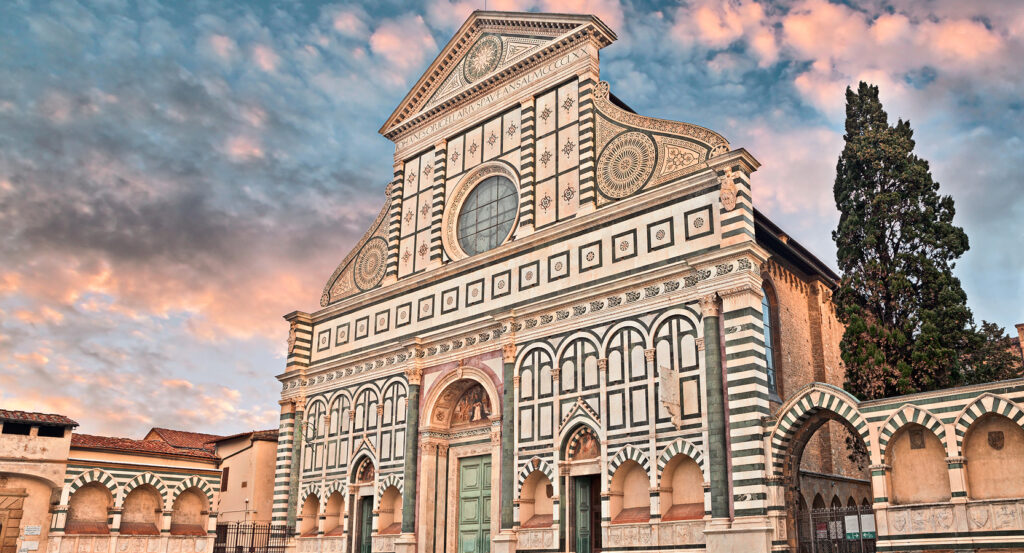
Leon Battista Alberti's Façade at Basilica of Santa Maria Novella in Florence is among the purest examples of Renaissance harmony ever built, a work of architecture that turns mathematics into poetry.
Standing in the sunlit piazza, the façade gleams in bands of white and green marble, its geometry unfolding like a divine equation. Alberti, commissioned in the mid-15th century by the wealthy Rucellai family, completed the medieval church's unfinished front with a design that fused Gothic devotion and classical reason into perfect balance. His scroll-like volutes, the graceful spirals connecting the lower nave to the upper pediment, were an innovation that became a hallmark of Renaissance architecture, visually linking heaven and earth through proportion and continuity. The entire façade reads like a page of Euclid transcribed into stone: circles, squares, and triangles aligned in rhythmic precision, creating a surface both serene and monumental. Yet for all its logic, it feels deeply human, calm, luminous, and inviting. To stand before it is to feel Florence's belief that beauty itself could be an act of faith.
What you should know about Leon Battista Alberti's Façade.
Leon Battista Alberti's Façade is not merely decorative, it is the architectural manifesto of the Renaissance.
When Giovanni Rucellai commissioned the project around 1458, the Lower Gothic section of the church, built in the 13th century, already existed. Alberti's challenge was to unite this vertical medieval base with the new ideals of humanist proportion. His solution was both daring and elegant: he imposed a grid of classical harmony over the irregular foundation, transforming asymmetry into equilibrium. The volutes, the great S-shaped scrolls that bridge the upper and lower levels, were his invention, solving both a visual and philosophical problem. They guide the eye upward while symbolically connecting the rational world of man to the divine sphere above. The façade's proportions follow strict mathematical ratios derived from Pythagorean theory, reflecting Alberti's belief that architecture was a form of music made visible. The central portal, framed by Corinthian pilasters and a pediment, introduces a rhythmic cadence to the façade, while the inlaid marble rosettes and geometric patterns pay homage to Florence's decorative tradition. Hidden within these patterns is the subtle insignia of the Rucellai family, a small tribute to the patrons whose wealth and intellect helped make the Renaissance possible. Alberti's design was so influential that it became a blueprint for countless later façades, from Roman churches to Neoclassical temples across Europe.
How to fold Leon Battista Alberti's Façade into your trip.
Experiencing Leon Battista Alberti's Façade is among the simplest yet most profound pleasures in Florence, an open-air lesson in proportion, light, and grace.
Begin your visit in the Piazza di Santa Maria Novella, ideally in the early morning when the marble glows with cool clarity or in the golden hour when the sunlight softens its edges. Stand at the center of the square and let your gaze trace the symmetry, from the broad base to the circular oculus framed in delicate ornament, and up to the triangular pediment that crowns the composition. Step closer to study the marble inlay: green serpentine from Prato and white Carrara stone, arranged with precision that seems both mathematical and musical. Walk to either side to appreciate how the volutes bridge the height difference between the nave and the aisles, Alberti's most famous innovation, imitated for centuries after. Then take a few steps back and view the façade in its entirety; the effect is transformative. What once was a Gothic church now appears as a vision of perfect balance, Florence's devotion made rational, reason made divine. Before entering the basilica, pause for a final moment on the piazza, and imagine Alberti standing where you are, sketching the future of architecture. Leon Battista Alberti's Façade at Basilica of Santa Maria Novella in Florence is not just a building front, it's the Renaissance itself, carved into marble, illuminated by Tuscan light.
Where your story begins.
Foresyte Travel reveals places that feel extraordinary long before you arrive.
Experience premium editorial crafted for luxury travelers.




















































































































