
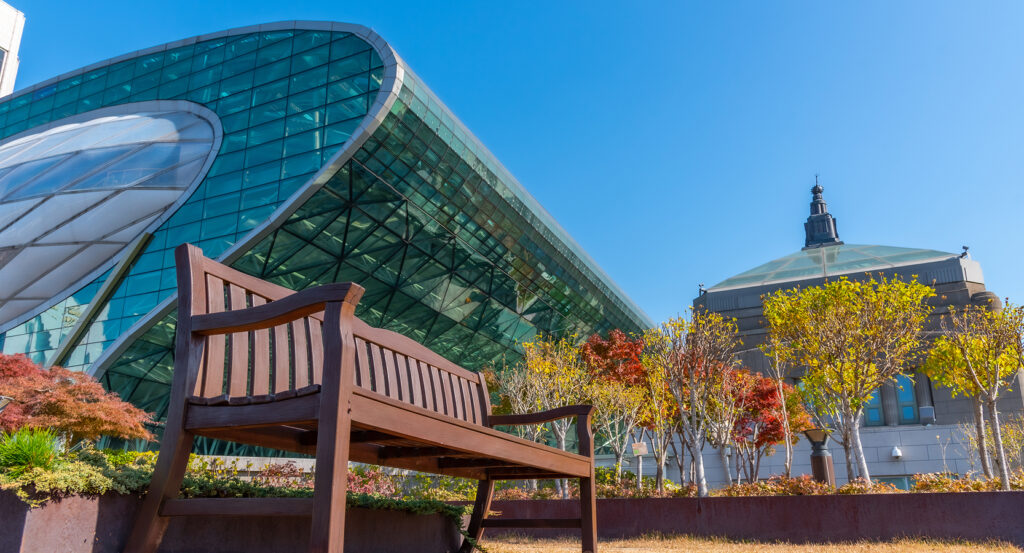
Why you should experience Deoksugung Stonewall Walkway in Seoul, South Korea.
Deoksugung Stonewall Walkway is Seoul's quietest masterpiece, a narrow ribbon of stone and shade winding between past and present, where time itself seems to slow.
Running alongside Deoksugung Palace and skirting the edge of City Hall, it feels worlds apart from the city's neon rhythm. The air is softer here, perfumed with gingko and pine, and the soundscape shifts from horns to footsteps and the occasional temple bell. Couples stroll hand-in-hand, photographers linger for the perfect shot of filtered sunlight against weathered walls, and locals pause on benches to breathe before rejoining the rush of downtown. It's a walk of serenity, history, and intimacy, among those rare places where Seoul lets you hear its heartbeat, steady and human beneath the stone.
What you should know about Deoksugung Stonewall Walkway.
The Stone-Wall Walkway traces the outer boundary of Deoksugung Palace, the royal residence that once sheltered kings through war, exile, and modern rebirth.
The wall itself dates to the late 16th century, built of granite and brick in alternating bands, a Joseon design that symbolized resilience. But the walkway as we know it today emerged in the early 20th century, when the palace became the seat of Emperor Gojong's short-lived Korean Empire. Courtiers, soldiers, and foreign envoys once used this shaded path to reach the western gate of the palace. During Japanese occupation, it became a border between royal dignity and colonial encroachment; after liberation, it turned into a civic promenade that witnessed student protests and candlelight vigils alike. The present-day walkway stretches nearly 900 meters, framed by mossy walls on one side and the modern spires of Seoul City Hall and Jeongdong on the other. A persistent urban legend claims that lovers who walk its full length together will eventually part ways, a superstition born from its past as the path leading to the Seoul Family Court, which once stood nearby. Yet, for many, it has become a symbol of endurance instead, of walking through history side by side, no matter how much changes beyond the wall.
How to fold Deoksugung Stonewall Walkway into your trip.
To walk the Stone-Wall Way is to experience Seoul in slow motion.
Begin at City Hall Station (Exit 2) and head toward the Deoksugung Palace Main Gate. From there, follow the gently curving path north, the wall on your right, the whisper of gingko leaves overhead. Stop often: at the small stone pagoda near the National Museum of Modern and Contemporary Art's Deoksugung Branch, or at one of the iron benches halfway down, where you can watch the city breathe. If you visit in autumn, the golden canopy overhead transforms the entire stretch into one of Seoul's most romantic scenes; in spring, cherry blossoms drift across the path like falling confetti. Visit in the morning for solitude, or in the evening, when the palace walls glow under lamplight and couples drift through the shadows in quiet conversation. The full walk takes about 20 minutes, ending near the Jeongdong Observatory Café, which offers a sweeping view of the palace grounds below. Pair this stroll with a visit to Deoksugung Palace itself or the Seoul Metropolitan Library just across the street, together they tell the story of a city that learned to keep its soul intact amid reinvention. Deoksugung Stonewall Walkway in Seoul isn't just a path, it's a poem of stone and silence, a reminder that even in the heart of a metropolis, grace can still find room to breathe.
Where your story begins.
Foresyte Travel reveals places that feel extraordinary long before you arrive.
Experience premium editorial crafted for luxury travelers.

















































































































